
Writing about boats seems a bit surreal on a morning such as this. It’s six a.m. and the temperature outside reads -9° Fahrenheit. A hot mug of coffee sits beside me as I look at the dog curled in a tight ball refusing to go outside until he absolutely has to. Our African Grey parrot, who usually comes out and says good morning and loves to have her head scratched, huddles next to her heated perch silent as the morning at hand. Julia gets up in a half hour. All is quiet.
I know that February is the shortest month of the year but this year, it seems to be the longest. Here in the Great Lakes region, we have had an exceptionally cold month with temperatures well below average. It has been a rare moment when the thermometer has read above 20° during the day with nighttime temps below O°. Today is the 27th and the month is, in fact, almost over.
March will certainly give us a break from the deep freeze that holds us so tightly in its grip. In Michigan, March is that month of transition when Spring’s arrival beckons us with signs of warmer days ahead. Old Man Winter begrudgingly yields his reign over the land. We begin to notice the lengthening of the days while plodding through half frozen mud and melting snow banks. We spot a bluebird perched on a fence post along a lonely country road; its ditch overflowing with melt water. Sap drips from the trees as they awaken from their deep sleep. Soon, there will be the chorus of spring peepers and blackbird songs to let us know the time has come.
The Great Lakes have frozen almost completely over, much as they did last year. This will mean a slower melt and the probability of cooler Summer water temperatures for the big lakes. While this is not appealing to beach goers, it means less evaporation and higher water levels for the Great Lakes; great news for those of us who have been watching the steady decline in lake levels over the past decade or so. When you are sailing a boat that draws over 4 feet of water, any increase is welcome.
The off-site boat work has been going well but last weekend, I had to get to the boat to take a few measurements and do some more prep work for the next phase that involves removing and replacing the deck beams. “Remove and replace the deck beams” It sounds pretty straightforward. Easier said than done. One short sentence sums up a whole lot of work. So, it was off to the boat on a blustery 15° day to see what needs to be done.
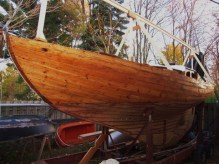
Reverie sat there under a massive mound of snow that strained her tarp taut against her deck. Fortunately, she sits alongside an industrial building protected from the significant Westerly winds blowing off Lake Michigan. I had to shovel my way to get alongside and clambered aboard. I tried to coax the snow from the tarp then had to lift 10 pound chunks of ice that had settled on the deck just to make room to squeeze into the cockpit. Julia handed me tools and other work related items. I quickly had the cockpit filled with milk crates and 5 gallon buckets full of work stuff. I then had to navigate my way around everything to get into cabin. Julia had some business to attend to nearby so I went to work for a few hours alone.
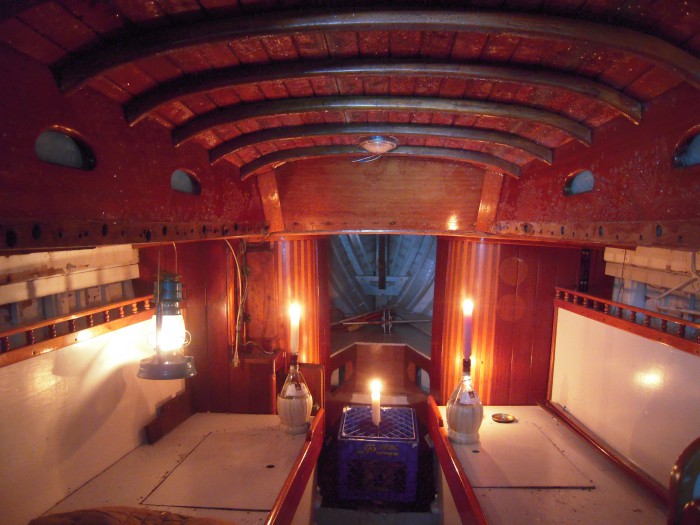
The building next door where I plug in had just been rented to a new tenant and I didn’t have access to electricity (lights, heater…) so I brought along a supply of candles and a Dietz lantern for light and a wee bit of welcome heat. I climbed into the the cabin and it was pitch black due to the amount of snow on the tarp. I got a few candles lit and looked about me to discover the interior of the boat looked more like an ice cave than a cozy work space. There was hoarfrost covering the entire interior. It was so dark, the candles did little to illuminate the cabin enough to work so I had to leave the companionway open for whatever light came from outside. This deprived me of any heat they might have given off.

Light at the end of the tunnel
With a little LED lamp in one hand and candles all around, I set to work. This stage of the project involves a lot of assessment and planning so, I had no illusions about getting a lot of physical work done. What I wanted to do on this cold day was to get the port-side bunk removed so as to be able to inspect the hull and deck beam ends.
The deck beams are notched into a hefty sheer clamp which is a board running the entire length of the boat that provides stiffness to the hull and support for the deck. I wanted to see how the deck beams were fastened so as to plan for their extraction later. I removed the most rotted beam and found that it was nailed to the sheer clamp from above and fastened to the frame.
Frames are the ‘ribs’ you see inside of a wooden boat that resemble the ribs of a fish. The deck beams we have to replace first are the ones that were tied into the carline or header I made last week. They are called half beams. Those ends that are inboard were easy to inspect with the carline removed. The mystery of what was outboard hidden by the sheer clamp was what I came to ascertain and therein lay most of the work.
One of the great things about a wooden boat is that everything is held together with fasteners; screws, nails and trenails (essentially wooden dowels or pins). If it can be put together, it can be taken apart. To get at the outboard beam ends is going to require the removal of the toe rail, covering board and sheer plank. The toe rail is on the deck and does the job of keeping one’s toes from slipping overboard. The covering board is the piece that provides a big, solid edge trim for the entire deck. The sheer strake is the final plank of the topside of the hull. All of these pieces are held together with screws that are hidden under bungs, which are wooden plugs glued and sealed to make the piece uniform and water tight.
Gaining access to the beams is more work than replacing the beams themselves. If there were just a few small half beams to replace, the sheer strake might not have to be removed but one of the king beams or ‘heavy beams’ (major structural components) has to be replaced and I see no way to do it without removing the sheer strake. In the long run, the whole job will be easier with the sheer strake removed. This will give us a good look at the frame ends and allow the rest of the ‘good’ beam ends to be sealed and treated.
I got the port-side bunk removed and had a look at the interior of the hull. The whole interior of the hull is painted and the paint is peeling badly. That’s going to require the removal of all of the interior joiner work, a lot of scraping and stripping with a heat gun once we have electricity. That’s not such a bad thing as it will allow the inspection of every inch of the hull. I found another cracked frame hidden below the bunk in a place I couldn’t see when I made my initial survey of the boat in December. I expect to find more of this as there are a lot of areas I was unable to see without removing everything.
The bunk came out in an hour or so and I sat there with a jar full of screws to be labelled ‘port bunk’. In the darkness, still clutching the LED lamp in my left hand, I scraped what paint I could. Some of it came off in rather sizable chunks. I refrained from really going at it and creating dust since I wasn’t wearing a dust mask and not fond of inhaling lead. After that, I then cleaned up and sorted tools and supplies in as orderly a fashion as possible.
In just three hours, several hundred more hours of labor reared it’s head like a serpent from the deep. My initial estimate was optimistic but I’m a realist and won’t overlook anything that would compromise the integrity of the boat as a whole. “Did I do this?” or, “Did I do that?”, are not questions you want to ask yourself on the open water in heavy weather.
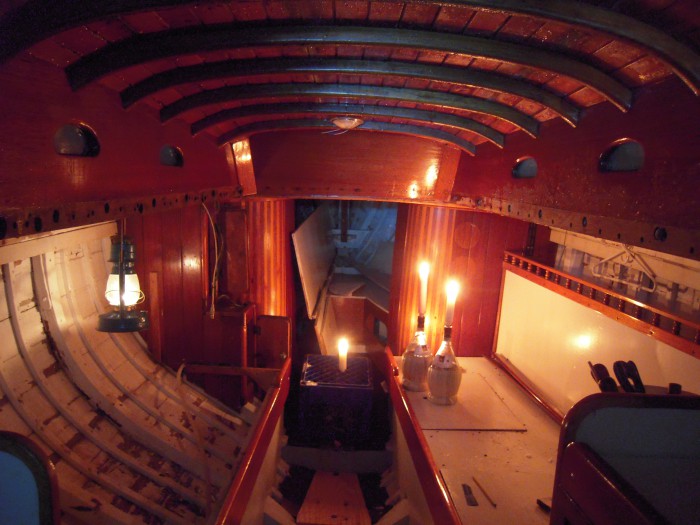
Port-side bunk removed.
Even in 15° with my feet and hands numb from the cold, I had to pull myself away and close up Reverie until another work day. Maybe the next time we return, we’ll even hear a blackbird or two.
Stay warm, my friends.
Roger

 Restoring Reverie