Restoring Reverie

: The Art of Restoring & Sailing a Classic Wooden Sailboat


2 Comments

Into The Light

The new year is upon us and it’s finally starting to look like January here along the Lake Michigan shoreline.  We had an unseasonably warm December due to the El Niño-Southern Oscillation (ENSO) cycle.

   http://oceanservice.noaa.gov/facts/ninonina.html

As avid cross country skiers, we were somewhat disappointed by the lack of snow.  As boat restorers, we took advantage of the mild weather to further the cause and get as much done on Reverie as possible before Winter set in.  Fortunately, we tempered these hours of work with some Grade-A, late season sailing aboard Prudence.  

Winter weather has now arrived and we got down near the single digits Fahrenheit last night.  Lake Effect snow has been quietly dusting us and the ground is now covered in white. Last week, we put a tarp over Prudence and brought her outboard in from the cold; time to replace that old water pump impeller I’ve been putting off all season.

Whenever there’s good news and bad news to be communicated, I prefer to have the bad news delivered first.  Candy coating something before the medicine does not help the medicine go down “in the most delightful way”.    Prepare yourself.  Gird your loins.  Here it comes.

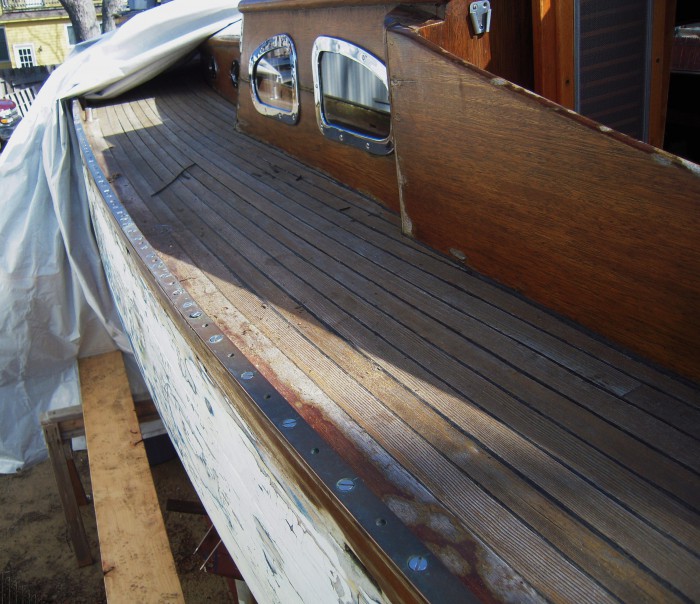
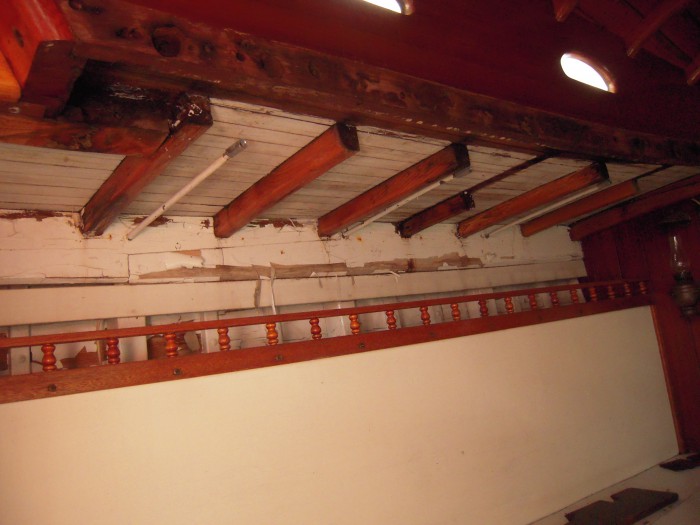
If you have been following this blog, you have ascertained we are removing the entire deck of Reverie to get at the rotted deck beams and carlines.  I have no doubt in my mind that this decision was indeed, the best tack. It will also facilitate the replacement of broken frames.  The port-side tongue and groove decking has been carefully removed, labelled and toted off to storage. It proved to be a bit of a task seeing that many of the strips are in excess of twenty feet.  The port-side deck beams are now visible, as are the  areas aft near the cockpit and transom that get little ventilation.

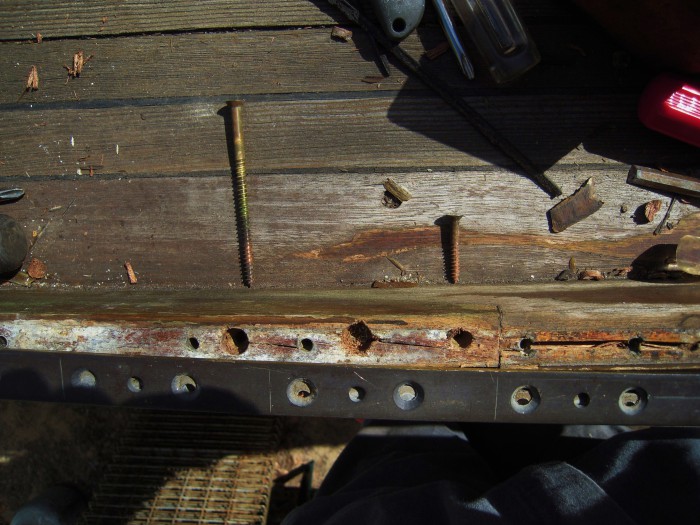
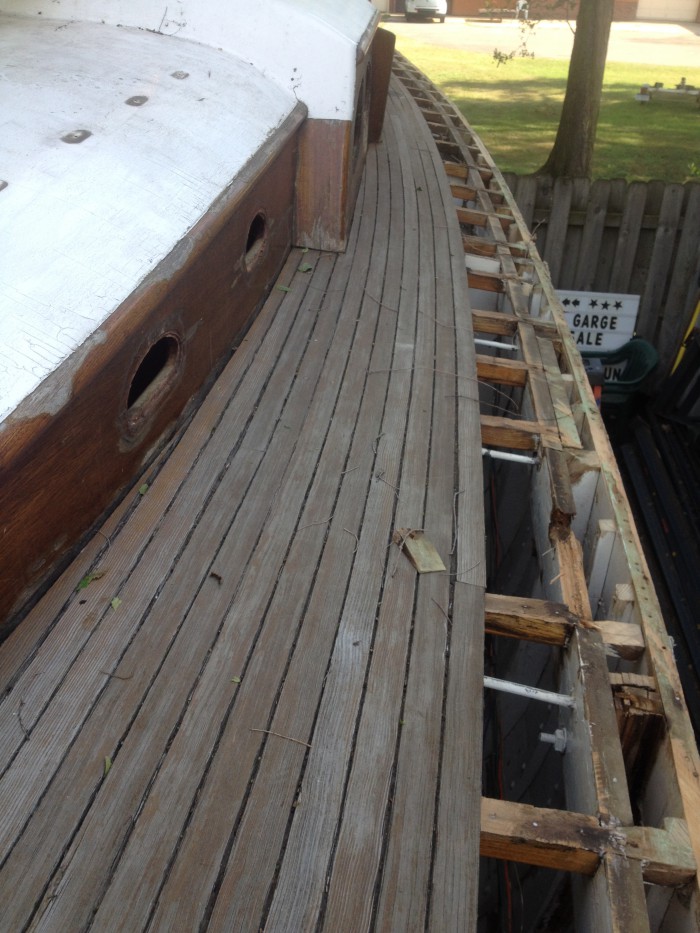
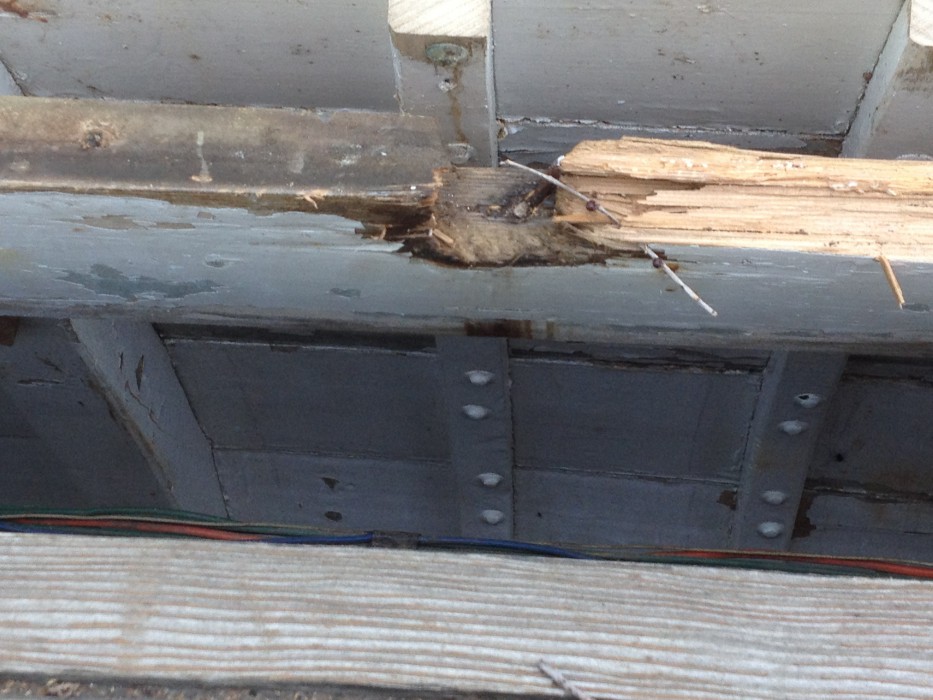
The entire port-side sheer clamp is now visible and there is evident damage amidship.  The sheer clamp is a structural  member that runs stem to stern and serves to support the deck beams and provide resistance to the torsional twisting of the hull.  It is bolted along the inside of the hull at the frames and the deck beams are half-dovetailed into it.  It appears to be made of cypress wood; a good choice considering the need for a light, strong,  rot resistant wood.   I thought of white oak as an alternative for replacement yet was convinced otherwise after researching the weight difference between the two.  Had we gone with oak, there would be another 300 lbs. added to the sheer.
IMG_2779

The port-side sheer clamp showing evident signs of rot amidship.
IMG_2782

A closeup of the rot on the port-side sheer clamp.

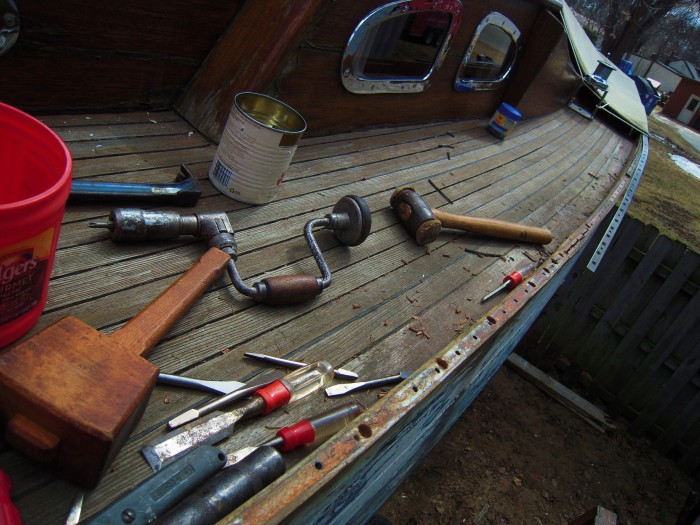
Once the port-side deck was removed, it became time to prep the starboard-side deck for removal.  Julia began the monotonous chore of removing all the bungs from the toe rail in order to get at the 4 inch bronze screws holding it down every 6 inches.  While she did that, I worked on the deck hardware.  I removed the starboard winch, cleats, anchor chocks, spinnaker pole chocks and, with Julia’s help, the stanchion bases.

The stanchion bases are particularly hard to get at as they are fastened between the sheer clamp and the sheer plank.  Inside the cabin, it was a tight squeeze but in the cockpit, it seemed nigh impossible.  I had to lie on my back and reach through one of the cuddy holes in the cockpit with my arm fully extended all the while attempting to reach the nut I couldn’t see with a deep socket  and extension.  This maneuver was what I imagine it would be like wearing a blindfold while trying to steal a bag of chips from the top row of a vending machine by reaching up through the discharge bin.  While I attempted this feat of derring-do, Julia waited  patiently on the ladder ready to unscrew the fastener once I found the nut.

Lying on my back, in this twisted state, up became down and down became up.  I fished around here and there but could not find the nut to the stanchion base.  I rolled the socket wrench into the small of my hand hoping for some tactile reassurance that this wasn’t all a bad, painful dream and that I would eventually find the nut and bolt that were obviously eluding me.  I extended my forefinger here and there and suddenly, it felt as if I had stuck it clean through some wood!  “…all part of this bad dream”, I thought.  “Just relax.  Embrace the pain.  Find the bolt.”

My eyes were closed.  They were useless in this endeavor. All sensory input was being conveyed through an arm bent into positions it was never meant to be in yet, there it was: the sensation that I had my finger stuck clean through a piece of wood. I wriggled my forefinger around.   It was as if it was stuck through a hole in a sock; a 5/4 inch thick rotted sock.  I felt air on the other side.  Was my finger sticking through the sheer plank and the world outside?  “No”, Julia assured me.  “I can’t see your finger.”  Then, the truth set in.  I had stuck my finger through the rotten starboard-side sheer clamp!

I writhed about like a crocodile being swallowed by a python,  still unable to find the damn bolts. I began to see a shining light through my closed eyes.  I heard a voice beckoning me.  “Come to the light!”   I reached out, with my contorted arm, and touched the stanchion bolt I so desperately sought.  I focused, careful not to let this moment slip away.  I got the socket on the nut.  Julia unscrewed it from above.

Bolt number two was right next to a frame but now that my arm was a bent pipe cleaner, I got the socket onto it, as well.  The two other bolts to the stanchion base were screwed through the deck and into the sheer clamp.  The cause of the rot, perhaps?  They pulled out without even needing to be unscrewed.  The stanchion base was finally liberated from the covering board.  It then took several minutes to extract my now serpentine arm from the labyrinth while I relived the pain of a long-ago separated shoulder.  Why did I ever think rollerblading was a good idea?

The outcome of these travails are the issues with the starboard-side sheer clamp that will be come into focus as work progresses.  It was  reminder that there is more than meets the eye in our little project.  We’re certainly not out of the woods with these hidden issues.  “… two steps back.”  I’m glad we found this out before Winter set in.   It gives us time to plot out the next course of action. These sheer clamps must be addressed before the deck beam work can start.   I guess that big slab of white oak we have will have to wait a bit before it’s sawn into deck beams.  Time to start shopping for some nice cypress.

Now that we’ve had our medicine, I must say that it has been a delightful season.  El Niño might be wreaking havoc all over the world but he allowed us to get out on our Com-Pac 16, Prudence for some extra-fine Fall/Winter sailing.  One of the real highlights of the season was sailing on Christmas Day.  There had been a raging gale several days before Christmas with 22 foot waves on Lake Michigan.  That’s 22 foot December, Great Lakes waves which are steeper and heavier than ocean waves. While not 22 feet, there were still some big rollers that picked up in the 20 knot afternoon breeze. The waves were very uniform with an occasional series standing above the others.  It was consistent and certainly memorable.

The icy, steel blue water was beautiful and deadly as we beat  5 miles WNW onto the lake.  We were driving so hard, we kept the Port Sheldon pier off our stern with almost no leeway to the South.  Prudence yields a bit to the currents so this was a pleasant surprise.  We would be able to triangulate back to the pier.  Three legs and we’d be home.   We ended up gybing off on the second leg then rounding back NE as Prudence didn’t want to tack into the rollers that were beginning to stand up 5 miles offshore.  On leg three, we ran S along the Lake Michigan shoreline back to Port Sheldon. That leg ended way too soon.

DSCN1304

October on Lake Michigan

DSCN1405

November sailing- Holland, Michigan

DSCN1419

November sailing. Coming into Lake Macatwa from Lake Michigan.

DSCN1453

Christmas Day 2015. 5 miles out, 5 miles back with Julia’s daughter, Chloe. Fine sailing. -Port Sheldon, Michigan

Christmas Day - Lake Michigan

Christmas Day – Lake Michigan

It has, indeed, been a delightful year filled with hard work and dedication that shows in all we have accomplished  It has been a year of change and sacrifice balanced with the enjoyment of life’s small pleasures.  It helps to have someone like Julia who can see the forest through the trees.  She has been working tirelessly alongside me.  Even during the 60 hours it took me to strip the paint from the port topsides,  she was there at the end of the day with a couple of cold beers that we would drink at the Sunset Lounge, our two lawn chairs in the shade of Reverie.  Here’s to everyone having an eventful and  productive 2016.  Cheers!

Leave a comment

Off With the Deck?!

IMG_2530

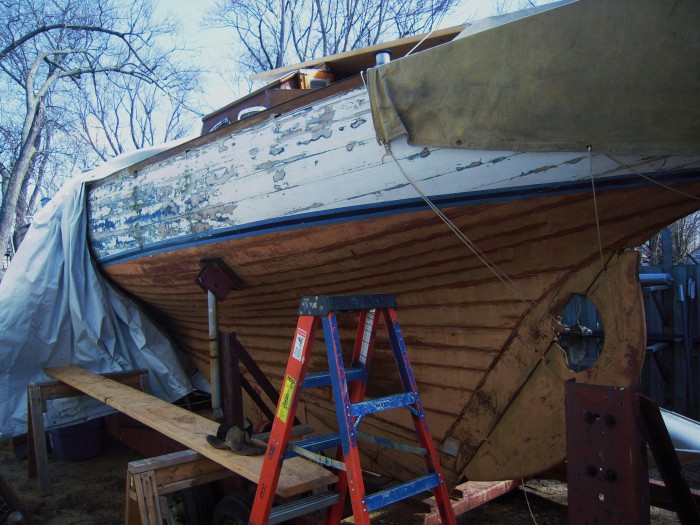
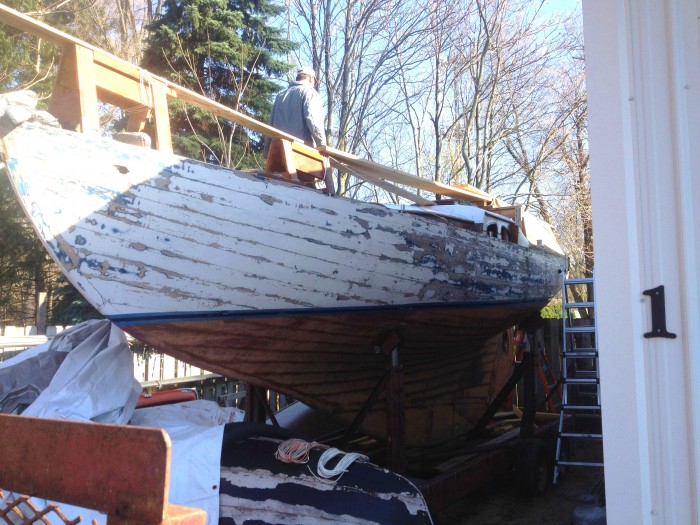
Reverie’s beautiful lines are evident even with her hull looking this way.


Boat repair and restoration requires both optimism (This can be done.) and realism (This is a mess.).  Lately, it’s been a healthy dose of realism.  A lot of the early work on Reverie has been assessing the situation of the leaking deck by finding the damage and what caused it. Rainwater from deck leaks is the culprit, of course, and the damage is insidious at best.  This water coming down from the sky contains a rich collection of fungi and molds ready to set up shop on any food source.  A wooden boat left out in the elements, uncovered for several years, with a leaking deck is a great place for these tiny creatures to do their business.

We got a tarp over Reverie last December, the first day we saw her.  I knew that was the only way to slow down the rot that was beginning to consume her.  Rot needs moisture and the first step was to get that out of the equation.  The next step was to find the entry points where the green water was coming through and stop it.  That was pretty easy as there’s rot in all of the places where the rain water was leaking below.  As I was poking around in the tight confines of the forepeak, (Reverie was designed for sailing and not so much for below decks comfort), I found mushrooms had been growing in the corner joint of the fore hatch carline. They were dried and no longer actively growing but they were there.  I’m sure spores are everywhere!

The next work session involves the complete removal of the fore hatch and immediate treatment with sodium tetraborate (good ol’ borax).  We’re using borax to initially treat any spots that have begun to rot.  It has excellent anti-fungal properties and is safe to use.  It’s major downfall in marine use is that it’s water soluble and will leach out of wood that comes in contact with water.  The immediate goal is to kill what rot is  in the wood already and worry about long term treatment as the restoration progresses.

The real damage from all of this leaking water has been to the deck beams and it is obvious many of them need to be replaced.  Getting at the deck beams is the reason for removing the covering board (the strip of teak that provides an edge for the decking and runs the full length of the hull).  To get to the deck beam end requires removal of the jib tracks to get to the toe rail to get to the covering board. This all reminds me of the children’s song, I Know An Old Lady Who Swallowed A Fly. I just hope it doesn’t get to the point where I swallow the horse!


IMG_2520

A big section of toe rail comes off!

IMG_2510

Stanchion bases half screwed into the sheer clamp, half through covering board. I would like to see them 100% through bolted.


So, our work is exemplified in a children’s song.  So be it.  The initial tack was to get the covering board off which would provide access to the outer ends of the deck beams.  While the toe rail was fastened to the covering board with 4 inch long bronze screws, the covering board is fastened to the sheer clamp and beam ends with steel screws.  These screws are proving to be formidable opponents to extraction and it looks like they have a date with a date with a sawzall and metal cutting blade.  We’ll remove all screws that will come out willingly but the others will have to be cut.

One of the three king beams needs to be replaced.  The king beams provide support for the the mast amidship and can only be extracted by removing the top hull plank known as the sheer plank or sheer strake; unless the entire deck is removed.  Examining the sheer planks, as we worked on the toe rail removal, I began to seriously wish the sheer planks could stay right where they are.  Both port and starboard sides are in fine condition and removing them would mean ‘fixing something that ain’t broke’.  I began to seriously consider removing the deck altogether.

Removing the entire deck might seem extreme but the main issue Reverie faces is this leaking deck. The deck is Douglas Fir and appears in fine condition.  It is attached to the deck beams by a method called “secret nailing”.  Secret nailing is done much the way that wooden floors in houses are laid.  The tongue and groove strips are nailed diagonally through the tongue so the groove covers the nail.  Secret nails go into the beams and then additional nails are driven horizontally through each strip tying the strips together even more. A real advantage of this method is that it leaves a nice, clean deck free of bung holes that are all invitations for water entry.  The major disadvantage is that it is a real pain to repair.  I don’t relish the thought of ripping up this beautiful deck and having to shell out for more lumber.  One of the reasons we took on this project was the condition to the wood.  The only real wood I thought needed replacing was American White Oak, readily available and relatively cheap here in Michigan.  Nice, long, clear lengths of Douglas Fir isn’t going to be cheap.

Remove the sheer planks or remove the deck?   And the winner is: Remove the deck.  Loathing the thought of removing perfectly good planks that are screwed and riveted was what got me considering the deck option and, from there, it began to make more sense.  The damage to the deck beams that can be seen is most likely the tip of the iceberg.  I’m sure there’s plenty more rot in the beams that has yet to rear it’s head.  The mushrooms growing out to joint in the forehatch carline is a real red flag. With the entire deck removed, all of the tops of the beam can be assessed and a fresh coat of red lead primer can be applied.  I’m hoping we can disassemble the secret nailing and reuse the old deck but not banking on it.  Que sera, sera.   Off with the deck!

Cheers,

Roger


2 Comments

Toe Rail & Covering Board

DSCN0680

“It was one of those March days when the sun shines hot and the wind blows cold: when it is summer in the light, and winter in the shade.” ~ Charles Dickens, Great Expectations


Here we are, watching March, 2015 fade to memory. This year, March came in like a lion and has remained roaring ever since. The Great Lakes region has been sunny and dry, for the most part, but it has been “…summer in the light and winter in the shade.”, as Charles Dickens put it.  I started work yesterday morning in 24° Fahrenheit with a strong North wind gusting 25-30 mph.  The temps stayed steady throughout the day but it was “summer in the light” and there’s work to be done

The Great Lakes began to shed their ice in early March.  The Coast Guard, police and fire rescue crews have had their hands full with idiots on ice ever since. Every year, overzealous ice fishers, snowmobilers unaccustomed to the laws of physics and errant sightseers end up falling through the ice or somehow trapped on a floe drifting off into the open water of the Great Lakes. As more and more people are taking to the water in small craft, there has been a surge in kayak, canoe and paddleboard related incidents as well. This is nothing new, as we can see from previous generations: these people breed.

The work at hand is to get the port-side deck beams in order.  The leaking deck caused them to rot and I’m sure there’s more to discover once things are taken apart.  So, the bronze jib track, the toe rail and the covering board need to come off to get a look the deck beam ends below.  The deck beams are not as accessible as the carlines, which make up the framing for the hatches and cabin.  The deck beams run perpendicular to the keel line of the boat and their outboard ends are worked into the sheer clamp.

The sheer of a boat is the edge where the topsides meet the deck. It is an important aesthetic point in boat design.  The sheer clamp is the board that runs inside, along the topside and provides a band of support for the deck beams.  On larger boats, there is often a board that sits on top of the clamp called a shelf. Reverie only has a clamp that the deck beams are tied into.  The situation gets complicated by the fact that the deck beams are tied into the clamp outboard and not accessible from inside. .

One of the nice things about a wooden boat built in a traditional manner is that, “what’s done, can be undone”. The fact that the boat is held together with fasteners is a plus when doing major work such as replacing the deck beams.   Even though it can be undone, I’m cursing the fact that the deck was allowed to leak and this all occurred. I suppose that is how every old boat, house or any other creation of humanity meets it’s end: human neglect. “An ounce of prevention is worth a pound of cure”.  Yes, it’s times like these when many an old proverb comes to mind.  DSCN0683

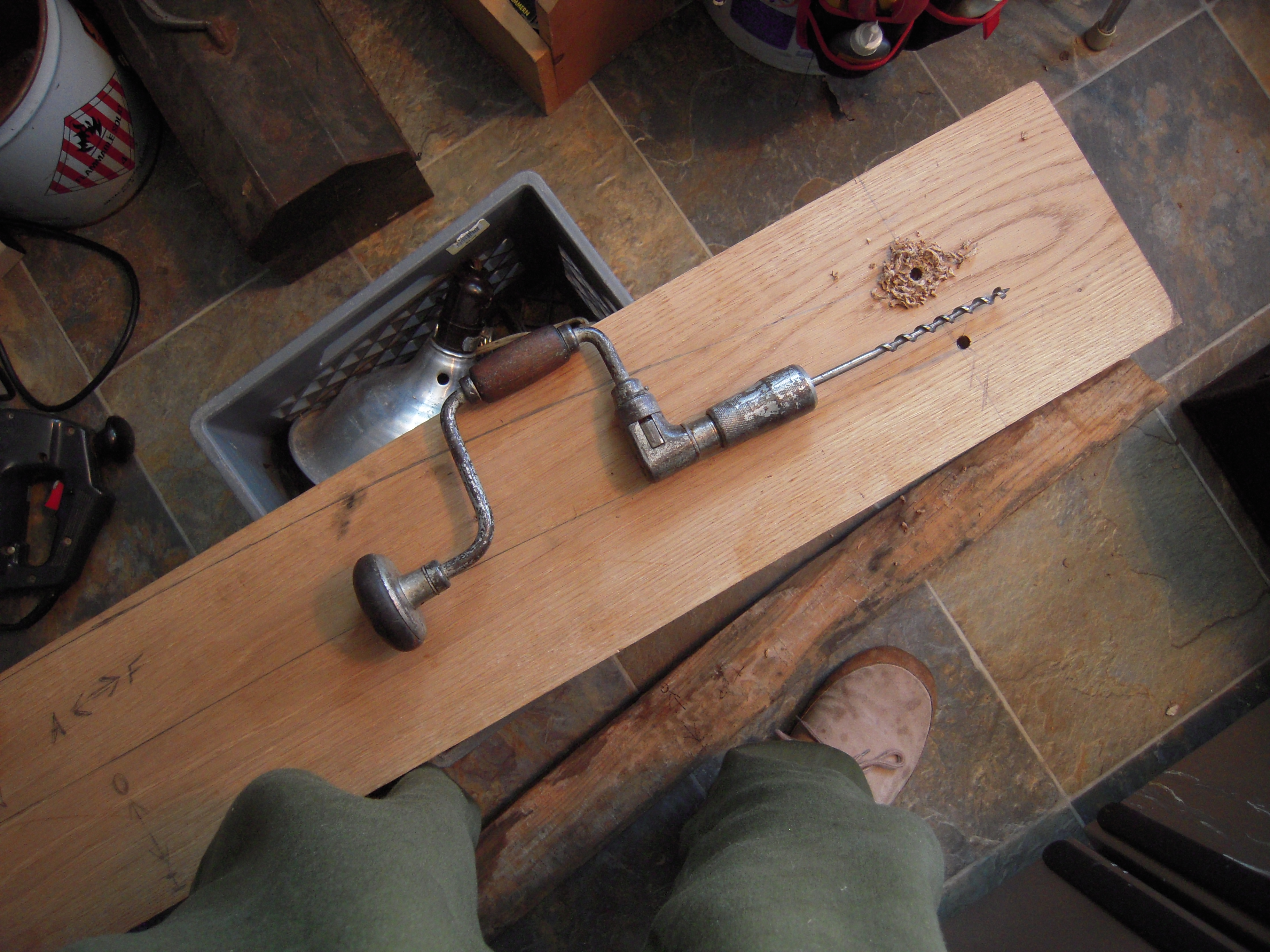
The task of removing a multitude of screws is best done with a hand brace fitted with the appropriate screwdriver bit.  I also came armed with a hand impact driver to loosen up any recalcitrant fastenings.  The hand brace exerts an amazing amount of torque and allows you to put downward pressure on the screw.  This is especially important when removing screws that have been in place for over 60 years and are unwilling to yield.

DSCN0684

The bronzed track is held down with stainless steel screws and came off without incident.  I did find splitting in the toe rail at the scarf which was caused by the linear nature of the track and the natural grain of wood.  “Easy, Igor. You impetuous young boy!”

The toe rail is fastened to the covering board with 4" silicon bronze screws.  The phillips heads want to strip out if you even look at them the wrong way.

The toe rail is fastened to the covering board with 4″ silicon bronze screws under wooden bungs. The phillips heads want to strip out if you even look at them the wrong way.

The covering board appears to be fastened with steel flat head screws which have very shallow slots that will require careful cleaning and concentration to remove.  I left that task until I set up a better scaffolding as it will require a lot of downward pressure on the brace and bit.  I’m going to have to make a concerted effort to extract these puppies.

I made it four hours before calling it a day. The wind really took it out of me.  The day was a success in that, I was able to ascertain how easy or difficult this stage would be.  I’m expecting the rest of the port-side toe rail and covering board removal is going to take another 8 to 10 hours.  And that’s if everything goes well!

11:00 a.m.

11:00 a.m.

3:00 p.m.

3:00 p.m.

Think Spring, my friends!

~Roger


2 Comments

Port-side Carline

DSCN0259

Old Man Winter is really giving it to us this week with daytime temps in the single digits and nighttime temps below zero. On our back road morning commute, the other day, the thermometer read -20 F.  We have now been monitoring that area of our commute and have been finding there’s this little stretch of micro climate where the temperature is usually a few degrees cooler than elsewhere.  Hmm…

I’m committed to splitting up a giant red oak for firewood tomorrow but we’ll have to see if the machine will start in this kind of weather.   The forecast calls for -17 F night tonight so, dreaming of boats is a good way to pass the time.  As cold and snowy as it is outside, I still have some off-site projects to accomplish.

One of the off-site projects I am pleased to have gotten done is cutting out the port-side cabin carline to replace the damaged rotting one.


Port-side carline removed with rotting deck beams

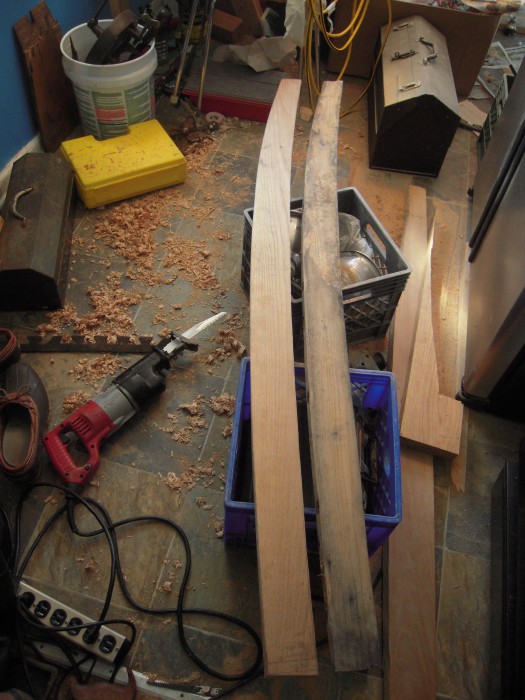
On wooden boats, carlines are fore and aft deck supports that frame openings, such as hatches and the coach roof of the cabin, that run parallel to the keel.  This carline had already been removed when we got the boat. Luckily, it was intact so I had a nice template for the new one to replace it.  White Oak is the wood used for the deck beams and carlines of Reverie.    A band saw would have been very handy to cut out this piece as the carline is about 5-1/2 feet long.  That means 11 feet of sawing through 1-1/2 inch white oak.   Not having a band saw at my immediate disposal didn’t deter me from getting this done.


Pilot holes for the cut.

Pilot holes for the cut.


I first tried using a saber saw thinking it would be a good tool to keep the blade perpendicular to the mark and, ultimately, less work shaping the carline to its final dimensions. I made it less than a foot before the saber saw blade yielded to the mighty white oak and snapped.  Had I been successful with that laborious method, it would have taken me forever to cut that eleven feet.

It was time for bigger guns and a bit more concentration.  I chose to go at it again with a Sawzall and the largest blade aptly named ‘The Ax’ .  This is a big blade made for demolition work and capable of cutting through not only wood but stray nails and the like; perfect for hard white oak.  That said, I started with a fresh blade and noticed it wasn’t cutting as well by the time I finished.


Sawzall with 'Axe' blade

Sawzall with ‘Ax’ blade

Concentration was key at this phase.  I wanted to keep the cut 1/8″ from the template lines so as not to spend an inordinate amount of time shaping the piece later.  It wasn’t fast but the cut went well and I was glad to have gotten that close when I finished shaping the outer curve of the carline with a draw knife and hand planes.


DSCN0488

Stanley Rabbet Plane set to bullnose position.

DSCN0489

Draw knife used bevel side up for convex cuts and bevel side down for concave cuts.

The draw knife was used to bring the piece evenly close to the final mark.  The rabbet plane set in the bull nose position worked admirably for the concave planing as did the wooden jack plane for the convex planing.  As I worked, I checked for square often. It varied by no more than a 32nd” off square. I marked those areas with a pencil so as not to plane the rest of the edge out of square.

Keeping the Sawzall visually perpendicular to the piece takes a bit of practice and I would recommend cutting 1/4″ or slightly more away from the template mark if you’re not confident in your sighting ability.  It might take a bit more time in the final shaping but it’s better than ruining a big, expensive chunk of oak.

DSCN0487

16″ Wooden Jack Plane

The wooden jack plane is one of my favorite tools.  I stuck the removable handle back on it for the photo but I use it without.  I find I have a lot more control with both hands cupping the body.   It has somehow survived these 100 plus years and gives me great joy when I use it.  It looks crude and simple compared to more modern steel body planes but its razor sharp, heavy blade doesn’t chatter and provides lovely curls of fragrant wood as it glides its way through a project.  It literally sings with sonorous notes that tell you it is perfectly adjusted.  I made our Arts and Crafts inspired oak and walnut bed relying heavily on this plane and I can still hear the notes as I planed away. It planes so smoothly, I’ve never bothered to sand or take a cabinet scraper to the bed. The old jack plane comes alive and the resonance in the wood is sheer delight to experience. It did sing a couple of times when I was working on the carline but it was quick work and I never really got it going.   It is a privilege to own and I hope it provides some other lucky woodworker(s) the joy is has for me when I am dead and gone.

Out with the old, in with the new.

Out with the old, in with the new.


Once the piece was square and within 1/16 ” to the template mark, I stopped and will do the last few passes when I’m back at the boat. When you shape a piece of wood like this, you are releasing it from its former state and it now has a definite purpose.  The carline was always there, latent in that slab of oak.  I feel that I did nothing more than free it to a higher purpose.  After all, it could very well have been cut into 16″ sections and split up into firewood to warm some chilly soul on this frigid Winter day.

Stay warm, my friends.

~Roger