Restoring Reverie

: The Art of Restoring & Sailing a Classic Wooden Sailboat


Leave a comment

The Elephant in the Room

As the last week of August fades to memory, it’s time to reflect on what’s been done and plan for the cooler months ahead.  For many people, summer ends at Labor Day; the tug of the academic calendar is just too much for folks raised to abide by the “back to school” mentality.  They may not be in school or have children in school but the hand is writing on the wall.  We are bombarded by yet another consumer milestone.  “Buy, buy, buy”, the ads say.  When I’m out shopping, I feel like maybe I should pick up a fresh pack of crayons or maybe some paste.

Here in West Michigan, we see the last of the tourists “recreating profusely”; they’re squeezing that last bit of juice from the lemon before it’s time to get the kids off to school.  Then, it’s a little easier to breathe around here.  We don’t have to fight the crowds to get around and no longer have to plan our sailing time during the week.  It was so hot and humid for the first part of August, there was not much going on in the way of boat work.  I’m not partial to heat indexes in the lower 100’s and the fact that I’m using a heat gun only reinforces my prejudices.

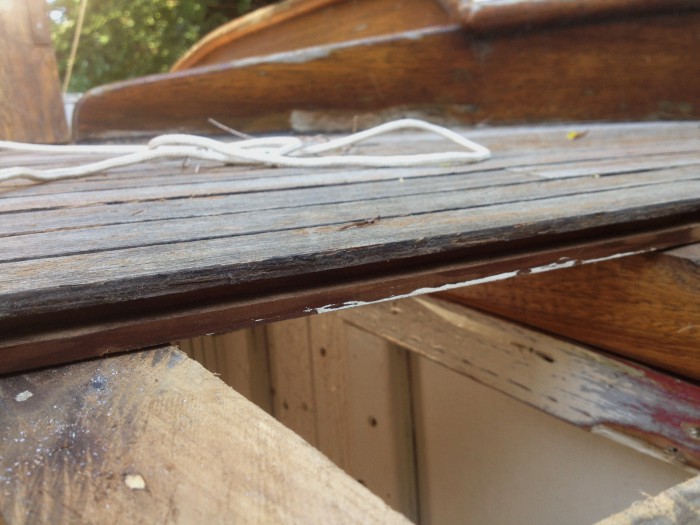
Late July and some of August saw us dutifully removing the rest of the covering board and begin the process of removing the deck from Reverie.

IMG_2747IMG_2771IMG_2761

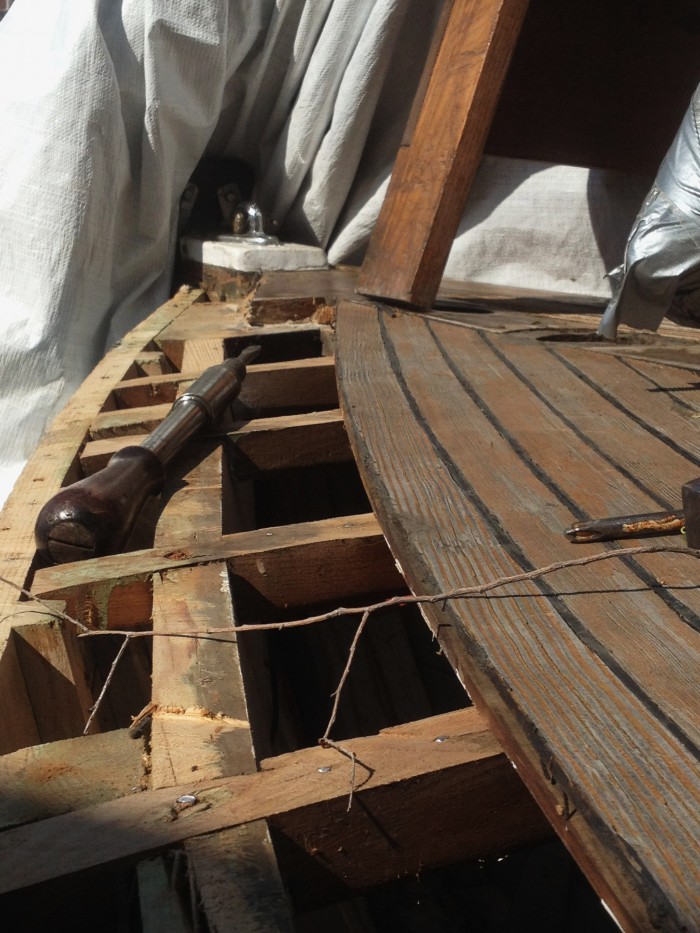
That went as well as it could and we are now able to see the extent of the rot to the port-side deck beams.  There weren’t really many surprises as I was expecting to find more rot than was visible from the interior.  After all, that is one of the main reasons we are completely removing the deck.   We got 3 rows of the tongue and groove decking off yet, something wasn’t quite right.  There was an elephant in the room and it wasn’t going away.

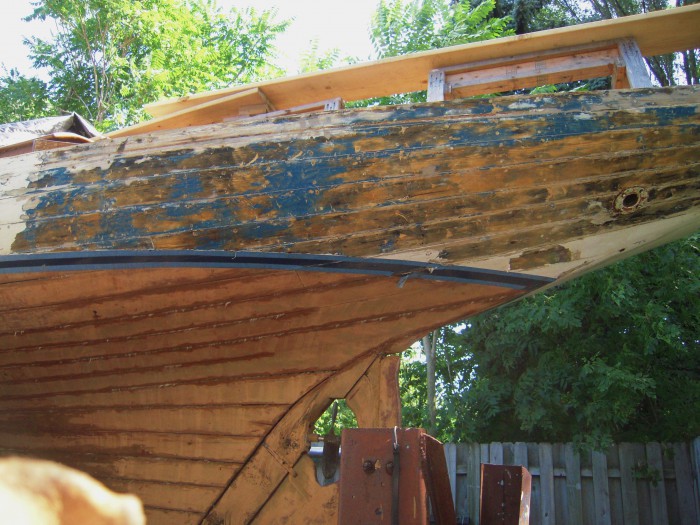
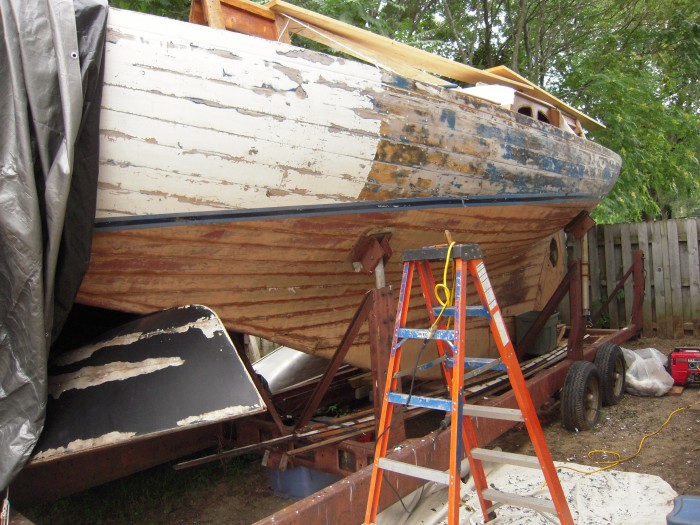
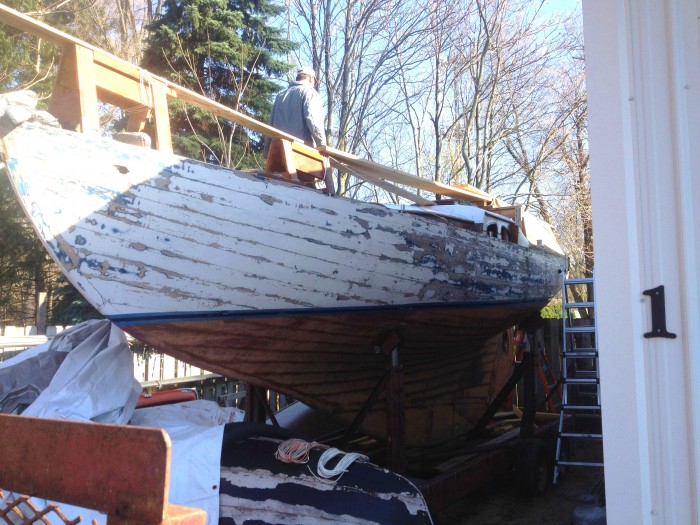
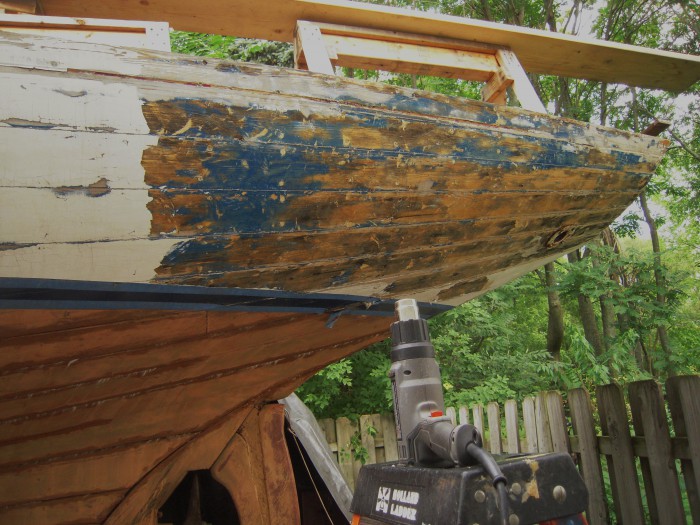
The warm weather did slow us down but it was the impending cold weather that made the elephant more apparent.  While focusing on the deck and executing the plan to remove it, time was ticking away.  After seeing what would need to be done with the deck beams, the seemingly innocuous topsides began to call out for help.  The paint was crazed and peeling.  There were bare spots from an attempt, made by the previous owner, to sand them.  I’m not sure how long ago the attempted sanding took place but the sections of exposed bare wood was showing signs of weathering that could lead to wholesale splitting of the lovely,  longleaf yellow pine that planks our fair vessel.  It was time to feed the elephant.

Completely stripping the multiple layers of topside paint was the only course of action seeing how the paint had split and cracked where it hadn’t already been sanded.  Reverie has been out of the water for years and the planking is a lot drier than a wooden boat’s should be.  Dry planks can stress the fasteners and shrink the dimensions enough to cause problems when it comes time to recaulk the seams.  If the seams are caulked when it’s dry, the expansion can cause undue stress and actually cause the fasteners to pull out.  Not good.

It’s going to take about 30 hours per side to strip the paint and a good 20 to do the sanding and oiling.  After the oil dries, the initial coat of primer goes on and Reverie will be much happier.  So, Julia gets about 100 hours of work time off while I    take one for the team since there’s no reason we should both be exposed to this mess.  She hasn’t stopped work altogether; she’s working on removing the multitude of bungs (wooden plugs that cover screw holes) from the cockpit coaming when I’m not making too much of a mess.

Wearing a respirator for 80 hours is not something I’m enjoying but it has to be done. I have the heat gun set just hot enough to lift the paint but not hot enough to burn it.  I’ve done some research on the release of lead and other toxic substances and am working at a lower temperature to avoid as much exposure to lead as I can.  I watched a video on youtube of this guy using a heat shrink gun and literally burning the paint off the topsides.  He said he can get a whole boat stripped in one day.  He wasn’t wearing a respirator.  I think I’ll err on the side of caution.

See you when it’s done.
DSCN1044IMG_2796006DSCN1138


Leave a comment

Off With the Deck?!

IMG_2530

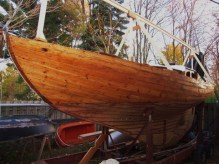
Reverie’s beautiful lines are evident even with her hull looking this way.


Boat repair and restoration requires both optimism (This can be done.) and realism (This is a mess.).  Lately, it’s been a healthy dose of realism.  A lot of the early work on Reverie has been assessing the situation of the leaking deck by finding the damage and what caused it. Rainwater from deck leaks is the culprit, of course, and the damage is insidious at best.  This water coming down from the sky contains a rich collection of fungi and molds ready to set up shop on any food source.  A wooden boat left out in the elements, uncovered for several years, with a leaking deck is a great place for these tiny creatures to do their business.

We got a tarp over Reverie last December, the first day we saw her.  I knew that was the only way to slow down the rot that was beginning to consume her.  Rot needs moisture and the first step was to get that out of the equation.  The next step was to find the entry points where the green water was coming through and stop it.  That was pretty easy as there’s rot in all of the places where the rain water was leaking below.  As I was poking around in the tight confines of the forepeak, (Reverie was designed for sailing and not so much for below decks comfort), I found mushrooms had been growing in the corner joint of the fore hatch carline. They were dried and no longer actively growing but they were there.  I’m sure spores are everywhere!

The next work session involves the complete removal of the fore hatch and immediate treatment with sodium tetraborate (good ol’ borax).  We’re using borax to initially treat any spots that have begun to rot.  It has excellent anti-fungal properties and is safe to use.  It’s major downfall in marine use is that it’s water soluble and will leach out of wood that comes in contact with water.  The immediate goal is to kill what rot is  in the wood already and worry about long term treatment as the restoration progresses.

The real damage from all of this leaking water has been to the deck beams and it is obvious many of them need to be replaced.  Getting at the deck beams is the reason for removing the covering board (the strip of teak that provides an edge for the decking and runs the full length of the hull).  To get to the deck beam end requires removal of the jib tracks to get to the toe rail to get to the covering board. This all reminds me of the children’s song, I Know An Old Lady Who Swallowed A Fly. I just hope it doesn’t get to the point where I swallow the horse!


IMG_2520

A big section of toe rail comes off!

IMG_2510

Stanchion bases half screwed into the sheer clamp, half through covering board. I would like to see them 100% through bolted.


So, our work is exemplified in a children’s song.  So be it.  The initial tack was to get the covering board off which would provide access to the outer ends of the deck beams.  While the toe rail was fastened to the covering board with 4 inch long bronze screws, the covering board is fastened to the sheer clamp and beam ends with steel screws.  These screws are proving to be formidable opponents to extraction and it looks like they have a date with a date with a sawzall and metal cutting blade.  We’ll remove all screws that will come out willingly but the others will have to be cut.

One of the three king beams needs to be replaced.  The king beams provide support for the the mast amidship and can only be extracted by removing the top hull plank known as the sheer plank or sheer strake; unless the entire deck is removed.  Examining the sheer planks, as we worked on the toe rail removal, I began to seriously wish the sheer planks could stay right where they are.  Both port and starboard sides are in fine condition and removing them would mean ‘fixing something that ain’t broke’.  I began to seriously consider removing the deck altogether.

Removing the entire deck might seem extreme but the main issue Reverie faces is this leaking deck. The deck is Douglas Fir and appears in fine condition.  It is attached to the deck beams by a method called “secret nailing”.  Secret nailing is done much the way that wooden floors in houses are laid.  The tongue and groove strips are nailed diagonally through the tongue so the groove covers the nail.  Secret nails go into the beams and then additional nails are driven horizontally through each strip tying the strips together even more. A real advantage of this method is that it leaves a nice, clean deck free of bung holes that are all invitations for water entry.  The major disadvantage is that it is a real pain to repair.  I don’t relish the thought of ripping up this beautiful deck and having to shell out for more lumber.  One of the reasons we took on this project was the condition to the wood.  The only real wood I thought needed replacing was American White Oak, readily available and relatively cheap here in Michigan.  Nice, long, clear lengths of Douglas Fir isn’t going to be cheap.

Remove the sheer planks or remove the deck?   And the winner is: Remove the deck.  Loathing the thought of removing perfectly good planks that are screwed and riveted was what got me considering the deck option and, from there, it began to make more sense.  The damage to the deck beams that can be seen is most likely the tip of the iceberg.  I’m sure there’s plenty more rot in the beams that has yet to rear it’s head.  The mushrooms growing out to joint in the forehatch carline is a real red flag. With the entire deck removed, all of the tops of the beam can be assessed and a fresh coat of red lead primer can be applied.  I’m hoping we can disassemble the secret nailing and reuse the old deck but not banking on it.  Que sera, sera.   Off with the deck!

Cheers,

Roger