Restoring Reverie

: The Art of Restoring & Sailing a Classic Wooden Sailboat


2 Comments

Into The Light

The new year is upon us and it’s finally starting to look like January here along the Lake Michigan shoreline.  We had an unseasonably warm December due to the El Niño-Southern Oscillation (ENSO) cycle.

   http://oceanservice.noaa.gov/facts/ninonina.html

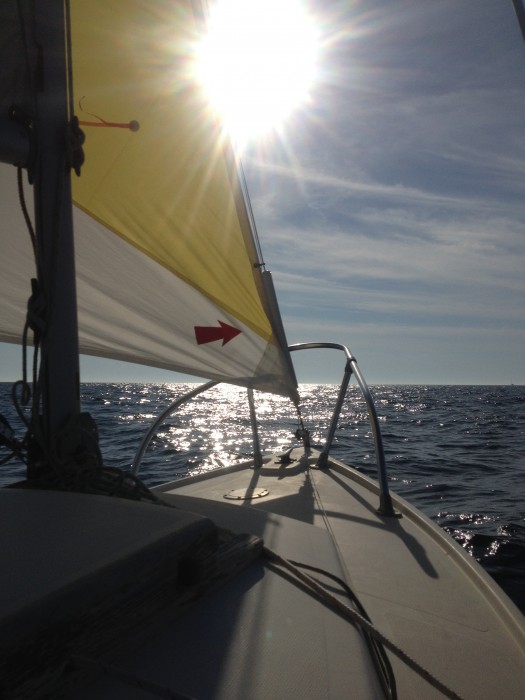
As avid cross country skiers, we were somewhat disappointed by the lack of snow.  As boat restorers, we took advantage of the mild weather to further the cause and get as much done on Reverie as possible before Winter set in.  Fortunately, we tempered these hours of work with some Grade-A, late season sailing aboard Prudence.  

Winter weather has now arrived and we got down near the single digits Fahrenheit last night.  Lake Effect snow has been quietly dusting us and the ground is now covered in white. Last week, we put a tarp over Prudence and brought her outboard in from the cold; time to replace that old water pump impeller I’ve been putting off all season.

Whenever there’s good news and bad news to be communicated, I prefer to have the bad news delivered first.  Candy coating something before the medicine does not help the medicine go down “in the most delightful way”.    Prepare yourself.  Gird your loins.  Here it comes.

If you have been following this blog, you have ascertained we are removing the entire deck of Reverie to get at the rotted deck beams and carlines.  I have no doubt in my mind that this decision was indeed, the best tack. It will also facilitate the replacement of broken frames.  The port-side tongue and groove decking has been carefully removed, labelled and toted off to storage. It proved to be a bit of a task seeing that many of the strips are in excess of twenty feet.  The port-side deck beams are now visible, as are the  areas aft near the cockpit and transom that get little ventilation.

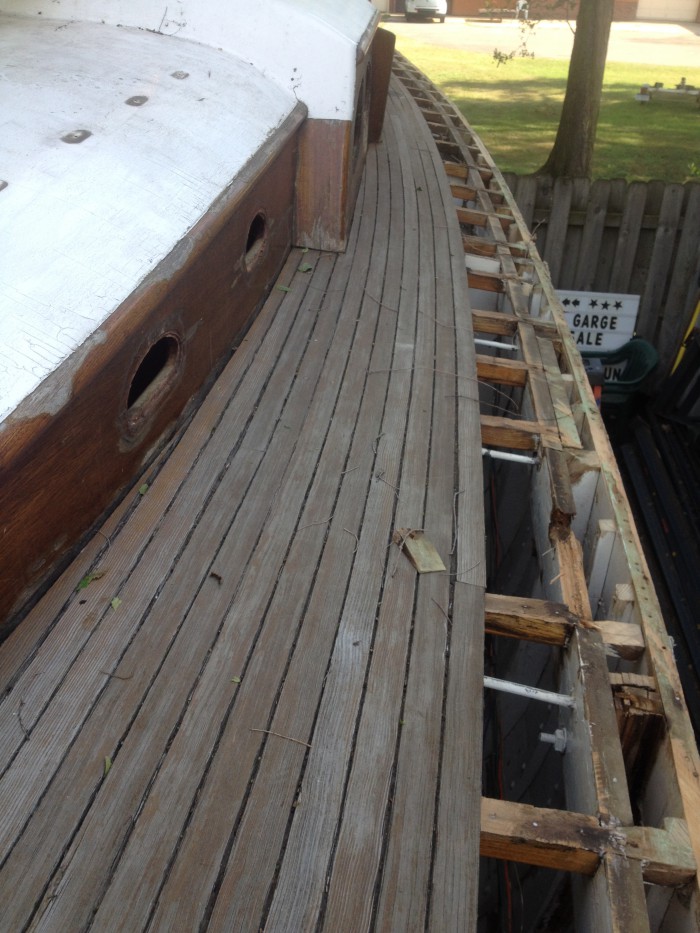
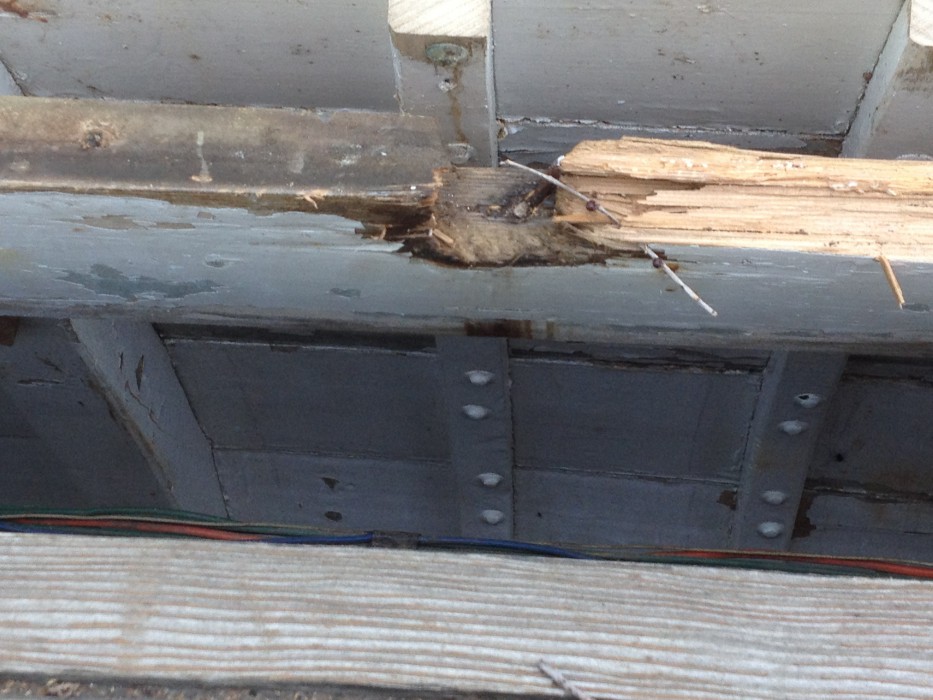
The entire port-side sheer clamp is now visible and there is evident damage amidship.  The sheer clamp is a structural  member that runs stem to stern and serves to support the deck beams and provide resistance to the torsional twisting of the hull.  It is bolted along the inside of the hull at the frames and the deck beams are half-dovetailed into it.  It appears to be made of cypress wood; a good choice considering the need for a light, strong,  rot resistant wood.   I thought of white oak as an alternative for replacement yet was convinced otherwise after researching the weight difference between the two.  Had we gone with oak, there would be another 300 lbs. added to the sheer.
IMG_2779

The port-side sheer clamp showing evident signs of rot amidship.
IMG_2782

A closeup of the rot on the port-side sheer clamp.

Once the port-side deck was removed, it became time to prep the starboard-side deck for removal.  Julia began the monotonous chore of removing all the bungs from the toe rail in order to get at the 4 inch bronze screws holding it down every 6 inches.  While she did that, I worked on the deck hardware.  I removed the starboard winch, cleats, anchor chocks, spinnaker pole chocks and, with Julia’s help, the stanchion bases.

The stanchion bases are particularly hard to get at as they are fastened between the sheer clamp and the sheer plank.  Inside the cabin, it was a tight squeeze but in the cockpit, it seemed nigh impossible.  I had to lie on my back and reach through one of the cuddy holes in the cockpit with my arm fully extended all the while attempting to reach the nut I couldn’t see with a deep socket  and extension.  This maneuver was what I imagine it would be like wearing a blindfold while trying to steal a bag of chips from the top row of a vending machine by reaching up through the discharge bin.  While I attempted this feat of derring-do, Julia waited  patiently on the ladder ready to unscrew the fastener once I found the nut.

Lying on my back, in this twisted state, up became down and down became up.  I fished around here and there but could not find the nut to the stanchion base.  I rolled the socket wrench into the small of my hand hoping for some tactile reassurance that this wasn’t all a bad, painful dream and that I would eventually find the nut and bolt that were obviously eluding me.  I extended my forefinger here and there and suddenly, it felt as if I had stuck it clean through some wood!  “…all part of this bad dream”, I thought.  “Just relax.  Embrace the pain.  Find the bolt.”

My eyes were closed.  They were useless in this endeavor. All sensory input was being conveyed through an arm bent into positions it was never meant to be in yet, there it was: the sensation that I had my finger stuck clean through a piece of wood. I wriggled my forefinger around.   It was as if it was stuck through a hole in a sock; a 5/4 inch thick rotted sock.  I felt air on the other side.  Was my finger sticking through the sheer plank and the world outside?  “No”, Julia assured me.  “I can’t see your finger.”  Then, the truth set in.  I had stuck my finger through the rotten starboard-side sheer clamp!

I writhed about like a crocodile being swallowed by a python,  still unable to find the damn bolts. I began to see a shining light through my closed eyes.  I heard a voice beckoning me.  “Come to the light!”   I reached out, with my contorted arm, and touched the stanchion bolt I so desperately sought.  I focused, careful not to let this moment slip away.  I got the socket on the nut.  Julia unscrewed it from above.

Bolt number two was right next to a frame but now that my arm was a bent pipe cleaner, I got the socket onto it, as well.  The two other bolts to the stanchion base were screwed through the deck and into the sheer clamp.  The cause of the rot, perhaps?  They pulled out without even needing to be unscrewed.  The stanchion base was finally liberated from the covering board.  It then took several minutes to extract my now serpentine arm from the labyrinth while I relived the pain of a long-ago separated shoulder.  Why did I ever think rollerblading was a good idea?

The outcome of these travails are the issues with the starboard-side sheer clamp that will be come into focus as work progresses.  It was  reminder that there is more than meets the eye in our little project.  We’re certainly not out of the woods with these hidden issues.  “… two steps back.”  I’m glad we found this out before Winter set in.   It gives us time to plot out the next course of action. These sheer clamps must be addressed before the deck beam work can start.   I guess that big slab of white oak we have will have to wait a bit before it’s sawn into deck beams.  Time to start shopping for some nice cypress.

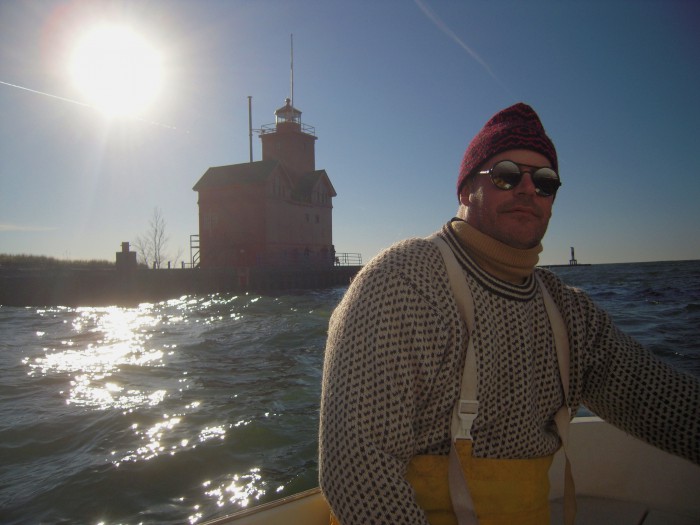
Now that we’ve had our medicine, I must say that it has been a delightful season.  El Niño might be wreaking havoc all over the world but he allowed us to get out on our Com-Pac 16, Prudence for some extra-fine Fall/Winter sailing.  One of the real highlights of the season was sailing on Christmas Day.  There had been a raging gale several days before Christmas with 22 foot waves on Lake Michigan.  That’s 22 foot December, Great Lakes waves which are steeper and heavier than ocean waves. While not 22 feet, there were still some big rollers that picked up in the 20 knot afternoon breeze. The waves were very uniform with an occasional series standing above the others.  It was consistent and certainly memorable.

The icy, steel blue water was beautiful and deadly as we beat  5 miles WNW onto the lake.  We were driving so hard, we kept the Port Sheldon pier off our stern with almost no leeway to the South.  Prudence yields a bit to the currents so this was a pleasant surprise.  We would be able to triangulate back to the pier.  Three legs and we’d be home.   We ended up gybing off on the second leg then rounding back NE as Prudence didn’t want to tack into the rollers that were beginning to stand up 5 miles offshore.  On leg three, we ran S along the Lake Michigan shoreline back to Port Sheldon. That leg ended way too soon.

DSCN1304

October on Lake Michigan

DSCN1405

November sailing- Holland, Michigan

DSCN1419

November sailing. Coming into Lake Macatwa from Lake Michigan.

DSCN1453

Christmas Day 2015. 5 miles out, 5 miles back with Julia’s daughter, Chloe. Fine sailing. -Port Sheldon, Michigan

Christmas Day - Lake Michigan

Christmas Day – Lake Michigan

It has, indeed, been a delightful year filled with hard work and dedication that shows in all we have accomplished  It has been a year of change and sacrifice balanced with the enjoyment of life’s small pleasures.  It helps to have someone like Julia who can see the forest through the trees.  She has been working tirelessly alongside me.  Even during the 60 hours it took me to strip the paint from the port topsides,  she was there at the end of the day with a couple of cold beers that we would drink at the Sunset Lounge, our two lawn chairs in the shade of Reverie.  Here’s to everyone having an eventful and  productive 2016.  Cheers!


4 Comments

Tung Oil and Turpentine

We are well into November and the weather has been good to Reverie’s restoration project.  The leaves were late to turn this year due to a warm Fall but they have now fallen  rapidly and carpet the earth in all shades of red, yellow and brown.  Still, the mild weather persists.   The birds aren’t quite so convinced of an eternal Autumn.  They know what’s about to happen and are acting accordingly.  We saw our first dark eyed junco the other day while working on Reverie; a sure sign of the change in seasons.  The shoreline of the Great Lakes is, well, a great place to watch migrating birds.  We were even  lucky enough to see 4 endangered whooping cranes the other day on a back road drive from Holland to Grand Rapids. Their size is impressive.

On a somber note, today is the 40th anniversary of the sinking of the Great Lakes freighter, Edmund Fitzgerald. It vanished without a trace in a massive storm on Lake Superior and has since been found lying at the bottom of the lake broken in half by the mighty waves.  http://www.shipwreckmuseum.com/the-fateful-journey-62/

102 years ago, the Great Lakes Storm of 1913 sank 19 ships with over 250 lives  lost on the open waters of these inland seas.  http://www.nws.noaa.gov/com/weatherreadynation/news/131107_white.html#.VkH8LdKrTwc

Today, is nothing like those days.  It is calm and mild and I’m going off to work on Reverie for a while thankful for this weather as I solemnly recall those who lost their lives on the Great Lakes.

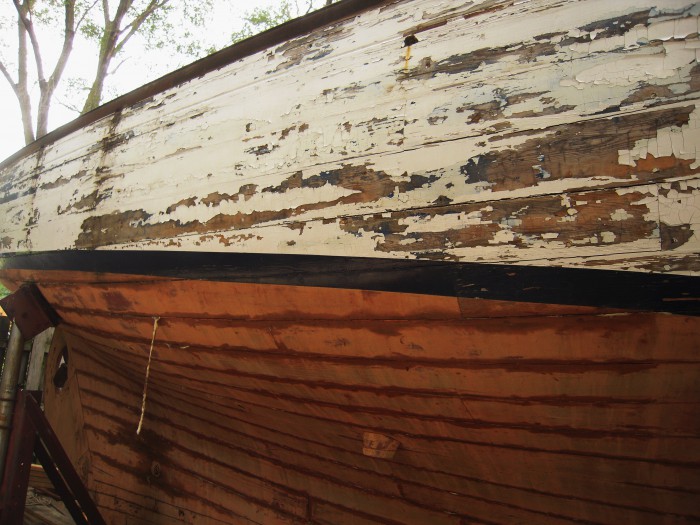
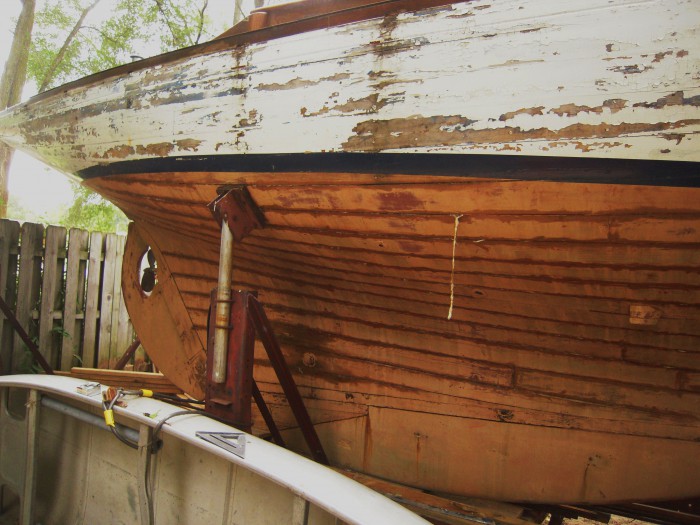
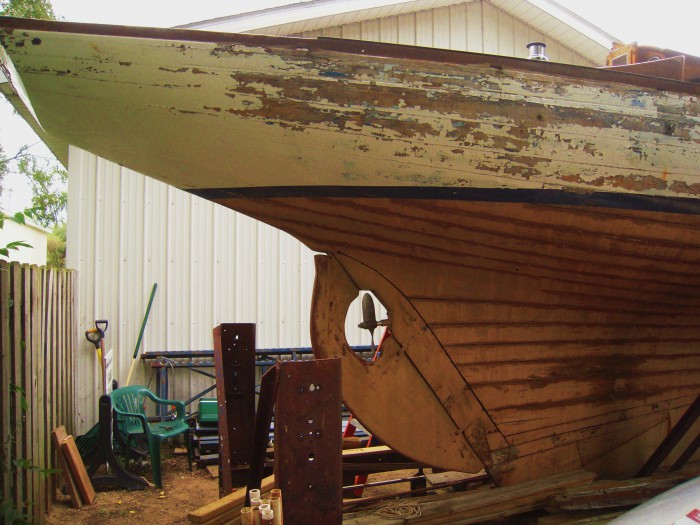
Yesterday, we passed a waypoint in the restoration project.  After 60 hours of scraping, sanding, and the cleaning of every single fastener hole on the port topside, I was able to apply a coat of tung oil and turpentine!  This was a process that took a lot longer than expected but we are pleased with the results.  The mixture, consisting of 50% tung oil and 50% turpentine, was heated to near boiling to facilitate its penetration into the thirsty yellow pine planking.  I could see it immediately expanding some of the surface cracks that had begun in the parts of the topside that had been without paint for an undetermined amount of time.  I worked this delightful smelling mixture into all the exposed fastener holes with a 3 inch chip brush.  You could see the hot oil and turpentine being sucked into the holes. It made all the time consuming work worth it.  There are certainly faster ways to strip the hull down and sand it but I would rather spend 2 or 3 or 4 times the amount of time to get it the way I wanted it and err on the side of safety.

The frames, which are basically the ribs of the skeleton, are laid out in a pattern of one very heavy white oak frame fastened with heavy galvanized nails and then two smaller frames fastened with copper rivets.   These smaller oak frames are steam bent and still fastened tight.   We will most likely add bronze screws to the heavy frames but that’s going to require some investigation of the existing nails.  For now, I’m guessing they have run their course in usefulness.  When white oak and steel get together, oak wins.  I removed the flat-head steel screws to the engine exhaust flange that was backed up with an oak block and there was barely any thread left.  The use of quality, hot dipped galvanized fasteners is a money saver and they served well for over 60 years but we’re going with silicon bronze.  The oil filling the fastener holes is a good thing.  It  expands the wood and seals it from the oxygen needed to create rot.

 The whole port topside consumed a little less than a half gallon of the tung oil/turpentine mixture.  The tung oil is 100% pure tung oil and costs about $70 dollars a gallon.  Tung oil cannot be allowed access to oxygen as this begins the curing process.  I poured off half the gallon of pure tung oil into a half gallon cider jug leaving no room for air and will save it for a later date.  That will keep for quite some time, as is.  I expected to use more of the 50/50 mixture but was happy to have used less, seeing we’re approaching $100 a gallon for this elixir, once the cost of the turpentine is factored in.  “Prepare for the worst, hope for the best.”  Last night, I had to scramble around for another half gallon container to put the rest of the 50/50 mixture in and came up with an empty half gallon bottle of Scotch in our recycling bin(now how did that happen?).   It was almost spot on one half gallon with a glass vitamin bottle to spare. Now I have to find some wood that needs treating today so as not to waste those precious fluids in the vitamin bottle.  That shouldn’t be difficult.   So, dear reader, I must be off and begin the next phase of the project which is to do the same thing to the forlorn  starboard side that now looks even more desperate compared to the freshly oiled port-side.  I will leave you with some pics of the progress.

Best Regards,

Roger

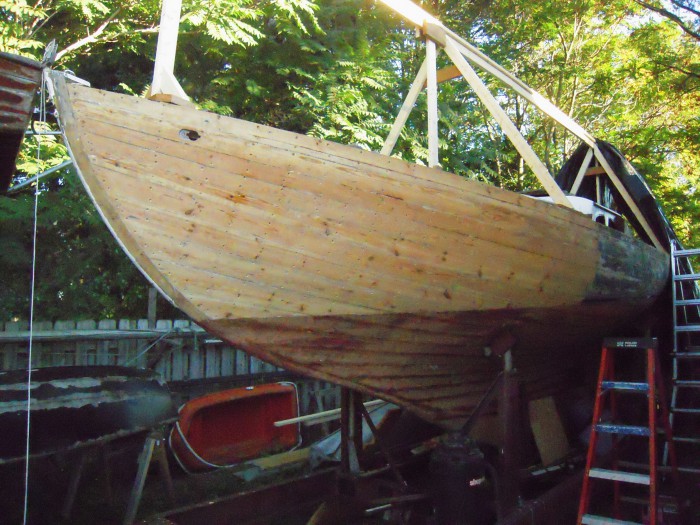
60 hours of scraping, sanding and oiling. Done!

60 hours of scraping, sanding and oiling. Done!

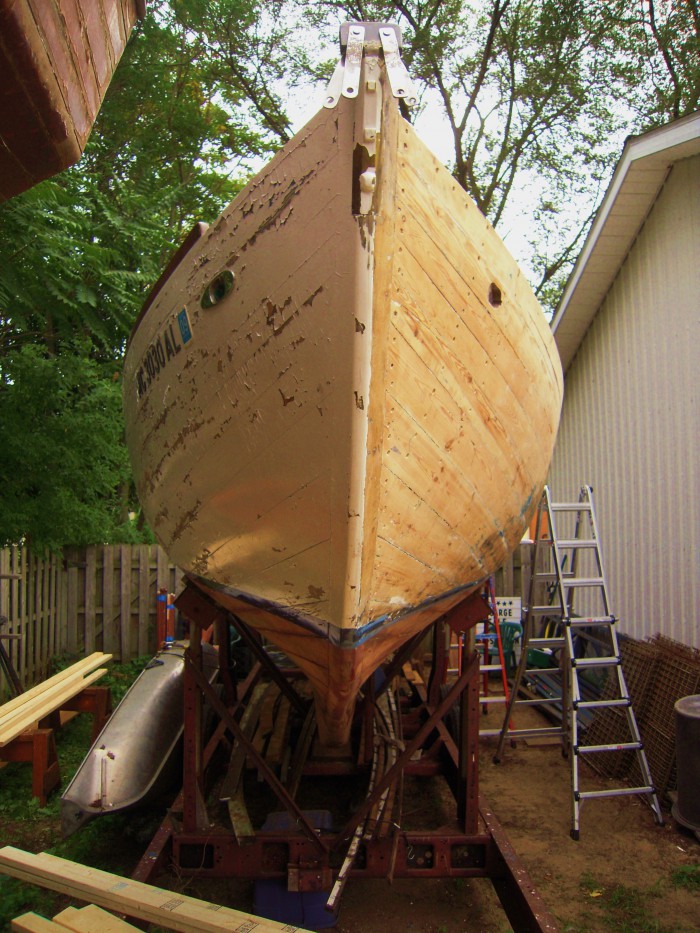
Reverie's lovely overhang. The one small plank is a former repair made of dissimilar wood and will most likely be replaced.

Reverie’s lovely overhang. The one small plank is a former repair made of dissimilar wood and will most likely be replaced.

Starboard topside looking forlorn and in need of help.

Starboard topside looking forlorn and in need of help.

Yikes!

Yikes!


2 Comments

Time Is of the Essence


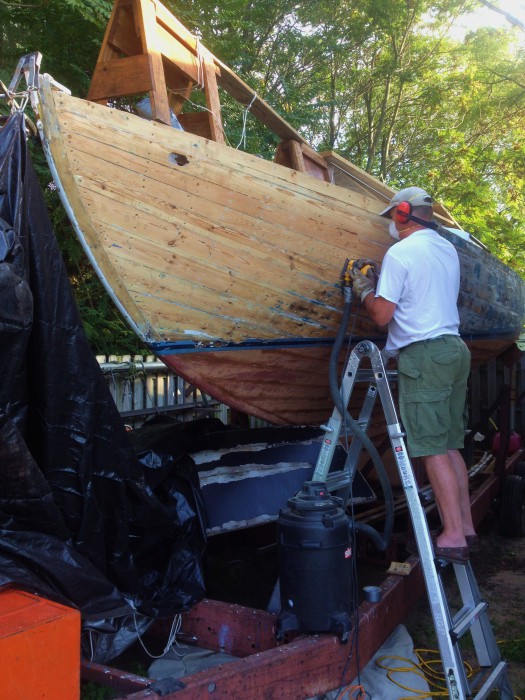
October is upon us and the race against the elements rages on.  My fit of optimism that predicted the scraping, sanding and oiling of the topsides was, of course just that: optimism.  In my dream world, it was going to take 20-25 hours per side to finish this project.  Now, my optimistic estimate is for each side to be completed in 50 hours per side.  Yes, it’s boat work and that’s how it goes.  The real time consumer has been cleaning out all the fastener holes.  They are filled with hardened putty and require a bit of concentrated heat to soften up then carefully dig out.   I want to get each one as clean as possible to facilitate the penetration of the 50/50 mixture of 100% pure tung oil and turpentine.  Any place there is exposed end grain needs to be soaked in this formula.  This mixture gets heated to near boiling and soaks into the wood quite well.

There are many hundreds of fastener holes and, depending on each ones depth, take a minute or so apiece to clean. The strength of a wooden boat lies in redundancy.  Many small fasteners and components are put together to effect the strength required to withstand the stresses incurred in a seaway.  The stress gets distributed across the greatest area possible and, voila,  you have a sturdy wooden boat.  You also have hundreds of fasteners that demand attention.  It only takes the failure of a few in a series to set off a chain reaction that could lead to catastrophe.

During this phase of paint scraping, I also had to determine the best way to preserve the waterline.  The waterline was already there so, to lose it then have to set up the procedure to draw a new waterline seemed to be the kind of redundancy we should like to avoid. Preserving the existing waterline is one of the reasons I chose to do the topsides first and address the hull below the waterline as a separate project; that, and the fact that the bottom paint has no bare spots and, therefore, is still protecting the wood.  It’s those bare spots on the topsides that initiated this phase of the restoration.

The waterline runs from the bow in a 3 inch strip and expands to 4 inches over the last few feet near the stern.  Easy enough.  I can mark where that begins and add that taper.  I was going to tape along the bottom of the waterline and work from that but the blue painters tape that was already there wasn’t holding up to the heat gun.  I chose to sharpen the scraper to a knife edge and work along the boot top (waterline)/bottom seam in an upward fashion so as to preserve the waterline.   You can see in the photo, where I have the waterline removed, that it worked well and there will be an accurate line to follow when it’s time to paint the new waterline.

As the sanding progresses, the hull is revealing itself in a very positive way.  It is nice to see the yellow pine exposed for the first time in over 60 years looking as if it had just been fastened.  It has withstood the test of time admirably and is a testament to it’s efficacy as a planking material.  I have a shop vac rigged up to the discharge of the sander and it is working quite well at keeping the dust down.  With this system, it is virtually dust free.  I’m still wearing a dust mask and ear protection but it is much more comfortable than the dreaded respirator.

We took a break from the topside project to begin construction of a better tarp frame.    With Winter coming on, the frame needed a steep pitch to deflect the incessant lake effect snows that dump on the shoreline of Lake Michigan. The frame will be reinforced with more rafters as the season progresses but, for now,  it’s enough to withstand the wind and rain. We had a makeshift setup last Winter and had quite a time getting the snow and ice dams off the deck.  This new structure will also serve as a beam to lift the cabin off the boat.  Julia is working on getting all the fasteners out of the cabin and cockpit (a whole lot of work in one small sentence).   Then, we will lift the cabin top off with a block & tackle and get it off the deck in order to have better access to the deck beam and carline repairs.  It will also make it easier to strip the inside of the coach roof and cabin sides as it can then be flipped upside down rather than us being showered by scraped varnish.

There is a bit of momentum and the only unknown factor is the weather.  If it all doesn’t get done before the snow flies, that’s the way it goes.  In the mean time, onward we plunge; led by an optimism that suggests a certain naivety while providing impetus to move along with this tedious, dirty job of stripping, sanding and oiling the topsides.

DSCN1228DSCN1229IMG_3002DSCN1232DSCN1227DSCN1224DSCN1223DSCN1222DSCN1220

Shakedown

1 Comment

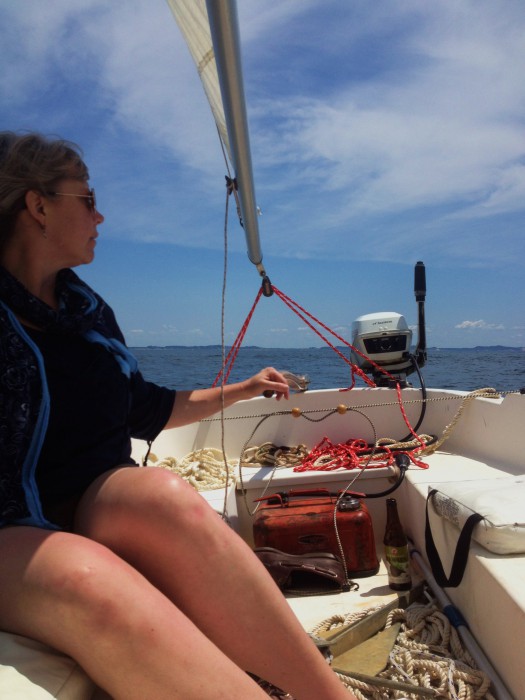
IMG_2602

Our “shakedown” sail aboard Prudence.


Work on Reverie slowed down in July as we took some much needed time to get out on Prudence, our “new” little Com-Pac 16.  July ended up being warm and humid.   At times, when we were working on Reverie, it was almost unbearable.  Luckily, we are in a fairly shaded area that gets decent breeze off Lake Michigan so we did accomplish a thing or two on Reverie.    All work and no play does indeed make Jack a dull boy and I was starting to feel my batteries were depleted.

We get kidded about the fact that we own multiple boats and that’s fine.  The reason for having Prudence is to maintain some connection with what’s truly important in our lives: Sailing.  The restoration work on Reverie is coming along nicely and my next post will get back to that but for now, a little sailing sure goes a long way in recharging those batteries.

By the time I was to pick up Prudence at her previous owner’s, all the ducks were in a row except for one small detail: we had not found a place to keep her. “No problem”, I thought.  “The storage place just down the road looks like it has a spot or two open.” Sorry, my friends, every storage facility within a 100 mile radius was full.   It seems everyone and his brother keep their boats in outdoor storage near the lake and, it being July,  we were a bit late on the take.  A trailerable sailboat is something new to me.  I’ve only dealt with travel lifts and cradles.  I imagined us driving around in this trailering limbo, parking on the streets, moving constantly, never welcomed, scorned by all.  It was starting to seem hopeless.

I was a bit occupied with all the details of getting the boat registered (my two Kafkaesque trips to the Secretary of State is a story itself), making sure the trailer was ok to drive across the state and such so Julia took over the search for a place to keep Prudence.  She got back to me with several updates: “Nothing to be had”and, “Nothing to be had”.  It seemed we had exhausted our options when I got a voicemail from Julia saying she called a marina right near the public launch on Lake Macatawa that leads to Lake Michigan.  We could park the boat anywhere out back and, as there were no power lines, could drive the boat- rig up, right to the launch.  Excellent!

Our eleventh hour reprieve seemed almost too good to be true.  Luckily, it wasn’t.  We leave the mast and boom up and have everything in totes which we bring every time.  It takes us about 15 minutes to be ready for launching.  The public launch at Lake Macatawa is a veritable hive of activity on weekends as hundreds of boats launch and retrieve. It’s 99% power boaters and jet skis at the launch.  It’s quite amusing to see their expressions as we drive out of the launch mast up and head on down the road.  Little do they know we’re less than 100 yards away.

I must say that Prudence sails like she looks, lovely.  She’s a lot of boat for a 16 footer and will keep us sane during the time it takes to get Reverie back in the water.   There are some things to be done on Prudence (don’t get me started on the main sheet) but she’s in sailing condition and that’s work for another time.

IMG_2700DSCN0998