
FALLING SNOW
The Winter of 2014/15 has been a strange one for us here in Southeast Lower Michigan. The month of November delivered bitter cold and record lake effect snow events along the windward shores of the Great Lakes. Lake Effect snow occurs when extremely cold air moves across the unfrozen Great Lakes. The moisture from the relatively warm lake is drawn into the frigid air creating snow that falls in bands when it hits the next land mass. The prevailing winds for this to occur are generally from the N, NNW and W.
December and January vacillated between exceptionally warmer temps and exceptionally frigid spells of Alberta Clippers and Polar Vortexes. There was little snow which made for lousy cross country skiing in our neck of the woods. After last years record snowfall, this Winter has been anticlimactic. The previous Winter was a once in a lifetime experience that allowed us to ski daily in near perfect conditions right in our own backyard.
Then, February arrived and let us know it was not messing around. 12 to 17 inches of snow fell across the entire lower portion of Michigan with most of the Midwest seeing significant amounts in that 24 hr period. It started in the wee hours of February 1 and ended the morning of the 2nd. The pendulum swung and we were in the grips of powerful Arctic air. Single digit Fahrenheit temperatures are not conducive to boat work but this is a huge project and progress must be made.

Post February 1-2nd snowstorm. It took us several hours to clear our driveway and pathways.
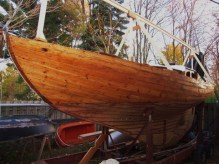
It was during one of those warmer spells (slightly above freezing) in early December when we went to take a look at this wooden sailboat, Reverie, stoically losing it’s battle with time. We are taking a Panglossian view of this Winter as it seems better for laying the foundations for the restoration of Reverie than it is for cross country skiing. Our ‘best of all possible worlds’ has provided corridors of time and windows of opportunity allowing us to get things done. To date, we have over 90 hours of labor invested in Reverie. That doesn’t count travel time to and from the boat. We’ve made the best use of this down time and have accomplished what we could. The boat is in Holland, Michigan, a 2-1/2 hr drive from our home in Southeastern Michigan so any off site work that can be done is crucial to a timely restoration.
POLISHING BRASS
On one of our visits to the boat, we removed the brass lamps, the ship’s bell and the original Airguide barometer and clock. Everything was badly in need of some elbow grease. I ripped up an old bed sheet into 1 foot squares and got cracking.
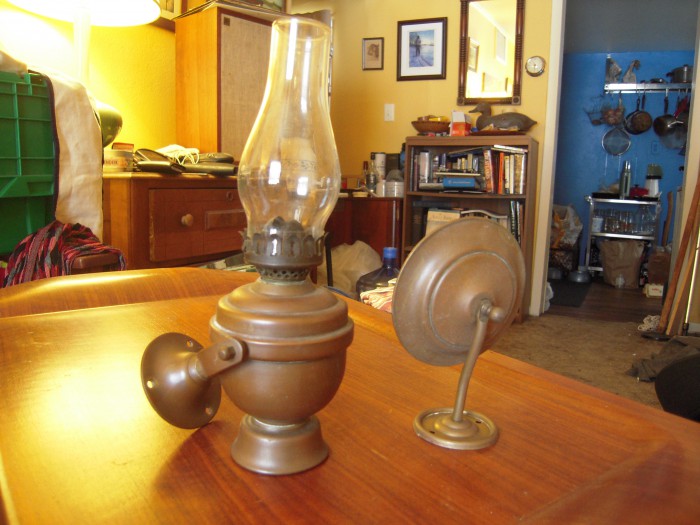
Perko Lamp: The Perko needs a new burner as the tabs have broken off, so I’m keeping my ear to the eBay door & scanning thrift shops for a replacements. It needs a P&A Hornet burner.
.

Nice old lamp that reads, “English Made 3/4″ wick” on the burner.
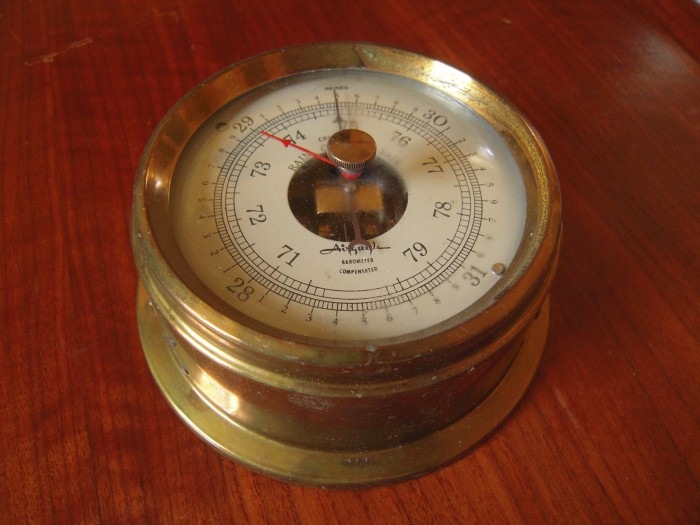
Airguide Barometer

Airguide Clock before cleaning
The Airguide clock is pretty neat. It cleaned up really well. It has a German movement that operates on a C battery and allows exact time adjustment. I’ve got it set to within a few seconds error a day and am slowly tweaking it to exact time.
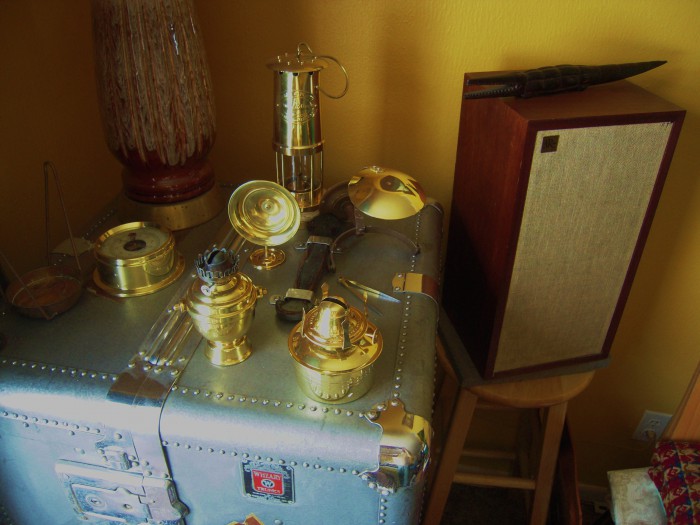
Everything polished up quite nicely and after 50 plus hours of polishing, we have this. Julia picked up a bottle of Wright’s Brass Polish and I was excited to give it a try. Over the years, I’ve tried many brands of polish and wasn’t terribly impressed by some of the brands that claim to be “the best”. Wright’s works the best, hands down. It doesn’t require a lot of pressure to work. With other polishes, I would have to stop after a few hours because my fingers were getting sore from applying pressure. With Wright’s it is a good idea to let the polish sit on the metal for a short time before beginning to polish to allow the chemical reaction to start. Speaking of chemical reactions, it was easy on my hands and washed off very easily with water.
I was very happy to get this tedious chore out of the way during the Winter. It’s one of those things I “don’t have time for” during the warmer months when one’s time is better spent outdoors. The only other time I might feel like doing this is while cruising . You’re on the boat anyway and there’s only so much napping and reading to do in the off-watch time. Hours and hours of polishing is not a bad way to go.
These lamps had a coating of grunge on them as well so they were especially nasty to clean. I find that polishing brass is rather cathartic and the results are amazing. Once polished, these old relics became wonderful works of art that would be hard to distinguish from new if it weren’t for the various dents that come with years of use. The real trick with brass is to maintain it. You have to keep up on it and not let any deep dark spots develop. I don’t expect the next round of polishing to take nearly as long.
“A rub in time saves nine”?
Cheers,
Roger
 Restoring Reverie