
We are well into November and the weather has been good to Reverie’s restoration project. The leaves were late to turn this year due to a warm Fall but they have now fallen rapidly and carpet the earth in all shades of red, yellow and brown. Still, the mild weather persists. The birds aren’t quite so convinced of an eternal Autumn. They know what’s about to happen and are acting accordingly. We saw our first dark eyed junco the other day while working on Reverie; a sure sign of the change in seasons. The shoreline of the Great Lakes is, well, a great place to watch migrating birds. We were even lucky enough to see 4 endangered whooping cranes the other day on a back road drive from Holland to Grand Rapids. Their size is impressive.
On a somber note, today is the 40th anniversary of the sinking of the Great Lakes freighter, Edmund Fitzgerald. It vanished without a trace in a massive storm on Lake Superior and has since been found lying at the bottom of the lake broken in half by the mighty waves. http://www.shipwreckmuseum.com/the-fateful-journey-62/
102 years ago, the Great Lakes Storm of 1913 sank 19 ships with over 250 lives lost on the open waters of these inland seas. http://www.nws.noaa.gov/com/weatherreadynation/news/131107_white.html#.VkH8LdKrTwc
Today, is nothing like those days. It is calm and mild and I’m going off to work on Reverie for a while thankful for this weather as I solemnly recall those who lost their lives on the Great Lakes.
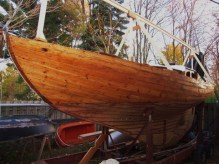
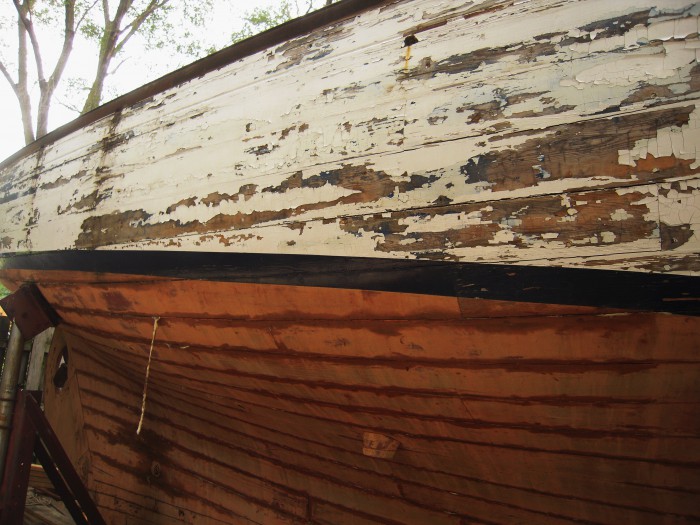
Yesterday, we passed a waypoint in the restoration project. After 60 hours of scraping, sanding, and the cleaning of every single fastener hole on the port topside, I was able to apply a coat of tung oil and turpentine! This was a process that took a lot longer than expected but we are pleased with the results. The mixture, consisting of 50% tung oil and 50% turpentine, was heated to near boiling to facilitate its penetration into the thirsty yellow pine planking. I could see it immediately expanding some of the surface cracks that had begun in the parts of the topside that had been without paint for an undetermined amount of time. I worked this delightful smelling mixture into all the exposed fastener holes with a 3 inch chip brush. You could see the hot oil and turpentine being sucked into the holes. It made all the time consuming work worth it. There are certainly faster ways to strip the hull down and sand it but I would rather spend 2 or 3 or 4 times the amount of time to get it the way I wanted it and err on the side of safety.
The frames, which are basically the ribs of the skeleton, are laid out in a pattern of one very heavy white oak frame fastened with heavy galvanized nails and then two smaller frames fastened with copper rivets. These smaller oak frames are steam bent and still fastened tight. We will most likely add bronze screws to the heavy frames but that’s going to require some investigation of the existing nails. For now, I’m guessing they have run their course in usefulness. When white oak and steel get together, oak wins. I removed the flat-head steel screws to the engine exhaust flange that was backed up with an oak block and there was barely any thread left. The use of quality, hot dipped galvanized fasteners is a money saver and they served well for over 60 years but we’re going with silicon bronze. The oil filling the fastener holes is a good thing. It expands the wood and seals it from the oxygen needed to create rot.
The whole port topside consumed a little less than a half gallon of the tung oil/turpentine mixture. The tung oil is 100% pure tung oil and costs about $70 dollars a gallon. Tung oil cannot be allowed access to oxygen as this begins the curing process. I poured off half the gallon of pure tung oil into a half gallon cider jug leaving no room for air and will save it for a later date. That will keep for quite some time, as is. I expected to use more of the 50/50 mixture but was happy to have used less, seeing we’re approaching $100 a gallon for this elixir, once the cost of the turpentine is factored in. “Prepare for the worst, hope for the best.” Last night, I had to scramble around for another half gallon container to put the rest of the 50/50 mixture in and came up with an empty half gallon bottle of Scotch in our recycling bin(now how did that happen?). It was almost spot on one half gallon with a glass vitamin bottle to spare. Now I have to find some wood that needs treating today so as not to waste those precious fluids in the vitamin bottle. That shouldn’t be difficult. So, dear reader, I must be off and begin the next phase of the project which is to do the same thing to the forlorn starboard side that now looks even more desperate compared to the freshly oiled port-side. I will leave you with some pics of the progress.
Best Regards,
Roger

60 hours of scraping, sanding and oiling. Done!

Reverie’s lovely overhang. The one small plank is a former repair made of dissimilar wood and will most likely be replaced.

Starboard topside looking forlorn and in need of help.
Yikes!
 Restoring Reverie