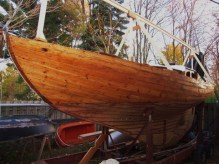


March has arrived like a lion and we have entered meteorological spring! While the Great Lakes saw some unusually springlike weather in February, we are now back to a decidedly wintertime feel. Michigan is known for it’s changing weather but this spate of fluctuating, roller coaster mayhem leaves us scratching our heads. It has been a season of extremes.
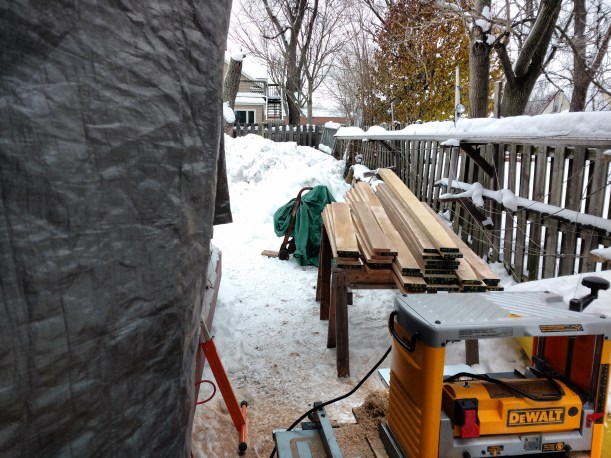
The gales of November and December gave us a run for our money and were a major factor in how to proceed with boat work. Accompanying those relentless gales were lake effect snow showers that dumped on us for days. Swirling ice pellets burned my cheeks in the hours it took to shovel out around Reverie to create some semblance of a work area.
Intersperse the death grip of Old Man Winter with unseasonably warm spells of total melt and torrential rain and you had a muddy mess of a work area. Take this cycle, repeat several times and you have our winter, in a nutshell. On a positive note, the warmer end of the cycle allowed me to clamber about the sheltered boat judiciously applying duct tape to Reverie’s tarp which survived another season.
Whenever it’s been too nasty to work outside (quite often), the indoor work has taken up the slack and kept us busy. Capricious weather aside, winter projects have proceeded at a good pace with some long overlooked tasks checked off the list. Work on Reverie is proceeding and there is much to tell but I must first get something on the table in order to move along.
∼
How and why we took on this restoration project is a bit cloudy now that we are several years along. It happened and it is happening. There are distinct moments when things align and click; moments when you have to make a decision and act or that decision will be made for you. I suppose it’s all sequences and ratios but it’s also somewhat poetic.
As difficult as it can be sometimes, it has been important to focus on the tasks at hand. We didn’t know exactly where this restoration would take us, but we knew it would be interesting. When the portal of opportunity began to open, it revealed the unexpected and unexplained. Things went from weird to wyrd. We’re just along for the ride.
“The greatest loss of time is delay and expectation, which depend upon the future. We let go the present, which we have in our power, and look forward to that which depends upon chance, and so relinquish a certainty for an uncertainty.”
– Lucius Annaeus Seneca
Once we began work on Reverie and accepted the task at hand, other boats began to appear in our periphery. It seems that looking at boats begets looking at even more boats. One was sitting in Douglas, Michigan at a marina along the Blue Star Highway.
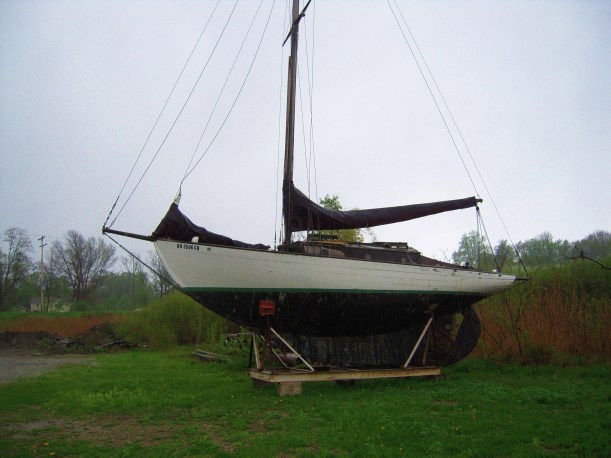
It’s too late for this little cutter.
We drove by, one rainy day in April and saw this lone, lorn cutter isolated from the rest of the yard, rigging and sails still on; water from the downpour was gushing from her tired seams. We got out and looked her over. She was in worse shape than Reverie and certainly an uphill battle to get back into sailing condition.
There in the deluge, I saw a much younger man with needs and desires that have trailed off like bubbles swirling in a rudder’s wake. I could see myself singlehanding this fine little cutter that measured somewhere around 28′ without the bowsprit and boomkin. Even in her sorry condition, she exuded youth. She was a young person’s boat. She was a nimble courser waiting under rot and peeling paint to once again prove her worth.
She would have been ideal for the younger, single me. In days of yore, I would have been a happy otter content to recline and read books in a cozy bunk in some quiet, out of the way anchorage. I would drink rum and wine and eat heartily only to weigh anchor on the next misty dawn setting sail for somewhere new. She would take me to where I am now but I got here some other way.
For some reason, every boat I come in contact with is a bit wanting for cabin space. Maybe, it’s through rationalization that I’ve prescribed to the Uffa Fox suggestion that, “if you want to stand up, go on deck”. Maybe, it’s because most people shop for boats by how much space and amenities are below deck and all these boats are throwaways.
I felt the “been there, done that” effect. As seaworthy as her lines appeared, there simply was not enough of this little cutter for the two of us, a parrot and a dog to exist comfortably for any length of time. I’m about 6’3″ and Julia’s close to 6′ so, we need a bit more elbow room. Then, there was the nagging fact that we were already restoring our own wooden boat.
Regardless, I called the marina and talked to the son, who is the yacht broker there. He seemed politely surprised that I was showing an interest in such a derelict boat. He said it was yard owned and gave the go ahead to climb aboard and have a better look.
Several days after that, the rain subsided. Julia and I took a ladder and had a look inside. It was a sad sight, indeed! It looked as if someone had walked away from the boat and never came back. It was an overturned mess and felt desecrated like a sacked tomb. Ports were smashed out, a dorade box was completely missing, the canvas deck and coachroof were completely shot. This and more was allowing mother nature full access to the interior but still, there seemed a glimmer of hope. This boat could have been restored.

What a mess.
Nevertheless, I called the marina back and talked to the son letting him know how desperate I thought the situation was. We talked about price and I told him it was only fair they get something for it but that in essence, it was a “free boat”. He switched from amicable, to petulant, to contentious as I described what I thought. All of the sudden, “the cradle was not included”, “there was a fortune in bronze hardware” (most of it was actually old school galvanized iron and steel), etc… . I ended the conversation as politely as I could and left it at that. About six months later, I heard the boat had been scrapped.
I thought there was more I could have done and I still believe that to be true. I was so caught up in our own project, it would have been detrimental to the overall outcome to start taking on derelict, orphan boats with no place to store them. Then, there was the Anne Gail.
Anne Gail was a beautiful yawl (or ketch) we found in a yard in South Haven. Whenever we were in town, we would take a drive through the section of the marina yard where all the lost causes are kept to admire her fine lines and, there, was another dream.
Anne Gail was actually of the size and design that would have been perfect for Julia and I to sail and cruise in comfort. Certainly not roomy by today’s standards but functional. Like Reverie and other designs of that era, she had a narrow beam and deep keel. She looked seaworthy. I did some searching of the name and found reference to her and that she had been sailed over from Ireland some time in the 50’s or early 60’s.
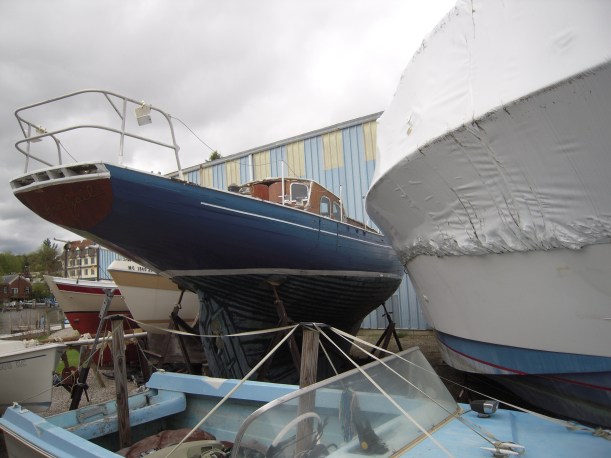
She was a gorgeous boat and needed considerable work, as well. Immediately, it was clear she needed a new stem. Someone had halfheartedly begun work on her and given up. From the outside, she looked like a project but not beyond the realm of possibility. For over a year, we would drive by to check up on her until one day, we found her in a most horrible state.
Julia and I were dumbstruck to see that this fine boat was in the process of being cut up and thrown into a dumpster. What a horrible fate. Looking at the cut up pieces, I saw nothing that showed she deserved this end. There was simply nobody interested in saving her. Or, was there? That’s the nagging question I keep asking myself as I come to terms with the loss of these relics from the past.

The sad fate of Anne Gail as we found her, one November day.
Both those boats could have been saved. Both those boats are gone. I know it wasn’t us that would have been able to restore them because of our own commitment to Reverie. Still, I look back and think I could have have done more. I could have posted their plight online and attracted somebody with the desire to save them. Why didn’t someone closer to the situation do that?
There’s a part of me that has to move past these losses and I have resolved to make any further discoveries such as these public. I will make sure to spread the word and make as many people aware of the impending fate of any more boats we might encounter in our journeys. I won’t be lulled into the belief that every one else is admiring the fine lines and hidden potential; that everyone else is interested. That is how old boats die.
The loss of these boats seems to me to be a loss for us all. Their beauty will no longer grace the waters where they had surely turned many a head in their day. In 2017, where slip after slip is filled with boats that were mass-produced by the thousands, it’s hard to imagine that that boat may be the only one of its kind in existence. For now, I can only focus on the restoration of our good ship, Reverie, and make sure she doesn’t come to the same end; at least, not in my lifetime!
“It is, unfortunately, only too clear that if the individual is not truly regenerated in spirit, society cannot be either, for society is the sum total of individuals in need of redemption.” -C.G. Jung, The Undiscovered Self
 Restoring Reverie