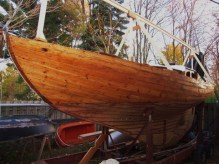

Winter is here! That means different things to different people. For us, here at Camp Reverie, it’s a busy time accentuated by the lengthening of each day. Today, we have sunset 9 minutes later than on the Dec. 21 solstice. That means we’re packing up just a little bit later every day and getting more done with each passing week.
Winter has always been the time for boat work. It was a time to take care of some of the large projects while the boat is out of the water and sailing is not a distraction. Endless projects pile up during the warmer months that need to be addressed in the off-season. Projects, projects, projects; we sailors love our projects.
One of the reasons I look forward to winter is the fact that I can get outside and perform some of the heavy labor without heat and humidity getting in the way. In the winter, you can always take off a layer if you’re too hot. I haven’t been cold once this season. Keep it moving.
Thankfully, we were able to take care of everything that needed to get done before the snow flew and have a formidable list to knock out before spring. Getting under the weather wire on the topsides project felt like a real victory as it left a clearer path to getting some other projects finished by spring. There’s no hibernation going on here at Camp Reverie. Well, maybe a little.
We can now get back to the removal of the deck and deck framing along with new sheer clamps and shelf, for good measure. Instead of hiding out from 90° F and 90% humidity, it’s lake effect rain showers, lake effect snow showers and blistering cold winter gales. I have had to shovel out a work area multiple times already and expect it to happen repeatedly over the winter. Holland is in the Lake Michigan snow belt so we are no strangers to a stray flake or two.
One of this winter’s first projects was to measure out the deck framing and sheer clamps to get a materials requirement for the new deck framing, sheer clamps and shelf. I did that on a day when the wind was gusting up to 60 mph which shook and rattled poor Reverie. It felt a bit surreal as I measured in the darkness with the aid of a shop light illuminating a small ring wherever I moved it. With her interior removed, Reverie picks up vibrations from without and sounds sympathetic tones much like a stringed instrument. On a good day, it’s pleasant and interesting. In a gale, it’s a bit unsettling.
When the weather allows, I’ve been outside running rough lumber through the planer. Last year, I picked up a nice 2″x 8″ x 12′ piece of white oak from Armstrong Millworks in Highland, Michigan. In late November, I paid a visit to L.L Johnson Lumber, in Charlotte, Michigan, where I picked out some nice 5/4″ x 12″ x 14′ southern yellow pine and some nice yellow birch for a furniture project. The yellow pine will be used to replace the bad planks and , possibly, for the sheer clamps. Add to the mix about 100 board feet of rough red oak that was just sitting around and you have some work on your hands.
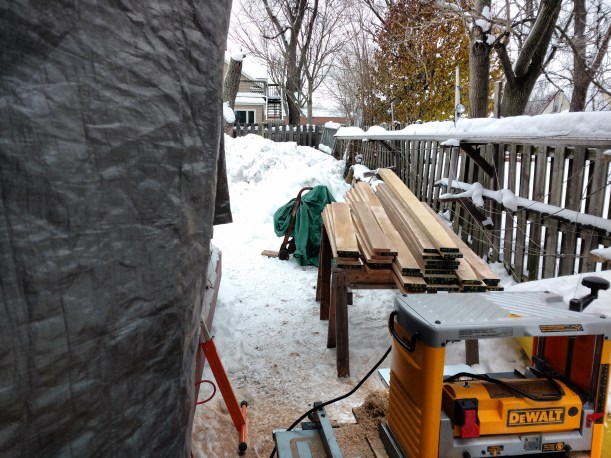
There was 100 board feet of red oak and 50 board feet of yellow birch on top of the boat wood. No sense just moving it. Let’s make it useful.
As soon as all the wood is processed, we can resume deck removal. When I was on board measuring deck beams, I had a chance to look over the construction of the deck framing and do not think the original builder of the hull and the builder of the deck/ interior are the same. The hull is sturdy and overbuilt. I am impressed by how well it has held together. The heavy frames with intermittent steam-bent frames is reminiscent of old work boat construction.
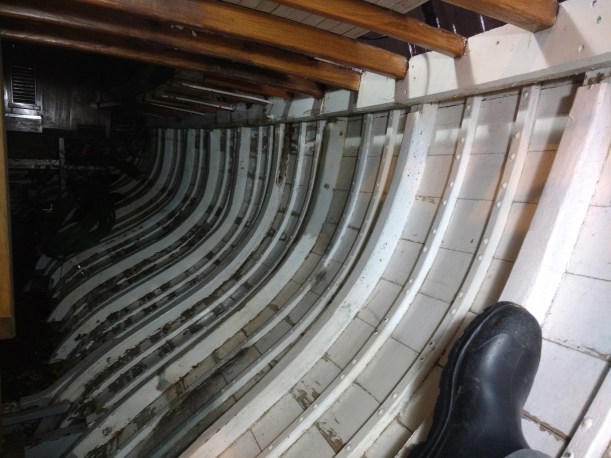
Sturdy hull with lightly built deck framing and sheer clamp. Part of the mystery.
Conversely, the interior and deck-beam construction leave something to be desired, in the way of craftsmanship. The deck framing and interior won’t be copied from what was found. Both the deck and the interior will be rebuilt as sturdily as the hull. Instead of ash for the deck beams, there will be white oak. The sheer clamp will either be of white oak or yellow pine with a shelf added to the sheer. More on that once the deck framing commences.
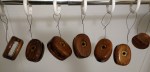
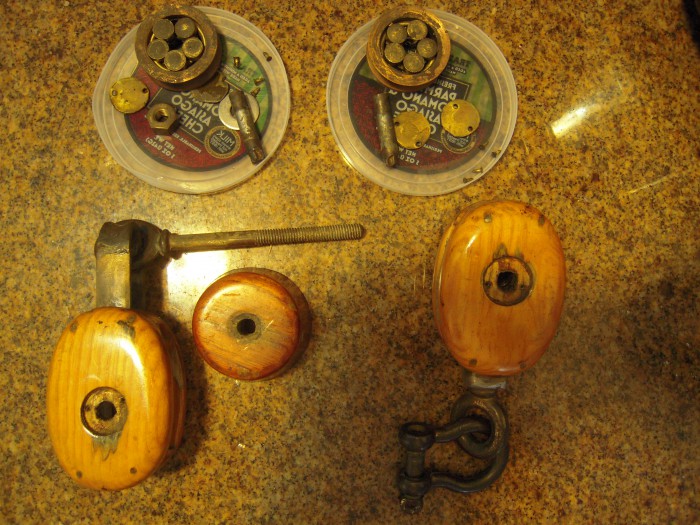
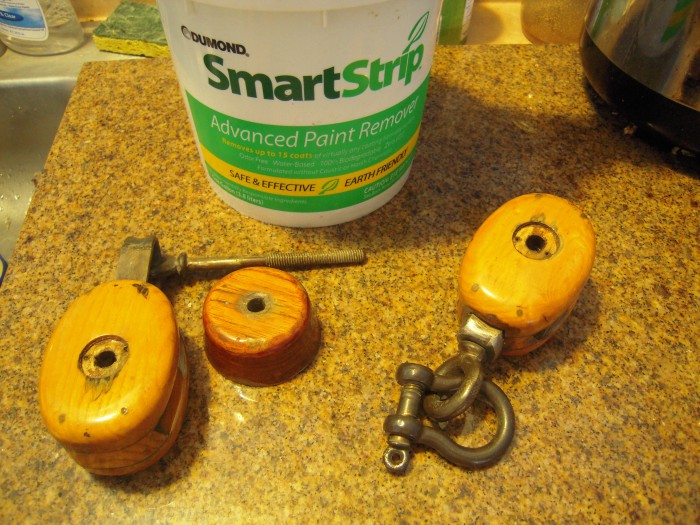
Winter shall proceed as such: it’s outside whenever possible and lots to do inside when being inside’s a good thing. Our front bathroom has become the varnish booth. The fan works great for exhaust and we haven’t had any issues with fumes while I varnish up Reverie’s wooden blocks.
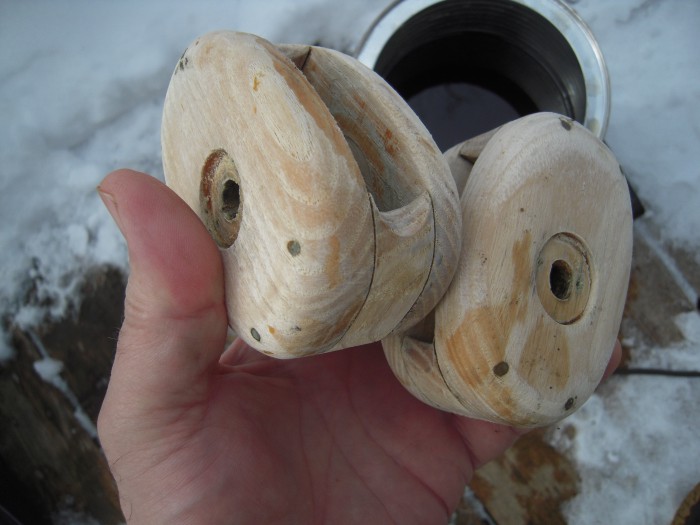
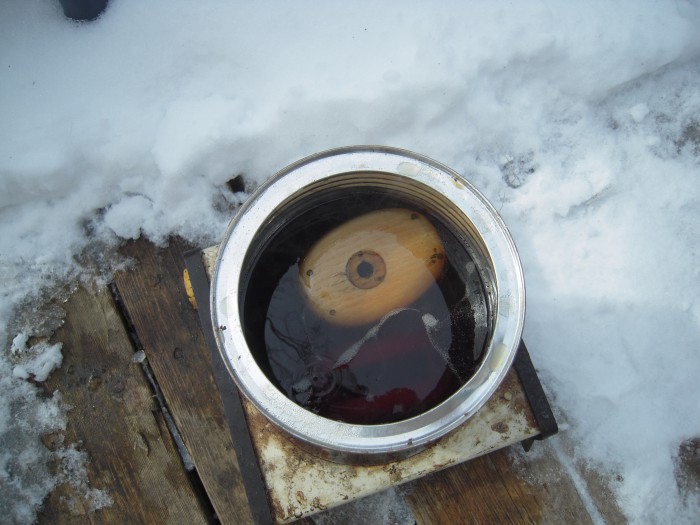
Stripping down the blocks and soaking them in hot oil was one of the first projects we did when we got the boat. The oil had over a year to dry so I gave them a sanding and have been dipping them in a can of spar varnish diluted with about 30% turpentine. As I write, they have 5 coats on them. They will get their sixth and final coat tomorrow and reassembled shortly after that. All said and done, there will be close to 40 hours devoted to the block restoration project alone.
“O God! methinks it were a happy life,
To be no better than a homely swain;
To sit upon a hill, as I do now,
To carve out dials quaintly, point by point,
Thereby to see the minutes how they run,
How many make the hour full complete;
How many hours bring about the day;
How many days will finish up the year;
How many years a mortal man may live.”
~William Shakespeare – King Henry Vl
Along with the varnishing, there is always a bit more organizing and sorting of everything from boat hardware, to tools, to wood, to lp records, to books and to all the other things that get piled around and in the way. We are removing the clutter and making a streamlined restoration machine. I will leave you with a shot of some fine, vintage power tools that got new cords and cleaning as part of the indoor winter work.
Happy 2017 from Julia and Roger! Thanks for following our project.
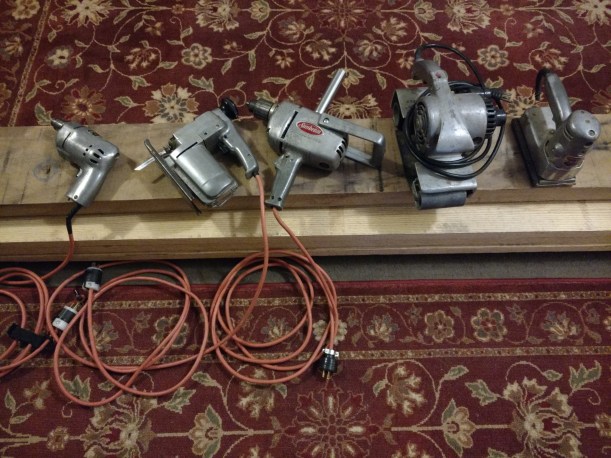
Tools that are as old as Reverie! Quality never goes out of style.

 Restoring Reverie