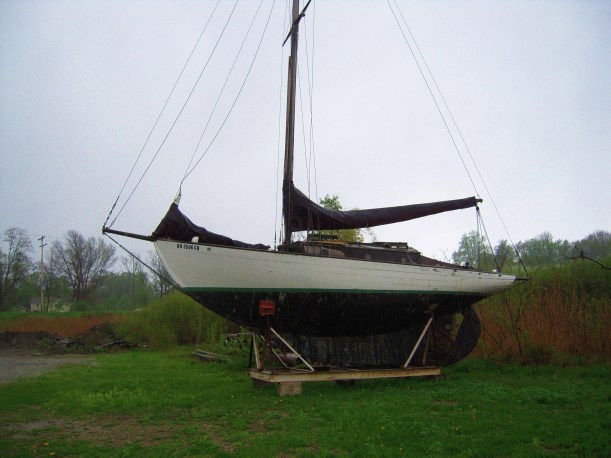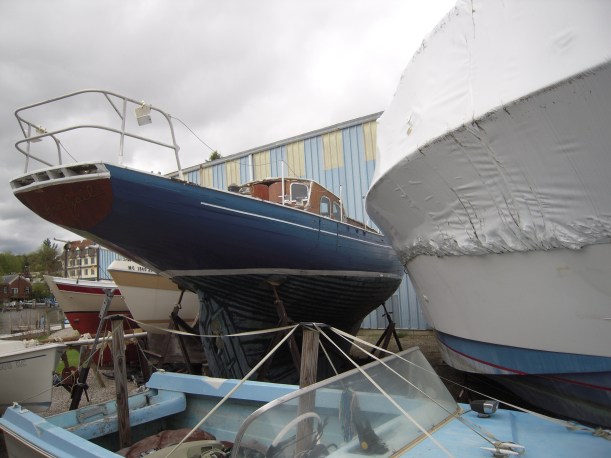
Restoring Reverie

: The Art of Restoring & Sailing a Classic Wooden Sailboat


Leave a comment

Getting A Handle On Things

This spring, icy rain and violent winds kept me inside for many a day, here along the shore of Lake Michigan; rain, cold, sporadic clearing, repeat.    What’s important is the sporadic clearing.  There were some decent days, here and there. In those fleeting times, I jumped at the opportunity to get out for a good day of work on Reverie.  After a winter of ferocious gales it became a “beggars can’t be choosers” situation. I found myself going out in weather that was less than ideal but, conversely, less than tempestuous.

It’s like being out on an extended cruise; you realize you’ll never get anywhere if you wait for ideal conditions and, sooner or later, find yourself sailing in weather you never would have imagined. This cool, wet weather was great for tulips, though, and we’ve been enjoying a wonderful display of colors provided by the city of Holland making the Tulip Time Festival a spectacular one.

The time I managed to get some boat work in was quality time.  I was a relentless force of deconstruction.  The multi tool and sawzall got put through their paces and the deck is now completely removed with half the cabin top removed, as well. The hands on work aboard Reverie has taken a leap forward but new challenges revealed themselves during the dismantling. That, dear reader, is for the next blog entry.  This entry is about getting a handle on things and that we did.
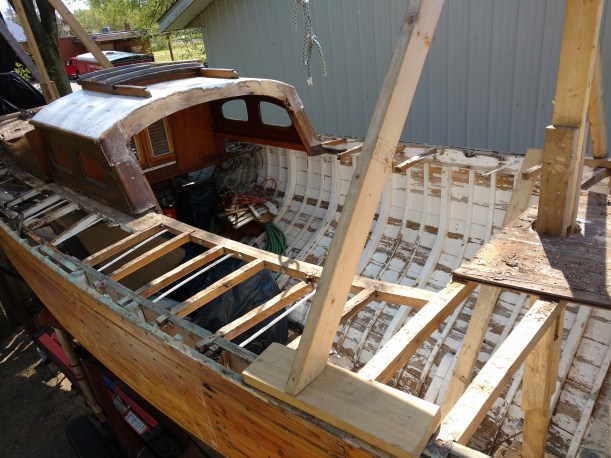
IMG_20170515_154638578

One of this past winter/spring projects was to get all the tools tuned up and ready for use. Over the years, more than  a few tools have arrived at “Roger’s Home For Wayward Tools” that were missing their handles or lacking in some other respect. They needed a little help to get them in working order.

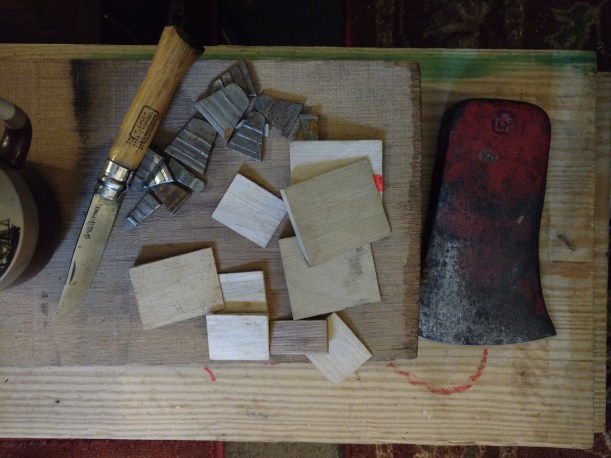
There was that 1-1/2 lb. ball-peen hammer we would need for riveting the frames.  There was that handsome Dayton pattern ax that had had its head secured with several large, hex head machine screws hammered over like clench nails; its handle also needed stripping and sanding (with the added benefit of erasing the name of the former owner proudly scrawled in bold, black marker).  There was also a hewing ax that was missing its handle but would soon be put to service.  It was time to get a handle on things.
IMG_20170318_101322238

Picking out the right wedge for the Council Tools Dayton pattern ax that needed its handle reset.

IMG_20170425_094457493

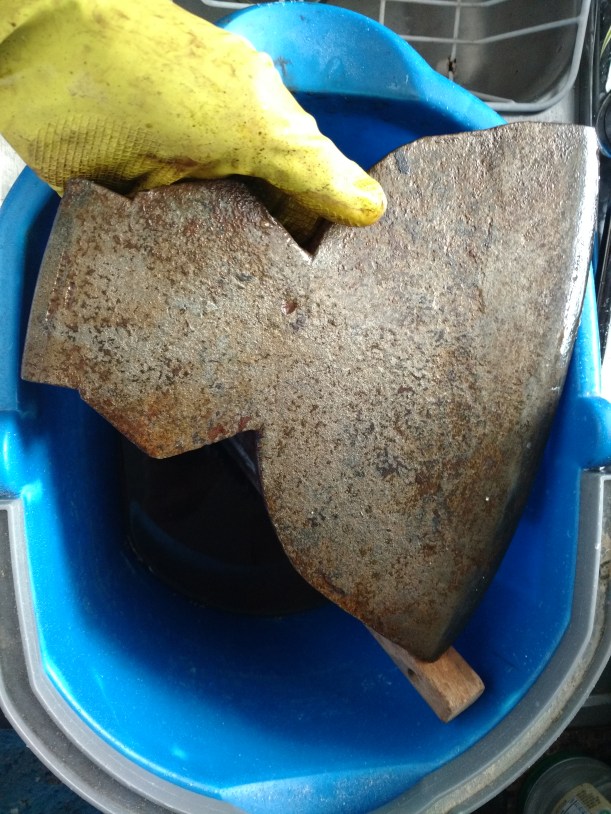
A fine old hewing ax head getting a soak in vinegar and salt to remove the century of rust that hid its true personality.
IMG_20170427_080506247

A finishing soak in baking soda and water to neutralize the acid and salt bath.  The blade still had a very sharp edge for being knocked about so many years.  Hand hammered forge marks and the folded cutting edge are apparent. “And what, pray tell, do you need a hewing ax for?”, you ask.  More on why we need a hewing ax in the next post.  Stay tuned.


Almost all of my chisels were in need of having their handles reset and some quality time on the Japanese waterstones.  Many of the blades needed to be hollow ground and lapped.  Hollow grinding is where you take the beveled side of the blade and run it over a grindstone to remove the middle of the bevel. This means less of the blade touches the honing surface.  Lapping is the process of making the flat side of the chisel completely flat.  This may not seem important but, avoid this process at your own peril; it’s an absolute necessity.

Most notable among the arsenal of chisels was the 2 inch wide timber slick.  A slick is a large chisel used where a substantial amount of wood needs to be worked such as in timber framing or working on the backbone of a wooden boat. For years, I used it occasionally but now am finding it necessary to use for some serious work ahead.  It had a broken old handle that I had reshaped and used awkwardly so I never really got to use it to its true potential.  Getting a handle on this beast is going to make less work in the long run and justify all the work I put into shaping a new handle.
IMG_20170320_153654919

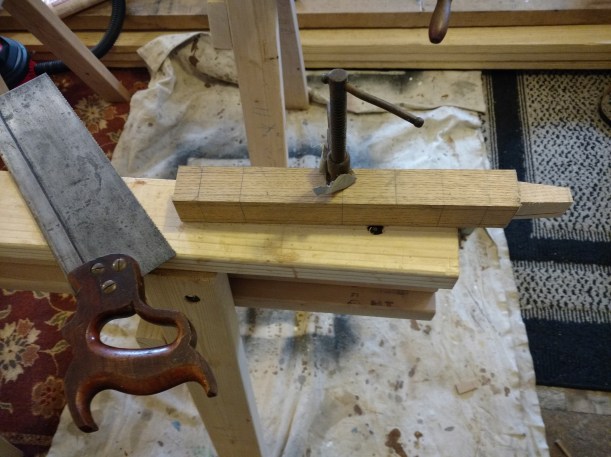
Here’s the white oak blank for the chisel handle with the tang fitting cut out using a fine-tooth Disston backsaw. The backsaw was sold by the T.B. Rayl Co. which sold tools in downtown Detroit.
IMG_20170321_095236192

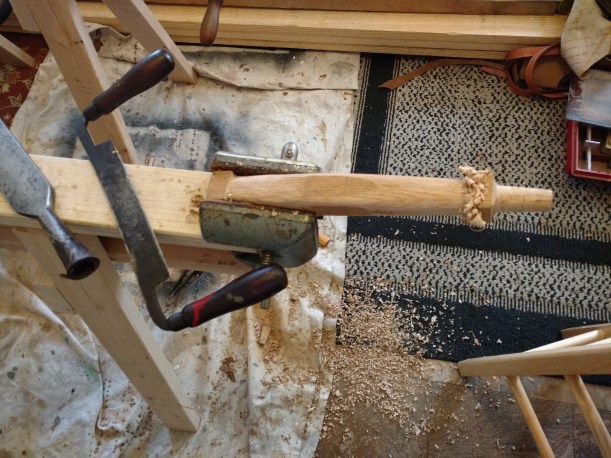
The handle taking shape thanks to the razor sharp draw knife made by the Ohio Tool Co.  It’s one of my favorite tools.  I’ve left the splatter of red paint on the handle to remind me of the trip to the emergency room that would be required if it were grabbed by the blade.  .
IMG_20170322_102503664 (2)

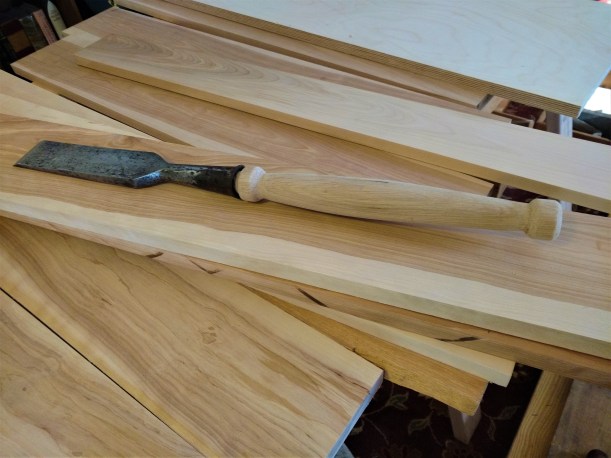
The handle getting its first fitting on the slick.  Pencil lines on the handle are preserved to keep things uniform right until it’s finished. Being able to use this tool two-handed is imperative.  The worldly slick, with its handle, is 23-1/2 inches long.

It feels good to get some of these old tools back in working order and on to a life of continued use.  Quite often, preparation is the most time consuming aspect of any job.  Having all your ducks in a row may seem tedious and even unnecessary when they seem to hardly relate to the task at hand but prepare, we must.

Having usable axes and hammers with sturdy handles along with sharp chisels that cut fine, paper thin slices of wood is truly worth the effort because they save time and are safer to use than tools that are just “good enough”.  Sometimes, only the best will do.  I’m happy to have this out of the way and on to more boat work.  There’s no need to shake one’s fist at the weather when it’s not agreeable.  There’s always something to do.


Leave a comment

On the Death of Old Boats

March has arrived like a lion and we have entered meteorological spring!  While the Great Lakes saw some unusually springlike weather in February, we are now back to a decidedly wintertime feel. Michigan is known for it’s  changing weather but this spate of fluctuating, roller coaster mayhem leaves us scratching our heads.  It has been a season of extremes.

The gales of November and December gave us a run for our money and were a major factor in how to proceed with boat work.  Accompanying those relentless gales were lake effect snow showers that dumped on us for days.  Swirling ice pellets burned my cheeks in the hours it took to shovel out around Reverie to create some semblance of a work area.

Intersperse the death grip of Old Man Winter with unseasonably warm spells of total melt and torrential rain and you had a muddy mess of a work area. Take this cycle, repeat several times and you have our winter, in a nutshell. On a positive note, the warmer end of the cycle allowed me to clamber about the sheltered boat judiciously applying duct tape to Reverie’s tarp which survived another season.

Whenever it’s been too nasty to work outside (quite often), the indoor work has taken up the slack and kept us busy.  Capricious weather aside, winter projects have proceeded at a good pace with some long overlooked tasks checked off the list. Work on Reverie is proceeding and there is much to tell but I must first get something on the table in order to move along.


How and why we took on this restoration project is a bit cloudy now that we are several years along.  It happened and it is happening.  There are distinct moments  when things align and click; moments when you have to make a decision and act or that decision will be made for you. I suppose it’s all sequences and ratios but it’s also somewhat poetic.

As difficult as it can be sometimes, it has been important to focus on the tasks at hand.  We didn’t know exactly where this restoration would take us, but we knew it would be interesting.   When the portal of opportunity  began to open, it revealed the unexpected and unexplained. Things went from weird to wyrd.  We’re just along for the ride.

“The greatest loss of time is delay and expectation, which depend upon the future. We let go the present, which we have in our power, and look forward to that which depends upon chance, and so relinquish a certainty for an uncertainty.”

–  Lucius Annaeus Seneca

Once we began work on Reverie and accepted the task at hand, other boats began to appear in our periphery. It seems that looking at boats begets looking at even more boats.  One was sitting in Douglas, Michigan at a marina along the Blue Star Highway.

dscn0883

It’s too late for this little cutter.

We drove by, one rainy day in April and saw this lone, lorn cutter isolated from the rest of the yard, rigging and sails still on; water from the downpour was gushing from her tired seams.   We got out and looked her over.  She was in worse shape than Reverie and certainly an uphill battle to get back into sailing condition.

There in the deluge,  I saw a much younger man with needs and desires that have trailed off like bubbles swirling in a rudder’s wake. I could see myself singlehanding this fine little cutter that measured somewhere around 28′ without the bowsprit and boomkin.  Even in her sorry condition, she exuded youth.  She was  a young person’s boat. She was a nimble courser waiting under rot and peeling paint to once again prove her worth.

She would have been ideal for the younger, single me. In days of yore, I would have been a happy otter content to recline and read books in a cozy bunk  in some quiet, out of the way anchorage. I would drink rum and wine and eat heartily only to weigh anchor on the next misty dawn setting sail for somewhere new.  She would take me to where I am now but I got here some other way.

For some reason, every  boat I come in contact with is a bit wanting for cabin space. Maybe, it’s through rationalization that I’ve prescribed to the Uffa Fox suggestion that, “if you want to stand up, go on deck”. Maybe, it’s because most people shop for boats by how much space and amenities are below deck and all these boats are throwaways.

I felt the “been there, done that” effect.  As seaworthy as her lines appeared, there simply was not enough of this little cutter for the two of us, a parrot and a dog to exist comfortably for any length of time.  I’m about 6’3″ and Julia’s close to 6′ so, we need a bit more elbow room.  Then, there was the nagging fact that we were already  restoring our own wooden boat.

Regardless,  I called the marina and talked to the son, who is the yacht broker there. He seemed politely surprised that I was showing an interest in such a derelict boat.  He said it was yard owned and gave the go ahead to climb aboard and have a better look.

Several days after that, the rain subsided.   Julia and I took a ladder and had a look inside. It was a sad sight, indeed!  It looked as if someone had walked away from the boat and never came back.  It was an overturned mess and felt desecrated like a sacked tomb.   Ports were smashed out, a dorade box was completely missing, the canvas deck and coachroof were completely shot.  This and more was allowing mother nature full access to the interior but still, there seemed a glimmer of hope.  This boat could have been restored.


DSCN0891.JPG

What a mess.


Nevertheless, I called the marina back and talked to the son letting him know how desperate I thought the situation was.  We talked about price and I told him it was only fair they get something for it  but that in essence, it was a “free boat”.  He switched from amicable, to petulant, to contentious  as I described what I thought.  All of the sudden, “the cradle was not included”, “there was a fortune in bronze hardware” (most of it was actually old school galvanized iron and steel), etc… .  I ended the conversation as politely as I could and left it at that.  About six months later, I heard the boat had been scrapped.

I thought there was more I could have done and I still believe that to be true.  I was so caught up in our own project, it would have been detrimental to the overall outcome to start taking on derelict, orphan boats with no place to store them. Then, there was the Anne Gail.

Anne Gail was  a beautiful yawl (or ketch) we found in a yard in South Haven.  Whenever we were in town, we would take a drive through the section of the marina yard where all the lost causes are kept to admire her fine lines and, there,  was another dream.

Anne Gail was actually of the size and design that would have been perfect for Julia and I to sail and cruise in comfort. Certainly not roomy by today’s standards but functional.  Like Reverie and other designs of that era, she had a narrow beam and deep keel.  She looked seaworthy. I did some searching of the name and found reference to her and that she had been sailed over from Ireland some time in the 50’s or early 60’s.

DSCN2005.JPG


She was a gorgeous boat and needed considerable work, as well.  Immediately, it was clear she needed a new stem.  Someone had halfheartedly  begun work on her and given up.  From the outside, she looked like a project but not beyond the realm of possibility.  For over a year, we would drive by to check up on her until one day, we found her in a most horrible state.

Julia and I were dumbstruck to see that this fine boat was in the process of being cut up and thrown into a dumpster.  What a horrible fate.  Looking at the cut up pieces, I saw nothing that showed she deserved this end.  There was simply nobody interested in saving her. Or, was there?  That’s the nagging question I keep asking myself as I come to terms with the loss of these relics from the past.

fed0277e354cc29c8012877e9a0aac6a

The sad fate of Anne Gail as we found her, one November day.


Both those boats could have been saved.  Both those boats are gone.  I know it wasn’t us that would have been able to restore them because of our own commitment to Reverie.  Still,  I look back and think I could have have done more.  I could have posted their plight online and attracted somebody with the desire to save them. Why didn’t someone closer to the situation do that?

There’s a part of me that has to move past these losses and I have resolved to make any further discoveries such as these public.  I will make sure to spread the word and make as many people aware of the impending fate of any more boats we might encounter in our journeys. I won’t be lulled into the belief that every one else is admiring the fine lines and hidden potential; that everyone else is interested.  That is how old boats die.

The loss of these boats seems to me to be a loss for us all.  Their beauty will no longer grace the waters where they had surely turned many a head in their day.  In 2017, where slip after slip is filled with boats that were mass-produced by the thousands, it’s hard to imagine that that boat may be the only one of its kind in existence. For now, I can only focus on the restoration of our good ship, Reverie, and make sure she doesn’t come to the same end; at least, not in my lifetime!

“It is,  unfortunately, only too clear that if the individual is not truly regenerated in spirit, society cannot be either, for society is the sum total of individuals in need of redemption.” -C.G. Jung, The Undiscovered Self


2 Comments

Into The Light

The new year is upon us and it’s finally starting to look like January here along the Lake Michigan shoreline.  We had an unseasonably warm December due to the El Niño-Southern Oscillation (ENSO) cycle.

   http://oceanservice.noaa.gov/facts/ninonina.html

As avid cross country skiers, we were somewhat disappointed by the lack of snow.  As boat restorers, we took advantage of the mild weather to further the cause and get as much done on Reverie as possible before Winter set in.  Fortunately, we tempered these hours of work with some Grade-A, late season sailing aboard Prudence.  

Winter weather has now arrived and we got down near the single digits Fahrenheit last night.  Lake Effect snow has been quietly dusting us and the ground is now covered in white. Last week, we put a tarp over Prudence and brought her outboard in from the cold; time to replace that old water pump impeller I’ve been putting off all season.

Whenever there’s good news and bad news to be communicated, I prefer to have the bad news delivered first.  Candy coating something before the medicine does not help the medicine go down “in the most delightful way”.    Prepare yourself.  Gird your loins.  Here it comes.

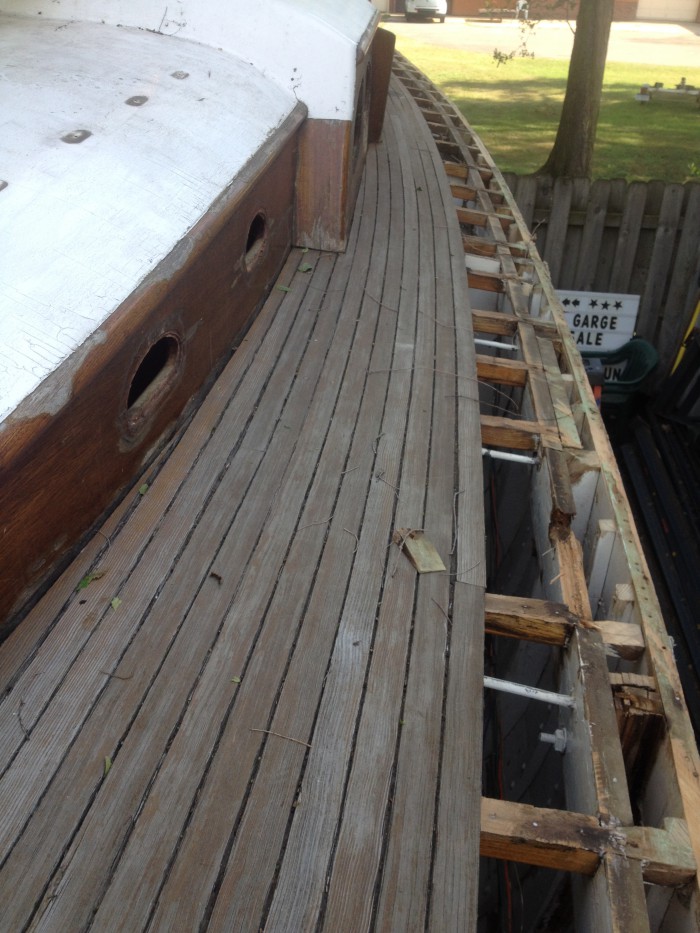
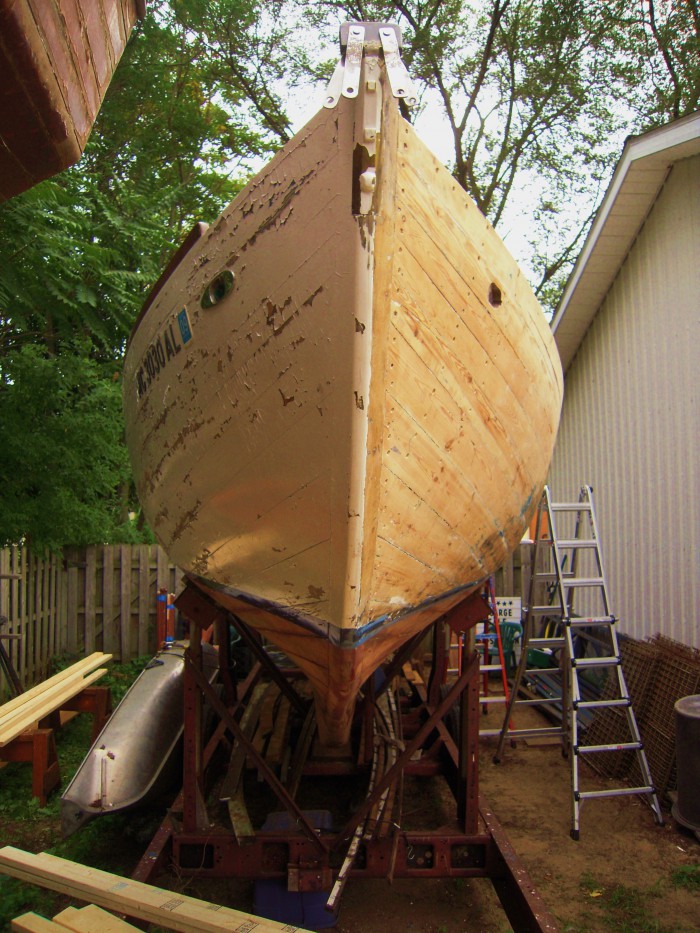
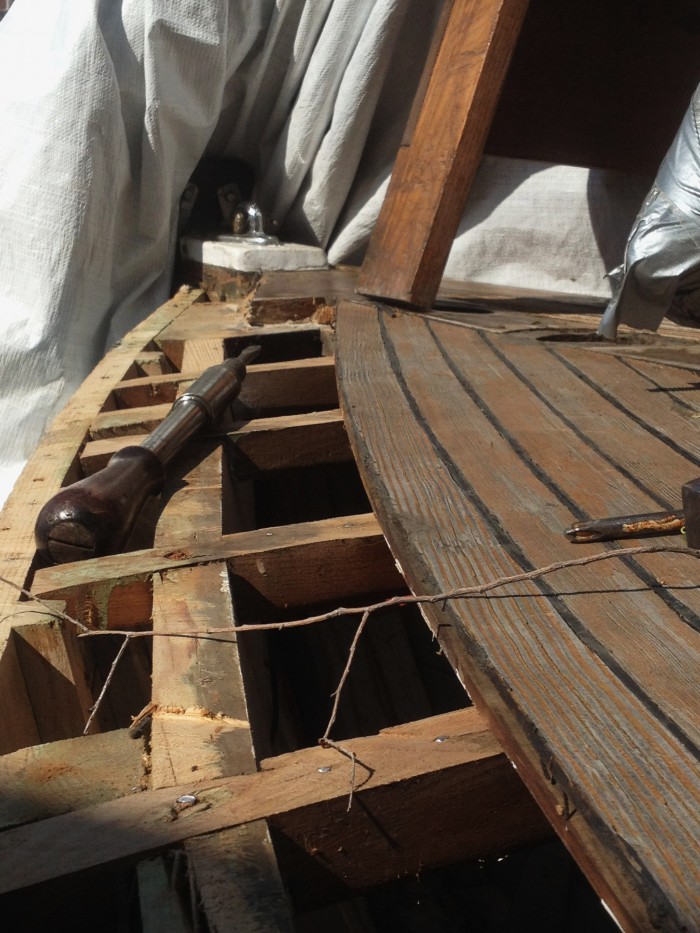
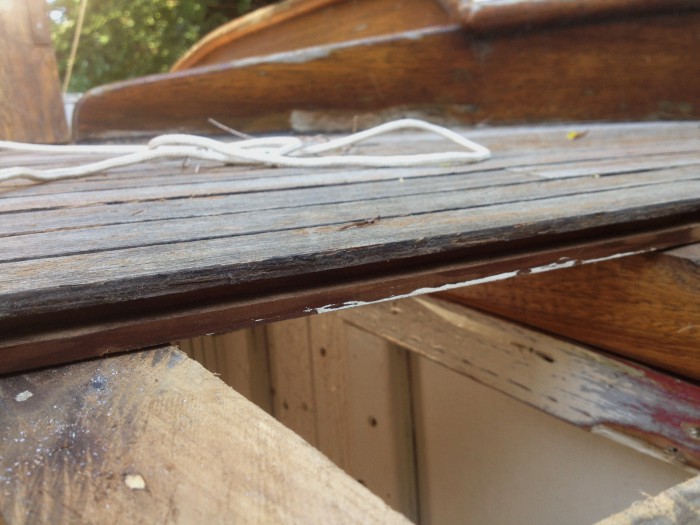
If you have been following this blog, you have ascertained we are removing the entire deck of Reverie to get at the rotted deck beams and carlines.  I have no doubt in my mind that this decision was indeed, the best tack. It will also facilitate the replacement of broken frames.  The port-side tongue and groove decking has been carefully removed, labelled and toted off to storage. It proved to be a bit of a task seeing that many of the strips are in excess of twenty feet.  The port-side deck beams are now visible, as are the  areas aft near the cockpit and transom that get little ventilation.

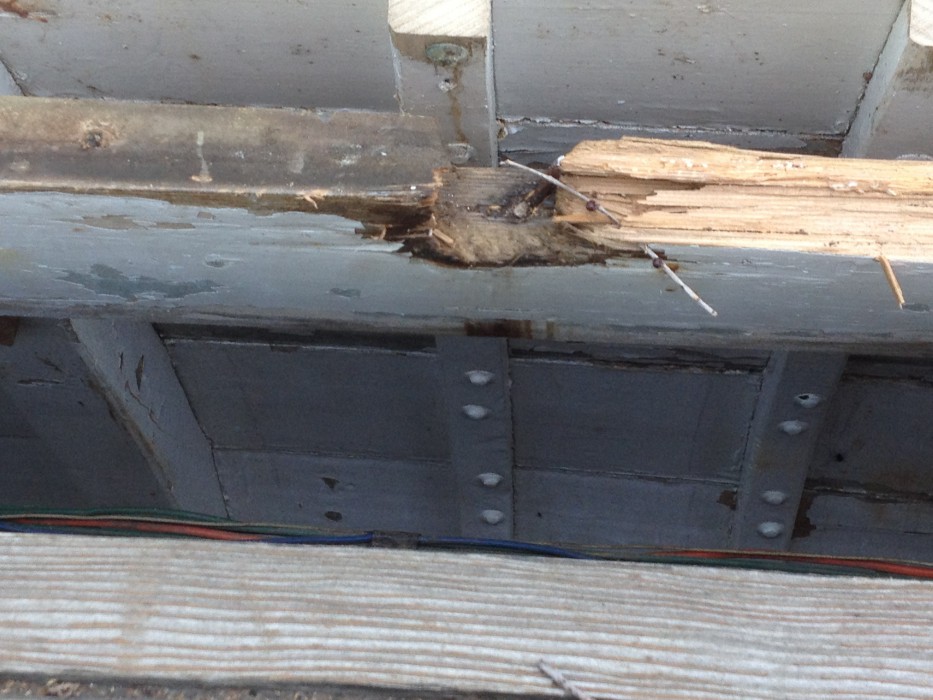
The entire port-side sheer clamp is now visible and there is evident damage amidship.  The sheer clamp is a structural  member that runs stem to stern and serves to support the deck beams and provide resistance to the torsional twisting of the hull.  It is bolted along the inside of the hull at the frames and the deck beams are half-dovetailed into it.  It appears to be made of cypress wood; a good choice considering the need for a light, strong,  rot resistant wood.   I thought of white oak as an alternative for replacement yet was convinced otherwise after researching the weight difference between the two.  Had we gone with oak, there would be another 300 lbs. added to the sheer.
IMG_2779

The port-side sheer clamp showing evident signs of rot amidship.

IMG_2782

A closeup of the rot on the port-side sheer clamp.

Once the port-side deck was removed, it became time to prep the starboard-side deck for removal.  Julia began the monotonous chore of removing all the bungs from the toe rail in order to get at the 4 inch bronze screws holding it down every 6 inches.  While she did that, I worked on the deck hardware.  I removed the starboard winch, cleats, anchor chocks, spinnaker pole chocks and, with Julia’s help, the stanchion bases.

The stanchion bases are particularly hard to get at as they are fastened between the sheer clamp and the sheer plank.  Inside the cabin, it was a tight squeeze but in the cockpit, it seemed nigh impossible.  I had to lie on my back and reach through one of the cuddy holes in the cockpit with my arm fully extended all the while attempting to reach the nut I couldn’t see with a deep socket  and extension.  This maneuver was what I imagine it would be like wearing a blindfold while trying to steal a bag of chips from the top row of a vending machine by reaching up through the discharge bin.  While I attempted this feat of derring-do, Julia waited  patiently on the ladder ready to unscrew the fastener once I found the nut.

Lying on my back, in this twisted state, up became down and down became up.  I fished around here and there but could not find the nut to the stanchion base.  I rolled the socket wrench into the small of my hand hoping for some tactile reassurance that this wasn’t all a bad, painful dream and that I would eventually find the nut and bolt that were obviously eluding me.  I extended my forefinger here and there and suddenly, it felt as if I had stuck it clean through some wood!  “…all part of this bad dream”, I thought.  “Just relax.  Embrace the pain.  Find the bolt.”

My eyes were closed.  They were useless in this endeavor. All sensory input was being conveyed through an arm bent into positions it was never meant to be in yet, there it was: the sensation that I had my finger stuck clean through a piece of wood. I wriggled my forefinger around.   It was as if it was stuck through a hole in a sock; a 5/4 inch thick rotted sock.  I felt air on the other side.  Was my finger sticking through the sheer plank and the world outside?  “No”, Julia assured me.  “I can’t see your finger.”  Then, the truth set in.  I had stuck my finger through the rotten starboard-side sheer clamp!

I writhed about like a crocodile being swallowed by a python,  still unable to find the damn bolts. I began to see a shining light through my closed eyes.  I heard a voice beckoning me.  “Come to the light!”   I reached out, with my contorted arm, and touched the stanchion bolt I so desperately sought.  I focused, careful not to let this moment slip away.  I got the socket on the nut.  Julia unscrewed it from above.

Bolt number two was right next to a frame but now that my arm was a bent pipe cleaner, I got the socket onto it, as well.  The two other bolts to the stanchion base were screwed through the deck and into the sheer clamp.  The cause of the rot, perhaps?  They pulled out without even needing to be unscrewed.  The stanchion base was finally liberated from the covering board.  It then took several minutes to extract my now serpentine arm from the labyrinth while I relived the pain of a long-ago separated shoulder.  Why did I ever think rollerblading was a good idea?

The outcome of these travails are the issues with the starboard-side sheer clamp that will be come into focus as work progresses.  It was  reminder that there is more than meets the eye in our little project.  We’re certainly not out of the woods with these hidden issues.  “… two steps back.”  I’m glad we found this out before Winter set in.   It gives us time to plot out the next course of action. These sheer clamps must be addressed before the deck beam work can start.   I guess that big slab of white oak we have will have to wait a bit before it’s sawn into deck beams.  Time to start shopping for some nice cypress.

Now that we’ve had our medicine, I must say that it has been a delightful season.  El Niño might be wreaking havoc all over the world but he allowed us to get out on our Com-Pac 16, Prudence for some extra-fine Fall/Winter sailing.  One of the real highlights of the season was sailing on Christmas Day.  There had been a raging gale several days before Christmas with 22 foot waves on Lake Michigan.  That’s 22 foot December, Great Lakes waves which are steeper and heavier than ocean waves. While not 22 feet, there were still some big rollers that picked up in the 20 knot afternoon breeze. The waves were very uniform with an occasional series standing above the others.  It was consistent and certainly memorable.

The icy, steel blue water was beautiful and deadly as we beat  5 miles WNW onto the lake.  We were driving so hard, we kept the Port Sheldon pier off our stern with almost no leeway to the South.  Prudence yields a bit to the currents so this was a pleasant surprise.  We would be able to triangulate back to the pier.  Three legs and we’d be home.   We ended up gybing off on the second leg then rounding back NE as Prudence didn’t want to tack into the rollers that were beginning to stand up 5 miles offshore.  On leg three, we ran S along the Lake Michigan shoreline back to Port Sheldon. That leg ended way too soon.

DSCN1304

October on Lake Michigan

DSCN1405

November sailing- Holland, Michigan

DSCN1419

November sailing. Coming into Lake Macatwa from Lake Michigan.

DSCN1453

Christmas Day 2015. 5 miles out, 5 miles back with Julia’s daughter, Chloe. Fine sailing. -Port Sheldon, Michigan

Christmas Day - Lake Michigan

Christmas Day – Lake Michigan

It has, indeed, been a delightful year filled with hard work and dedication that shows in all we have accomplished  It has been a year of change and sacrifice balanced with the enjoyment of life’s small pleasures.  It helps to have someone like Julia who can see the forest through the trees.  She has been working tirelessly alongside me.  Even during the 60 hours it took me to strip the paint from the port topsides,  she was there at the end of the day with a couple of cold beers that we would drink at the Sunset Lounge, our two lawn chairs in the shade of Reverie.  Here’s to everyone having an eventful and  productive 2016.  Cheers!


4 Comments

Tung Oil and Turpentine

We are well into November and the weather has been good to Reverie’s restoration project.  The leaves were late to turn this year due to a warm Fall but they have now fallen  rapidly and carpet the earth in all shades of red, yellow and brown.  Still, the mild weather persists.   The birds aren’t quite so convinced of an eternal Autumn.  They know what’s about to happen and are acting accordingly.  We saw our first dark eyed junco the other day while working on Reverie; a sure sign of the change in seasons.  The shoreline of the Great Lakes is, well, a great place to watch migrating birds.  We were even  lucky enough to see 4 endangered whooping cranes the other day on a back road drive from Holland to Grand Rapids. Their size is impressive.

On a somber note, today is the 40th anniversary of the sinking of the Great Lakes freighter, Edmund Fitzgerald. It vanished without a trace in a massive storm on Lake Superior and has since been found lying at the bottom of the lake broken in half by the mighty waves.  http://www.shipwreckmuseum.com/the-fateful-journey-62/

102 years ago, the Great Lakes Storm of 1913 sank 19 ships with over 250 lives  lost on the open waters of these inland seas.  http://www.nws.noaa.gov/com/weatherreadynation/news/131107_white.html#.VkH8LdKrTwc

Today, is nothing like those days.  It is calm and mild and I’m going off to work on Reverie for a while thankful for this weather as I solemnly recall those who lost their lives on the Great Lakes.

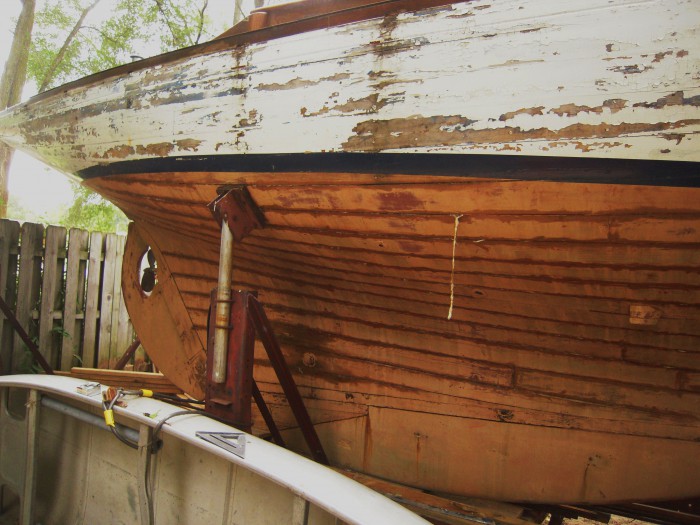
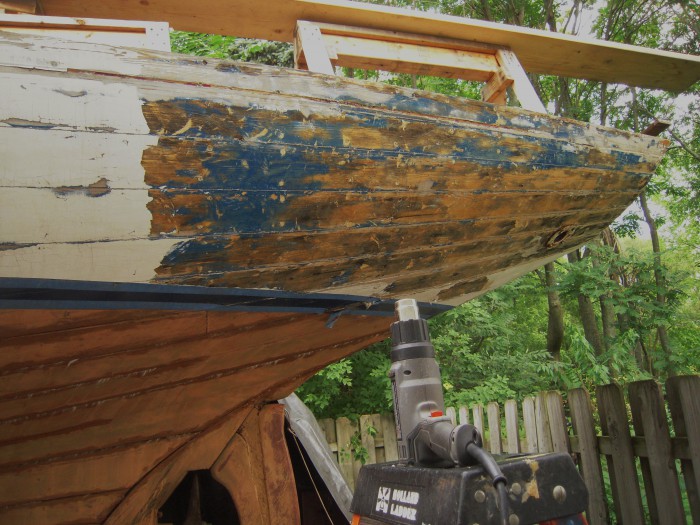
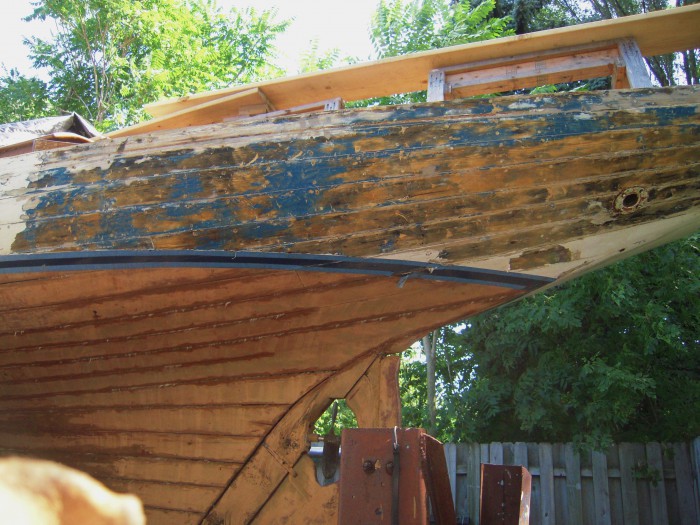
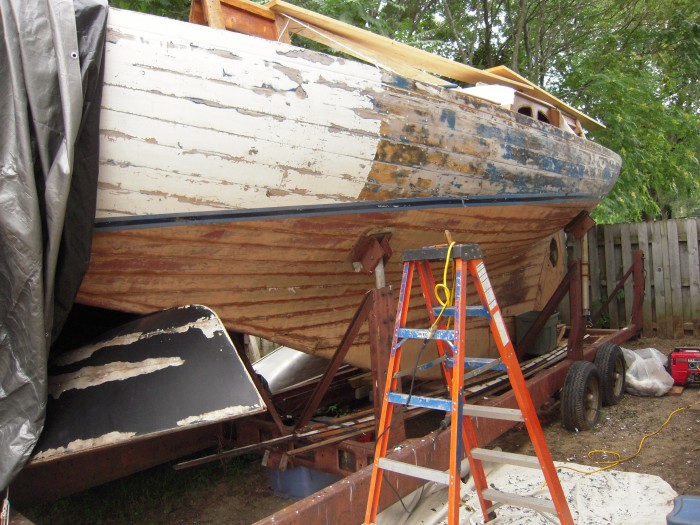
Yesterday, we passed a waypoint in the restoration project.  After 60 hours of scraping, sanding, and the cleaning of every single fastener hole on the port topside, I was able to apply a coat of tung oil and turpentine!  This was a process that took a lot longer than expected but we are pleased with the results.  The mixture, consisting of 50% tung oil and 50% turpentine, was heated to near boiling to facilitate its penetration into the thirsty yellow pine planking.  I could see it immediately expanding some of the surface cracks that had begun in the parts of the topside that had been without paint for an undetermined amount of time.  I worked this delightful smelling mixture into all the exposed fastener holes with a 3 inch chip brush.  You could see the hot oil and turpentine being sucked into the holes. It made all the time consuming work worth it.  There are certainly faster ways to strip the hull down and sand it but I would rather spend 2 or 3 or 4 times the amount of time to get it the way I wanted it and err on the side of safety.

The frames, which are basically the ribs of the skeleton, are laid out in a pattern of one very heavy white oak frame fastened with heavy galvanized nails and then two smaller frames fastened with copper rivets.   These smaller oak frames are steam bent and still fastened tight.   We will most likely add bronze screws to the heavy frames but that’s going to require some investigation of the existing nails.  For now, I’m guessing they have run their course in usefulness.  When white oak and steel get together, oak wins.  I removed the flat-head steel screws to the engine exhaust flange that was backed up with an oak block and there was barely any thread left.  The use of quality, hot dipped galvanized fasteners is a money saver and they served well for over 60 years but we’re going with silicon bronze.  The oil filling the fastener holes is a good thing.  It  expands the wood and seals it from the oxygen needed to create rot.

 The whole port topside consumed a little less than a half gallon of the tung oil/turpentine mixture.  The tung oil is 100% pure tung oil and costs about $70 dollars a gallon.  Tung oil cannot be allowed access to oxygen as this begins the curing process.  I poured off half the gallon of pure tung oil into a half gallon cider jug leaving no room for air and will save it for a later date.  That will keep for quite some time, as is.  I expected to use more of the 50/50 mixture but was happy to have used less, seeing we’re approaching $100 a gallon for this elixir, once the cost of the turpentine is factored in.  “Prepare for the worst, hope for the best.”  Last night, I had to scramble around for another half gallon container to put the rest of the 50/50 mixture in and came up with an empty half gallon bottle of Scotch in our recycling bin(now how did that happen?).   It was almost spot on one half gallon with a glass vitamin bottle to spare. Now I have to find some wood that needs treating today so as not to waste those precious fluids in the vitamin bottle.  That shouldn’t be difficult.   So, dear reader, I must be off and begin the next phase of the project which is to do the same thing to the forlorn  starboard side that now looks even more desperate compared to the freshly oiled port-side.  I will leave you with some pics of the progress.

Best Regards,

Roger

60 hours of scraping, sanding and oiling. Done!

60 hours of scraping, sanding and oiling. Done!

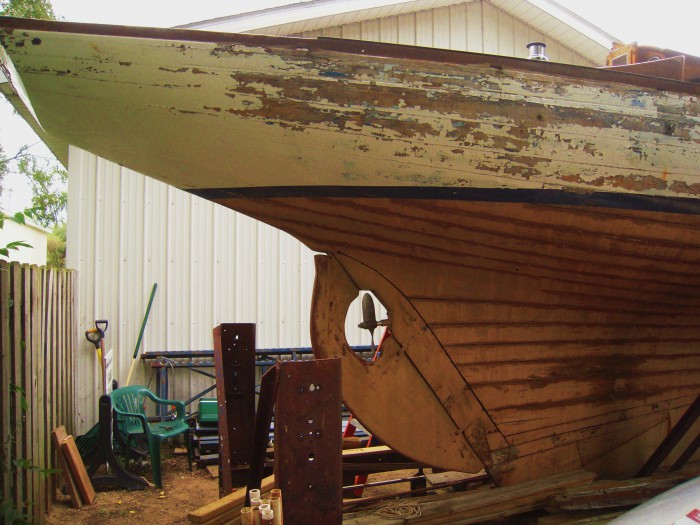
Reverie's lovely overhang. The one small plank is a former repair made of dissimilar wood and will most likely be replaced.

Reverie’s lovely overhang. The one small plank is a former repair made of dissimilar wood and will most likely be replaced.

Starboard topside looking forlorn and in need of help.

Starboard topside looking forlorn and in need of help.

Yikes!

Yikes!


2 Comments

Time Is of the Essence


October is upon us and the race against the elements rages on.  My fit of optimism that predicted the scraping, sanding and oiling of the topsides was, of course just that: optimism.  In my dream world, it was going to take 20-25 hours per side to finish this project.  Now, my optimistic estimate is for each side to be completed in 50 hours per side.  Yes, it’s boat work and that’s how it goes.  The real time consumer has been cleaning out all the fastener holes.  They are filled with hardened putty and require a bit of concentrated heat to soften up then carefully dig out.   I want to get each one as clean as possible to facilitate the penetration of the 50/50 mixture of 100% pure tung oil and turpentine.  Any place there is exposed end grain needs to be soaked in this formula.  This mixture gets heated to near boiling and soaks into the wood quite well.

There are many hundreds of fastener holes and, depending on each ones depth, take a minute or so apiece to clean. The strength of a wooden boat lies in redundancy.  Many small fasteners and components are put together to effect the strength required to withstand the stresses incurred in a seaway.  The stress gets distributed across the greatest area possible and, voila,  you have a sturdy wooden boat.  You also have hundreds of fasteners that demand attention.  It only takes the failure of a few in a series to set off a chain reaction that could lead to catastrophe.

During this phase of paint scraping, I also had to determine the best way to preserve the waterline.  The waterline was already there so, to lose it then have to set up the procedure to draw a new waterline seemed to be the kind of redundancy we should like to avoid. Preserving the existing waterline is one of the reasons I chose to do the topsides first and address the hull below the waterline as a separate project; that, and the fact that the bottom paint has no bare spots and, therefore, is still protecting the wood.  It’s those bare spots on the topsides that initiated this phase of the restoration.

The waterline runs from the bow in a 3 inch strip and expands to 4 inches over the last few feet near the stern.  Easy enough.  I can mark where that begins and add that taper.  I was going to tape along the bottom of the waterline and work from that but the blue painters tape that was already there wasn’t holding up to the heat gun.  I chose to sharpen the scraper to a knife edge and work along the boot top (waterline)/bottom seam in an upward fashion so as to preserve the waterline.   You can see in the photo, where I have the waterline removed, that it worked well and there will be an accurate line to follow when it’s time to paint the new waterline.

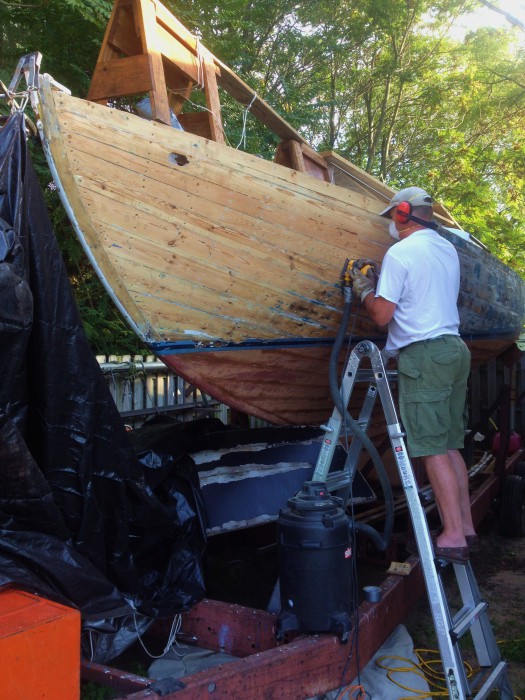
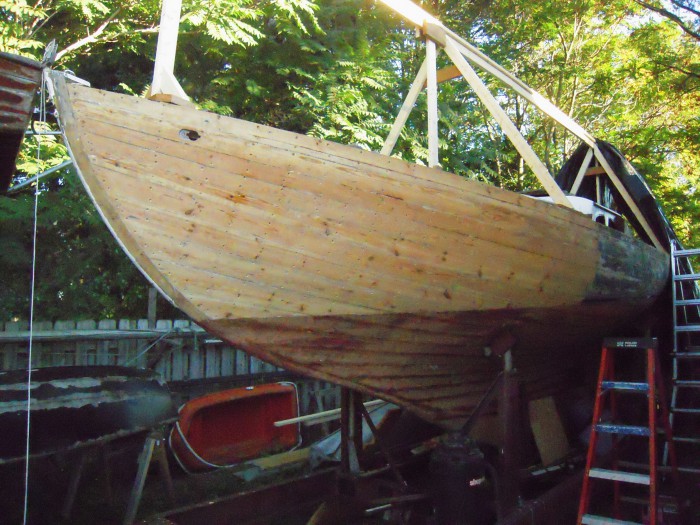
As the sanding progresses, the hull is revealing itself in a very positive way.  It is nice to see the yellow pine exposed for the first time in over 60 years looking as if it had just been fastened.  It has withstood the test of time admirably and is a testament to it’s efficacy as a planking material.  I have a shop vac rigged up to the discharge of the sander and it is working quite well at keeping the dust down.  With this system, it is virtually dust free.  I’m still wearing a dust mask and ear protection but it is much more comfortable than the dreaded respirator.

We took a break from the topside project to begin construction of a better tarp frame.    With Winter coming on, the frame needed a steep pitch to deflect the incessant lake effect snows that dump on the shoreline of Lake Michigan. The frame will be reinforced with more rafters as the season progresses but, for now,  it’s enough to withstand the wind and rain. We had a makeshift setup last Winter and had quite a time getting the snow and ice dams off the deck.  This new structure will also serve as a beam to lift the cabin off the boat.  Julia is working on getting all the fasteners out of the cabin and cockpit (a whole lot of work in one small sentence).   Then, we will lift the cabin top off with a block & tackle and get it off the deck in order to have better access to the deck beam and carline repairs.  It will also make it easier to strip the inside of the coach roof and cabin sides as it can then be flipped upside down rather than us being showered by scraped varnish.

There is a bit of momentum and the only unknown factor is the weather.  If it all doesn’t get done before the snow flies, that’s the way it goes.  In the mean time, onward we plunge; led by an optimism that suggests a certain naivety while providing impetus to move along with this tedious, dirty job of stripping, sanding and oiling the topsides.

DSCN1228DSCN1229IMG_3002DSCN1232DSCN1227DSCN1224DSCN1223DSCN1222DSCN1220


Leave a comment

The Elephant in the Room

As the last week of August fades to memory, it’s time to reflect on what’s been done and plan for the cooler months ahead.  For many people, summer ends at Labor Day; the tug of the academic calendar is just too much for folks raised to abide by the “back to school” mentality.  They may not be in school or have children in school but the hand is writing on the wall.  We are bombarded by yet another consumer milestone.  “Buy, buy, buy”, the ads say.  When I’m out shopping, I feel like maybe I should pick up a fresh pack of crayons or maybe some paste.

Here in West Michigan, we see the last of the tourists “recreating profusely”; they’re squeezing that last bit of juice from the lemon before it’s time to get the kids off to school.  Then, it’s a little easier to breathe around here.  We don’t have to fight the crowds to get around and no longer have to plan our sailing time during the week.  It was so hot and humid for the first part of August, there was not much going on in the way of boat work.  I’m not partial to heat indexes in the lower 100’s and the fact that I’m using a heat gun only reinforces my prejudices.

Late July and some of August saw us dutifully removing the rest of the covering board and begin the process of removing the deck from Reverie.

IMG_2747IMG_2771IMG_2761

That went as well as it could and we are now able to see the extent of the rot to the port-side deck beams.  There weren’t really many surprises as I was expecting to find more rot than was visible from the interior.  After all, that is one of the main reasons we are completely removing the deck.   We got 3 rows of the tongue and groove decking off yet, something wasn’t quite right.  There was an elephant in the room and it wasn’t going away.

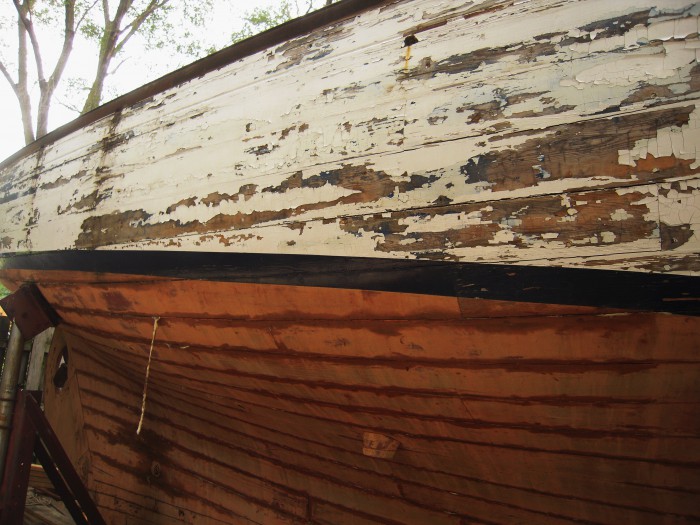
The warm weather did slow us down but it was the impending cold weather that made the elephant more apparent.  While focusing on the deck and executing the plan to remove it, time was ticking away.  After seeing what would need to be done with the deck beams, the seemingly innocuous topsides began to call out for help.  The paint was crazed and peeling.  There were bare spots from an attempt, made by the previous owner, to sand them.  I’m not sure how long ago the attempted sanding took place but the sections of exposed bare wood was showing signs of weathering that could lead to wholesale splitting of the lovely,  longleaf yellow pine that planks our fair vessel.  It was time to feed the elephant.

Completely stripping the multiple layers of topside paint was the only course of action seeing how the paint had split and cracked where it hadn’t already been sanded.  Reverie has been out of the water for years and the planking is a lot drier than a wooden boat’s should be.  Dry planks can stress the fasteners and shrink the dimensions enough to cause problems when it comes time to recaulk the seams.  If the seams are caulked when it’s dry, the expansion can cause undue stress and actually cause the fasteners to pull out.  Not good.

It’s going to take about 30 hours per side to strip the paint and a good 20 to do the sanding and oiling.  After the oil dries, the initial coat of primer goes on and Reverie will be much happier.  So, Julia gets about 100 hours of work time off while I    take one for the team since there’s no reason we should both be exposed to this mess.  She hasn’t stopped work altogether; she’s working on removing the multitude of bungs (wooden plugs that cover screw holes) from the cockpit coaming when I’m not making too much of a mess.

Wearing a respirator for 80 hours is not something I’m enjoying but it has to be done. I have the heat gun set just hot enough to lift the paint but not hot enough to burn it.  I’ve done some research on the release of lead and other toxic substances and am working at a lower temperature to avoid as much exposure to lead as I can.  I watched a video on youtube of this guy using a heat shrink gun and literally burning the paint off the topsides.  He said he can get a whole boat stripped in one day.  He wasn’t wearing a respirator.  I think I’ll err on the side of caution.

See you when it’s done.

DSCN1044IMG_2796006DSCN1138


Leave a comment

Galley Drawers

DSCN0608

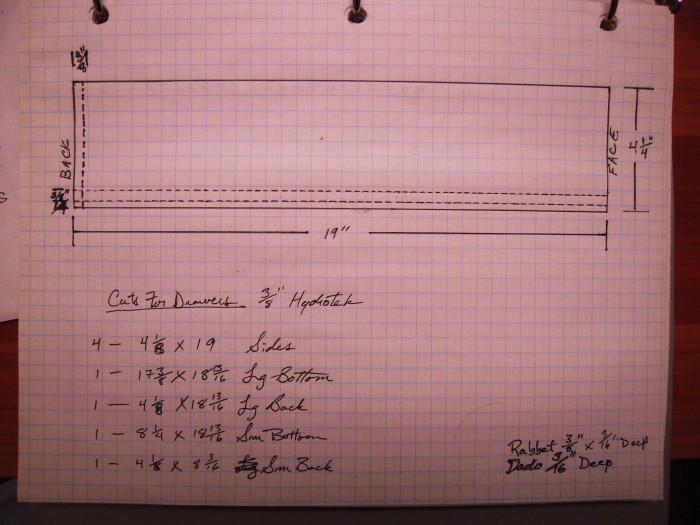
Dimensions for the galley drawers.


Happy Pi Day to all!  As the month of March approaches mid-point, we are seeing some real signs of Spring here in Michigan   We’ve had agreeable, sunny days with temperatures in the balmy 40° Fahrenheit range all week. The snow hasn’t quite melted and we are in the muddy limbo that happens every year.  This morning, we saw a number of Sandhill Cranes croaking overhead.  Their voices have a primal tone much like that of the Loon.  It stirs some kind of gut feeling that has no true explanation.

Last Sunday, we drove over to Holland to get the Winter’s snow off Reverie before it became an impossible mess of ice and condensation.  The last time we were there, it was 15° F and I was barely able to get under the heavy mass of snow piled atop Reverie’s tarp.   At the time, I knew we would have to get there at just the right time when things were softening up a bit but before temps were steadily above freezing.

 It took over an hour to get all the snow and ice off the tarp. The snow on deck was knee deep and weighed a considerable amount.  Massive blocks of ice had already formed along the toe rail pinning the tarp taut against the cabin and hatches.  This setup is  temporary and soon, we’ll have a better framework for the tarp so as to be able to work without having to untie the tarp every time; with a 20′ x 30′ tarp, that’s a lot of work.  I pulled the tarp back and we let the deck air out for the rest of the afternoon.  Had Reverie sat without a tarp for another Winter, I’m sure she would have been much worse off.  I know we got to her just in time; before she became nothing more than an assemblage of rotted wood.

The Galley, as we found it.  Looks pretty innocent,eh?

The galley, as we found it. Looks pretty innocent, eh?

The main problem with Reverie is her leaking deck, which started the insidious process that rotted her deck beams and other parts of her interior.  Her cabin-side seams are where a lot of the water entry was occurring; it was there that water leaked down into her galley space and wreaked havoc on the cabinetry.  Water was seeping into the sink/stove area which is the top of the galley space.  In December,  I removed the sink and found the opening completely soaked. In fact, the entire formica covered 3/4″ inch plywood top was completely saturated.

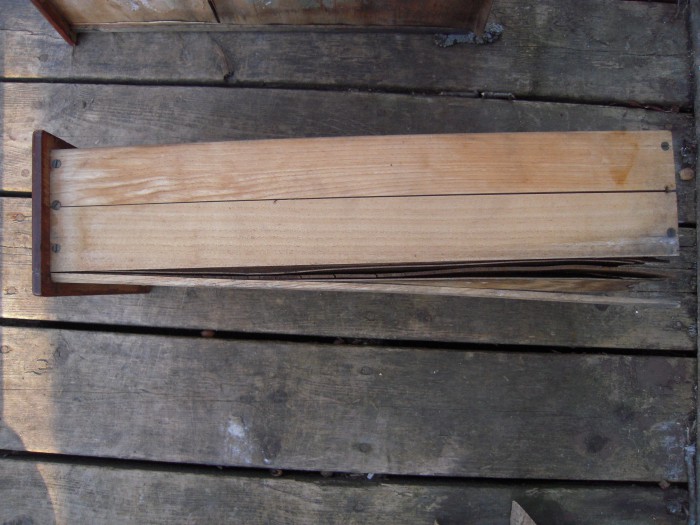
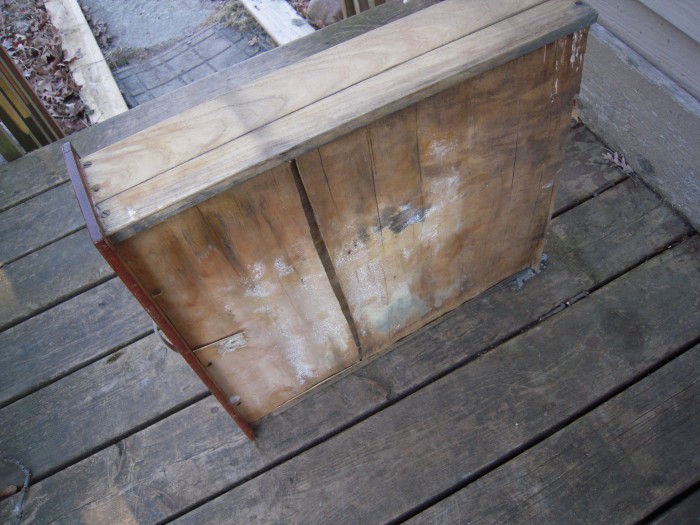
The drawers below had also gotten soaked making them impossible to open.  Luckily, there are two latched doors below them through which I was able to squeeze my arm in and force the damaged  drawers out.  We took them home with us with the intention of yet another off-site project.

Success!

Success!

Ouch

Ouch

The bottoms of the drawers were made of old school plywood, circa 1953, that didn’t take kindly to having water dripping on them.  The plywood was completely shot.  After taking the drawers apart, I decided to ditch the oak drawer sides in favor of 3/8″ marine plywood that will get sealed with epoxy.  The oak sides looked worse for the wear and were glued up from odd, narrow pieces that would have to be cleaned and  re-glued.  That’s more work than using fresh pieces of modern marine plywood.  The original wooden drawer faces are still serviceable but have splits that will get epoxied when they’re put back together.

Willy Nilly oak sides.  Probably a way of using scrap economically in the production of the boat.

Willy-nilly oak sides. Probably a way of using scrap economically in the production of the boat.

Crap!

Crap

So, I have the materials list all made up and construction method determined.  The entire galley cabinetry is going to have to come out to facilitate a frame repair so, I’m going to cut out the pieces and leave them that way until it all goes back together. If I assembled the drawers, they would be bulky and vulnerable to damage in storage.  For now, they’ll sit in a nice stack, ready to go back together in a moment’s notice.

So, the moral of this story, dear reader is: Never allow your deck leaks get to this point!  The whole mess with Reverie was caused by her leaking decks and would surely have been her undoing.

Stay dry, my friends!

~Roger


2 Comments

Wooden Blocks

March has arrived and the time change to Daylight Savings takes place in the early hours of Sunday morning.  Losing an hour of sleep shouldn’t be much of a problem seeing as I get up well before dawn anyway.  We have passed meteorologic Spring already and the  month brings with it the sense that I need to finish up with this Winter’s off-site projects.

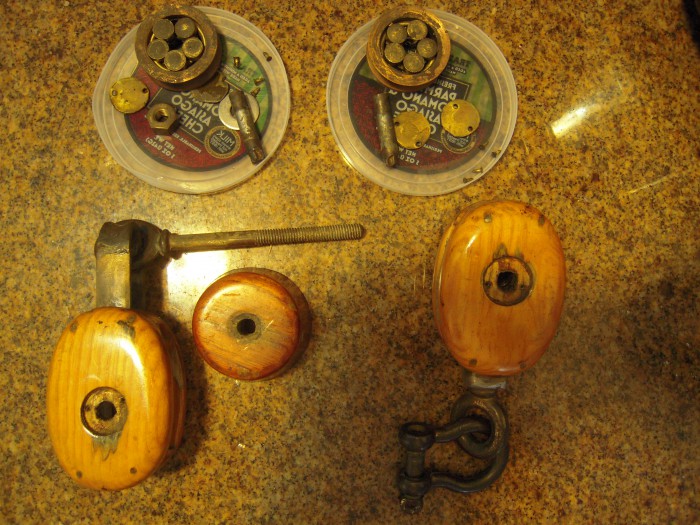
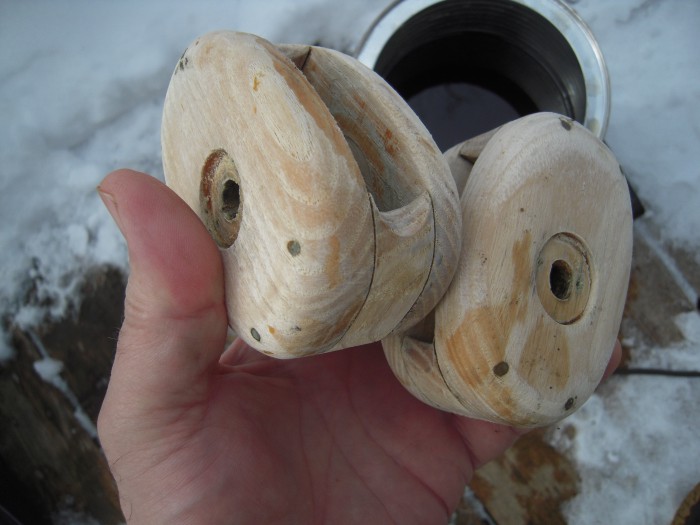
The blocks on Reverie were in desperate need of TLC. The varnish on all of them was chipped and worn with the sheet blocks showing the worst of it.  They had been left on the boat for who knows how long, and had deep splits in the wooden cheeks with black water stains that looked permanent.


DSCN0304

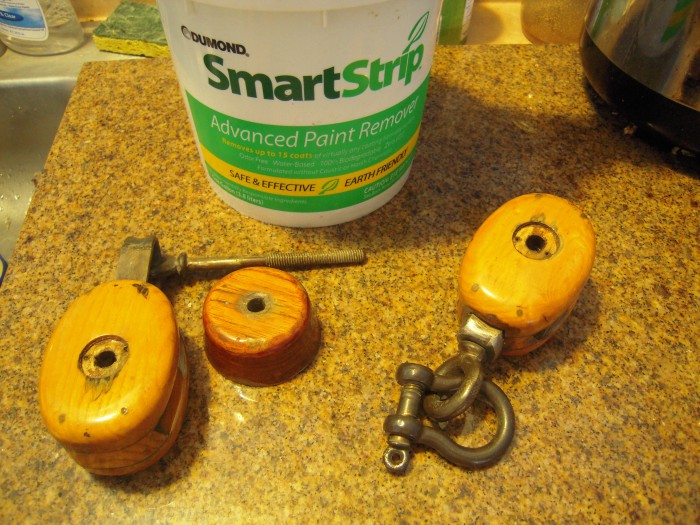
Blocks, their sheaves, bronze roller bearings and cheek plates.


DSCN0046

Some of the blocks as we found them. The lorn sheet blocks are on right.

DSCN0305

Smart Strip does the job.

The first course of action was to disassemble everything and strip the cheeks down to bare wood so they could go into a hot bath of linseed oil, beeswax and turpentine.  I discovered SmartStrip when I was working on Persistence and needed to strip paint from fiberglass.  It is expensive, costing close to $60.00 a gallon but it is environmentally friendly and does the job.  It’s biodegradeable and has very little odor. We have had good results covering whatever needs to be stripped with plastic bags or plastic food wrap and leaving it on overnight.  It will be the stripper of choice for the rest of Reverie’s projects along with a heat gun for the hull and other easily accessible areas.


DSCN0578

A couple of block cheeks stripped and ready to go into the hot linseed oil mixture.

I applied the SmartStrip to  the wooden cheeks and let them sit overnight in plastic grocery bags. The next morning, I scraped off the varnish with a plastic putty knife and an old toothbrush.  I brushed household bleach on the black spots repeating this procedure until the spots were all but gone.  I then scrubbed them under running water so as to remove all traces of paint stripper and bleach.  Before they went into the oil mixture, I let them air dry for several days.

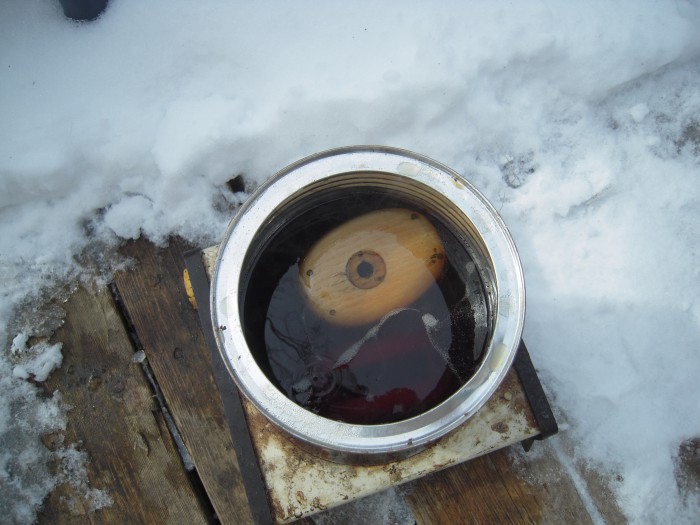
Getting the mixture of linseed oil, beeswax and turpentine at the right temperature takes careful monitoring of the hot plate.  I like to have it as hot as possible without smoking and potentially catching on fire.

DSCN0579

Well used hot plate and coffee can full of linseed oil, beeswax and turpentine.

I cooked each block for about 4 hours until I could see no more air bubbles coming out of the wood.  I then let them sit for a while on a piece of cardboard and really didn’t have to wipe any excess off except where they touched the cardboard.  I use boiled linseed oil, a bit of beeswax and  turpentine to help the mixture penetrate deep into the wood.  Boiled linseed oil dries faster than raw linseed oil but still, these cheeks are going to hang for a few months before I lightly sand them and finish them with spar varnish. The splits in the sheet block cheeks completely closed up after their soaking and one has to look hard to see them.  They’ll be fine.

So, that’s one more project off the list and a million more to go.  Regardless, it feels good to know it’s done and I don’t have to think about it any more.  That calls for a wee dram of Scotch!

Cheers,

Roger


Leave a comment

Mood Lighting and Hoarfrost

DSCN0560

Writing about boats seems a bit surreal on a morning such as this.   It’s six a.m. and the temperature outside reads -9° Fahrenheit.   A hot mug of coffee sits beside me as I look at the dog curled in a tight ball refusing to go outside until he absolutely has to.  Our African Grey parrot, who usually comes out and says good morning and loves to have her head scratched, huddles next to her heated perch silent as the morning at hand.  Julia gets up in a half hour.  All is quiet.

I know that February is the shortest month of the year but this year, it seems to be the longest.  Here in the Great Lakes region, we have had an exceptionally cold month with temperatures well below average.  It has been a rare moment when the thermometer has read above 20° during the day with nighttime temps below O°.  Today is the 27th and the month is, in fact, almost over.

March will certainly give us a break from the deep freeze that holds us so tightly in its grip.  In Michigan, March is that month of transition when Spring’s arrival beckons us with signs of warmer days ahead. Old Man Winter begrudgingly yields his reign over the land. We begin to notice the lengthening of the days while plodding through half frozen mud and melting snow banks.  We spot a bluebird perched on a fence post along a lonely country road; its ditch overflowing with melt water.  Sap drips from the trees as they awaken from their deep sleep.  Soon, there will be the chorus of spring peepers and blackbird songs to let us know the time has come.

The Great Lakes have frozen almost completely over, much as they did last year. This will mean a slower melt and the probability of cooler Summer water temperatures for the big lakes.  While this is not appealing to beach goers, it means less evaporation and higher water levels for the Great Lakes; great news for those of us who have been watching the steady decline in lake levels over the past decade or so.   When you are sailing a boat that draws over 4 feet of water, any increase is welcome.

The off-site  boat work has been going well but last weekend, I had to get to the boat to take a few measurements and do some more prep work for the next phase that involves removing and replacing the deck beams.  “Remove and replace the deck beams”  It sounds pretty straightforward.  Easier said than done.  One short sentence sums up a whole lot of work.  So, it was off to the boat on a blustery 15° day to see what needs to be done.

Reverie sat there under a massive mound of snow that strained her tarp taut against her deck.  Fortunately, she sits alongside an industrial building protected from the significant Westerly winds blowing off Lake Michigan.  I had to shovel my way to get alongside and clambered aboard.  I tried to coax the snow from the tarp then had to lift 10 pound chunks of ice that had settled on the deck just to make room to squeeze into the cockpit.  Julia handed me tools and other work related items.  I quickly had the cockpit filled with milk crates and 5 gallon buckets full of work stuff.  I then had to navigate my way around everything to get into cabin.   Julia had some business to attend to nearby so I went to work for a few hours alone.

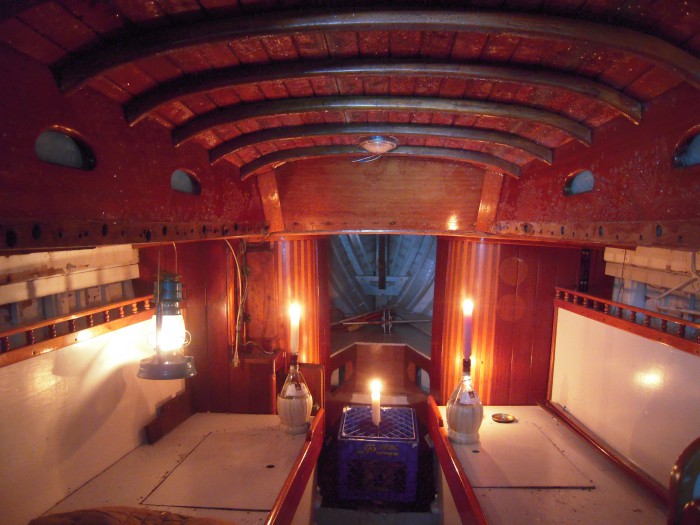
The building next door where I plug in had just been rented to a new tenant and I didn’t have access to electricity (lights, heater…) so I brought along a supply of candles and a Dietz lantern for light and a wee bit of welcome heat.   I climbed into the the cabin and it was pitch black due to the amount of snow on the tarp. I got a few candles lit and looked about me to discover the interior of the boat looked more like an ice cave than a cozy work space.  There was hoarfrost covering the entire interior.  It was so dark, the candles did little to illuminate the cabin enough to work so I had to leave the companionway open for whatever light came from outside. This deprived me of any heat they might have given off.

Light at the end of the tunnel

Light at the end of the tunnel

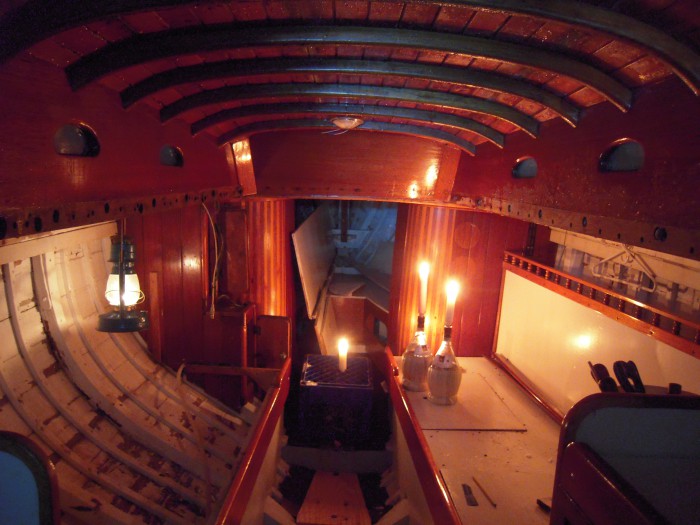
With a little LED lamp in one hand and candles all around, I set to work.  This stage of the project involves a lot of assessment and planning so, I had no illusions about getting a lot of physical work done.  What I wanted to do on this cold day was to get the port-side bunk removed so as to be able to inspect the hull and deck beam ends.

The deck beams are notched into a hefty sheer clamp which is a board running the entire length of the boat that provides stiffness to the hull and support for the deck.  I wanted to see how the deck beams were fastened so as to plan for their extraction later.  I removed the most rotted beam and found that it was nailed to the sheer clamp from above and fastened to the frame.

Frames are the ‘ribs’ you see inside of a wooden boat that resemble the ribs of a fish.  The deck beams we have to replace first are the ones that were tied into the carline or header I made last week.  They are called half beams.  Those ends that are inboard were easy to inspect with the carline removed.   The mystery of what was outboard hidden by the sheer clamp was what I came to ascertain and therein lay most of the work.

One of the great things about a wooden boat is that everything is held together with fasteners; screws, nails and trenails (essentially wooden dowels or pins).  If it can be put together, it can be taken apart.  To get at the outboard beam ends is going to require the removal of the toe rail, covering board and sheer plank. The toe rail is on the deck and does the job of keeping one’s toes from slipping overboard.  The covering board is the piece that provides a big, solid edge trim for the entire deck.  The sheer strake is the final plank of the topside of the hull.  All of these pieces are held together with screws that are hidden under bungs, which are wooden plugs glued and sealed to make the piece uniform and water tight.

Gaining access to the beams is more work than replacing the beams themselves.  If there were just a few small half beams to replace, the sheer strake might not have to be removed but one of the king beams or ‘heavy beams’ (major structural components) has to be replaced and I see no way to do it without removing the sheer strake.  In the long run, the whole job will be easier with the sheer strake removed.  This will give us a good look at the frame ends and allow the rest of the ‘good’ beam ends to be sealed and treated.

I  got the port-side bunk removed and had a look at the interior of the hull.  The whole interior of the hull is painted and the paint is peeling badly.  That’s going to require the removal of all of the interior joiner work, a lot of scraping and stripping with a heat gun once we have electricity.  That’s not such a bad thing as it will allow the inspection of every inch of the hull.  I found another cracked frame hidden below the bunk in a place I couldn’t see when I made my initial survey of the boat in December.  I expect to find more of this as there are a lot of areas I was unable to see without removing everything.

The bunk came out in an hour or so and I sat there with a jar full of screws to be labelled ‘port bunk’.  In the darkness, still clutching the LED lamp in my left hand, I scraped what paint I could. Some of it came off in rather sizable chunks.  I refrained from really going at it and creating dust since I wasn’t wearing a dust mask and not fond of inhaling lead. After that, I then cleaned up and sorted tools and supplies in as orderly a fashion as possible.

In just three hours, several hundred more hours of labor reared it’s head like a serpent from the deep.  My initial estimate was optimistic but I’m a realist and won’t overlook anything that would compromise the integrity of the boat as a whole. “Did I do this?” or, “Did I do that?”, are not questions you want to ask yourself on the open water in heavy weather.

Port-side bunk removed and some scraping done.

Port-side bunk removed.

Even in 15° with my feet and hands numb from the cold,  I had to pull myself away and close up Reverie until another work day.  Maybe the next time we return,  we’ll even hear a blackbird or two.

Stay warm, my friends.

Roger


Leave a comment

Falling Snow and Polished Brass

FALLING SNOW

The Winter of 2014/15 has been a strange one for us here in Southeast Lower Michigan.  The month of November delivered bitter cold and record lake effect snow events along the windward shores of the Great Lakes.  Lake Effect snow occurs when extremely cold air moves across the unfrozen Great Lakes. The moisture from the relatively warm lake is drawn into the frigid air creating snow that falls in bands when it hits the next land mass.  The prevailing winds for this to occur are generally from the N, NNW and W.

December and January vacillated between exceptionally warmer temps and exceptionally frigid spells of Alberta Clippers and Polar Vortexes. There was little snow which made for lousy cross country skiing in our neck of the woods.  After last years record snowfall, this Winter has been anticlimactic.  The previous Winter was a once in a lifetime experience that allowed us to ski daily in near perfect conditions right in our own backyard.

Then, February arrived and let us know it was not messing around.  12 to 17 inches of snow fell across the entire lower portion of Michigan with most of the Midwest seeing significant amounts in that 24 hr period. It started in the wee hours of February 1 and ended the morning of the 2nd. The pendulum swung and we were in the grips of powerful Arctic air.  Single digit Fahrenheit temperatures are not conducive to boat work but this is a huge project and progress must be made.


DSCN0255

Post February 1-2nd snowstorm. It took us several hours to clear our driveway and pathways.


It was during one of those warmer spells (slightly above freezing) in early December when we went to take a look at this wooden sailboat, Reverie, stoically losing it’s battle with time.  We are taking a Panglossian view of this Winter as it seems better for laying the foundations for the restoration of Reverie than it is for cross country skiing. Our ‘best of all possible worlds’ has provided corridors of time and windows of opportunity allowing us to get things done.  To date, we have over 90 hours of labor invested in Reverie.  That doesn’t count travel time to and from the boat. We’ve made the best use of this down time and have accomplished what we could.  The boat is in Holland, Michigan, a 2-1/2 hr drive from our home in Southeastern Michigan so any off site work that can be done is crucial to a timely restoration.

POLISHING BRASS

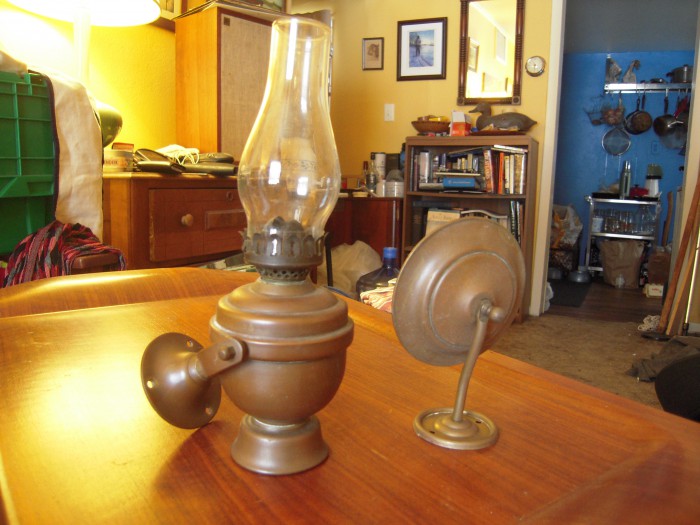
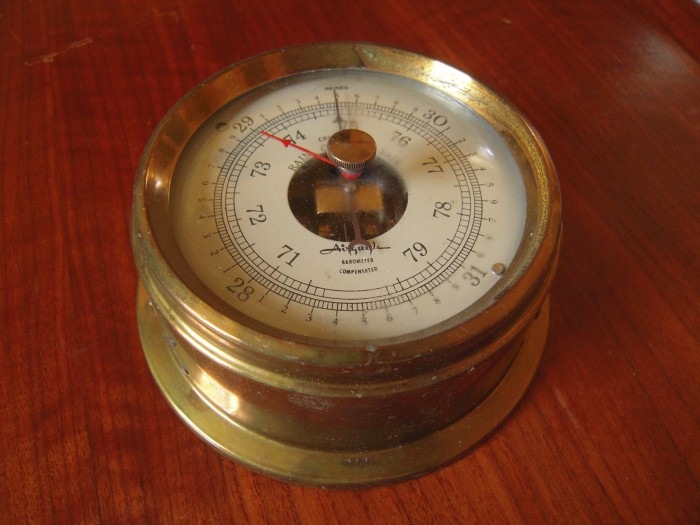
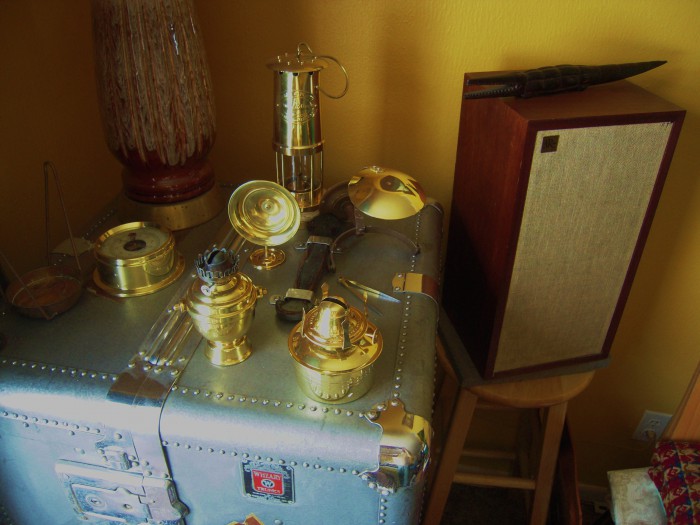
On one of our visits to the boat, we removed the brass lamps, the ship’s bell and the original Airguide barometer and clock. Everything was badly in need of some elbow grease.  I ripped up an old bed sheet into 1 foot squares and got cracking.

Perko Lamp

Perko Lamp: The Perko needs a new burner as the tabs have broken off, so I’m keeping my ear to the eBay door & scanning thrift shops for a replacements. It needs a P&A Hornet burner.

.


Nice old lamp that reads, "English Made 3/4" wick" on the burner.

Nice old lamp that reads, “English Made 3/4″ wick” on the burner.

Airguide Barometer

Airguide Barometer

Airguide Clock with German movement.

Airguide Clock before cleaning

The Airguide clock is pretty neat.  It cleaned up really well.  It has a German movement that operates on a C battery and  allows exact time adjustment.  I’ve got it set to within a few seconds error a day and am slowly tweaking it to exact time.

DSCN0257

Everything polished up quite nicely and after 50 plus hours of polishing, we have this. Julia picked up a bottle of Wright’s Brass Polish and I was excited to give it a try.  Over the years, I’ve tried many brands of polish and wasn’t terribly impressed by some of the brands that claim to be “the best”.  Wright’s works the best, hands down. It doesn’t require a lot of pressure to work.  With other polishes, I would have to stop after a few hours because my fingers were getting sore from applying pressure.  With Wright’s it is a good idea to let the polish sit on the metal for a short time before beginning to polish to allow the chemical reaction to start.  Speaking of chemical reactions, it was easy on my hands and washed off very easily with water.


I was very happy to get this tedious chore out of the way during the Winter.  It’s one of those things I “don’t have time for” during the warmer months when one’s time is better spent outdoors.   The only other time I might feel like doing this is while cruising . You’re on the boat anyway and there’s only so much napping and reading to do in the off-watch time. Hours and hours of polishing is not a bad way to go.

These lamps had a coating of grunge on them as well so they were especially nasty to clean.  I find that polishing brass is rather cathartic and the results are amazing.  Once polished, these old relics became wonderful works of art that would be hard to distinguish from new if it weren’t for the various dents that come with years of use.  The real trick with brass is to maintain it.  You have to keep up on it and not let any deep dark spots develop.     I don’t expect the next round of polishing to take nearly as long.

 “A rub in time saves nine”?

Cheers,

Roger