
“It was one of those March days when the sun shines hot and the wind blows cold: when it is summer in the light, and winter in the shade.” ~ Charles Dickens, Great Expectations
Here we are, watching March, 2015 fade to memory. This year, March came in like a lion and has remained roaring ever since. The Great Lakes region has been sunny and dry, for the most part, but it has been “…summer in the light and winter in the shade.”, as Charles Dickens put it. I started work yesterday morning in 24° Fahrenheit with a strong North wind gusting 25-30 mph. The temps stayed steady throughout the day but it was “summer in the light” and there’s work to be done
The Great Lakes began to shed their ice in early March. The Coast Guard, police and fire rescue crews have had their hands full with idiots on ice ever since. Every year, overzealous ice fishers, snowmobilers unaccustomed to the laws of physics and errant sightseers end up falling through the ice or somehow trapped on a floe drifting off into the open water of the Great Lakes. As more and more people are taking to the water in small craft, there has been a surge in kayak, canoe and paddleboard related incidents as well. This is nothing new, as we can see from previous generations: these people breed.
The work at hand is to get the port-side deck beams in order. The leaking deck caused them to rot and I’m sure there’s more to discover once things are taken apart. So, the bronze jib track, the toe rail and the covering board need to come off to get a look the deck beam ends below. The deck beams are not as accessible as the carlines, which make up the framing for the hatches and cabin. The deck beams run perpendicular to the keel line of the boat and their outboard ends are worked into the sheer clamp.
The sheer of a boat is the edge where the topsides meet the deck. It is an important aesthetic point in boat design. The sheer clamp is the board that runs inside, along the topside and provides a band of support for the deck beams. On larger boats, there is often a board that sits on top of the clamp called a shelf. Reverie only has a clamp that the deck beams are tied into. The situation gets complicated by the fact that the deck beams are tied into the clamp outboard and not accessible from inside. .
One of the nice things about a wooden boat built in a traditional manner is that, “what’s done, can be undone”. The fact that the boat is held together with fasteners is a plus when doing major work such as replacing the deck beams. Even though it can be undone, I’m cursing the fact that the deck was allowed to leak and this all occurred. I suppose that is how every old boat, house or any other creation of humanity meets it’s end: human neglect. “An ounce of prevention is worth a pound of cure”. Yes, it’s times like these when many an old proverb comes to mind. 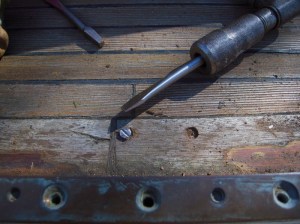
The task of removing a multitude of screws is best done with a hand brace fitted with the appropriate screwdriver bit. I also came armed with a hand impact driver to loosen up any recalcitrant fastenings. The hand brace exerts an amazing amount of torque and allows you to put downward pressure on the screw. This is especially important when removing screws that have been in place for over 60 years and are unwilling to yield.
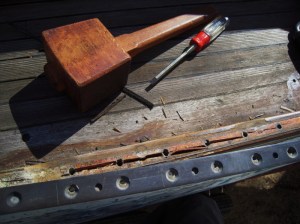
The bronzed track is held down with stainless steel screws and came off without incident. I did find splitting in the toe rail at the scarf which was caused by the linear nature of the track and the natural grain of wood. “Easy, Igor. You impetuous young boy!”
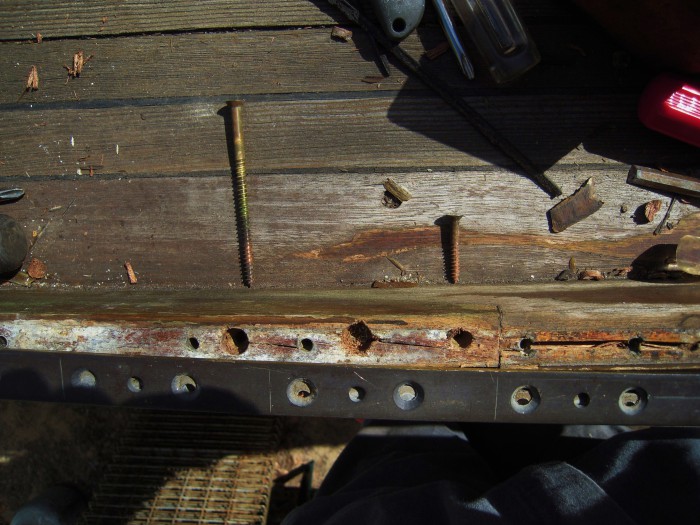
The toe rail is fastened to the covering board with 4″ silicon bronze screws under wooden bungs. The phillips heads want to strip out if you even look at them the wrong way.
The covering board appears to be fastened with steel flat head screws which have very shallow slots that will require careful cleaning and concentration to remove. I left that task until I set up a better scaffolding as it will require a lot of downward pressure on the brace and bit. I’m going to have to make a concerted effort to extract these puppies.
I made it four hours before calling it a day. The wind really took it out of me. The day was a success in that, I was able to ascertain how easy or difficult this stage would be. I’m expecting the rest of the port-side toe rail and covering board removal is going to take another 8 to 10 hours. And that’s if everything goes well!
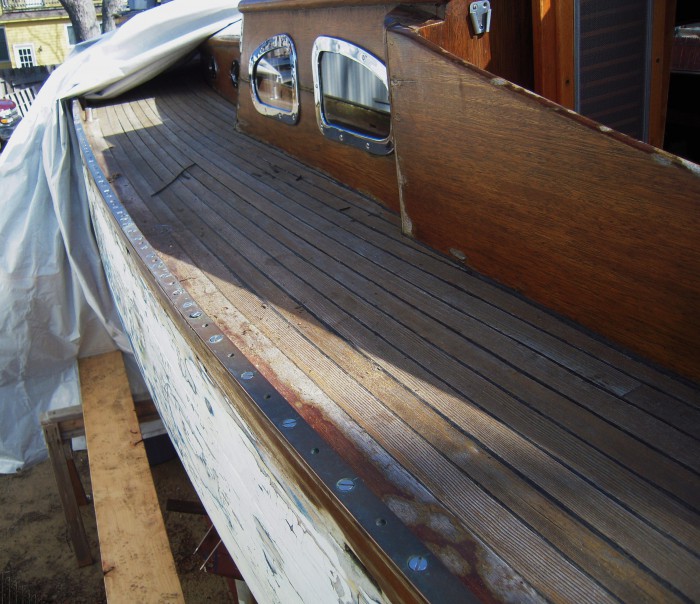
11:00 a.m.
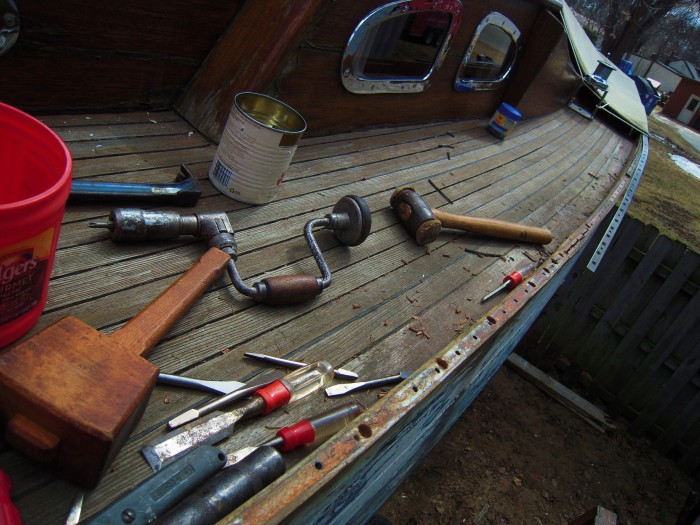
3:00 p.m.
Think Spring, my friends!
~Roger


March 28, 2015 at 3:25 pm
Good luck with the excavating – finding further ‘problems’ is I suppose one of the joys of restoration. Scary, but then again when sorted the integrity of the boat will truly be returned to the way her designer and builder meant it to be. I don’t envy you the weather though – the barn we are in in the UK is cold, but not nearly as cold as what you are experiencing.
LikeLiked by 2 people
March 28, 2015 at 4:39 pm
Thanks! Yes, the discovery process can reveal setbacks and they are to be expected. It’s a good thing knowing every square inch of the boat. By the time we’re done, we’ll know her through and through. I’m expecting all of this to proceed through next winter and we’ll be looking for indoor space for that!
LikeLike