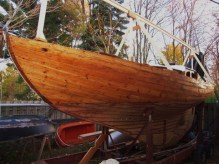

October is upon us and the race against the elements rages on. My fit of optimism that predicted the scraping, sanding and oiling of the topsides was, of course just that: optimism. In my dream world, it was going to take 20-25 hours per side to finish this project. Now, my optimistic estimate is for each side to be completed in 50 hours per side. Yes, it’s boat work and that’s how it goes. The real time consumer has been cleaning out all the fastener holes. They are filled with hardened putty and require a bit of concentrated heat to soften up then carefully dig out. I want to get each one as clean as possible to facilitate the penetration of the 50/50 mixture of 100% pure tung oil and turpentine. Any place there is exposed end grain needs to be soaked in this formula. This mixture gets heated to near boiling and soaks into the wood quite well.
There are many hundreds of fastener holes and, depending on each ones depth, take a minute or so apiece to clean. The strength of a wooden boat lies in redundancy. Many small fasteners and components are put together to effect the strength required to withstand the stresses incurred in a seaway. The stress gets distributed across the greatest area possible and, voila, you have a sturdy wooden boat. You also have hundreds of fasteners that demand attention. It only takes the failure of a few in a series to set off a chain reaction that could lead to catastrophe.
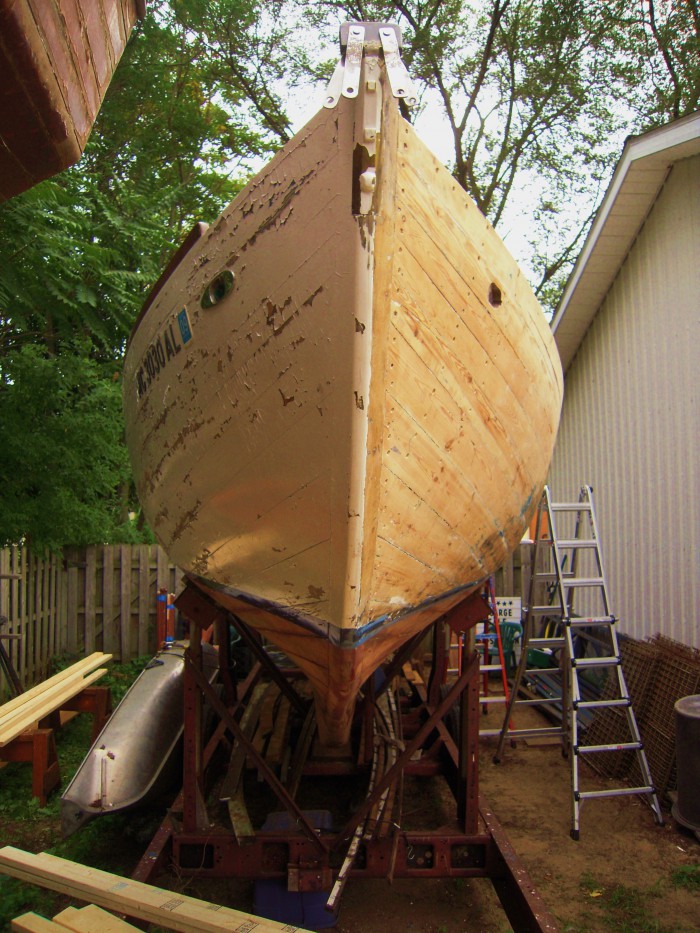
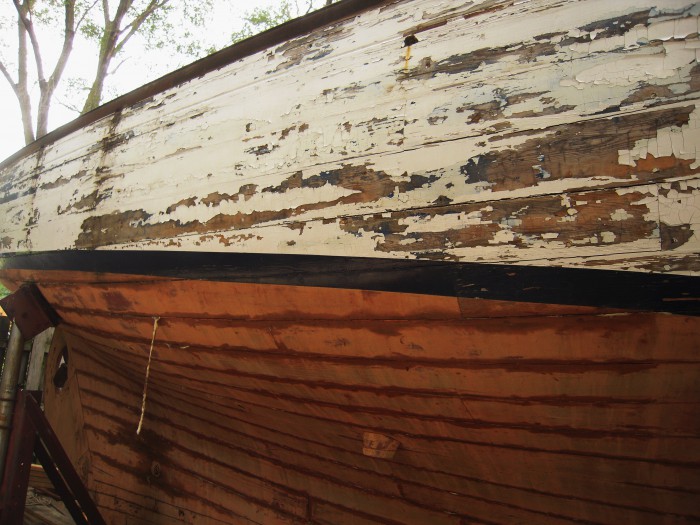
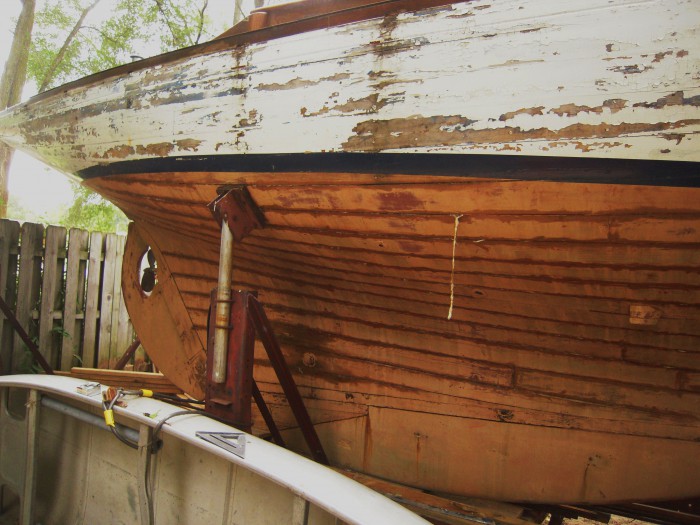
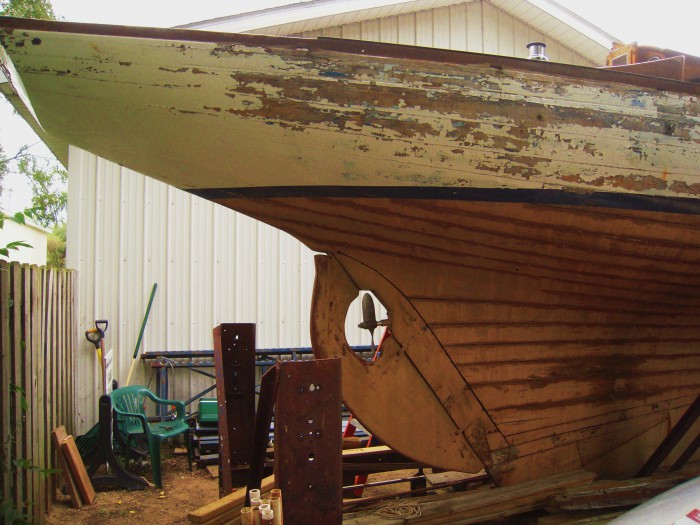
During this phase of paint scraping, I also had to determine the best way to preserve the waterline. The waterline was already there so, to lose it then have to set up the procedure to draw a new waterline seemed to be the kind of redundancy we should like to avoid. Preserving the existing waterline is one of the reasons I chose to do the topsides first and address the hull below the waterline as a separate project; that, and the fact that the bottom paint has no bare spots and, therefore, is still protecting the wood. It’s those bare spots on the topsides that initiated this phase of the restoration.
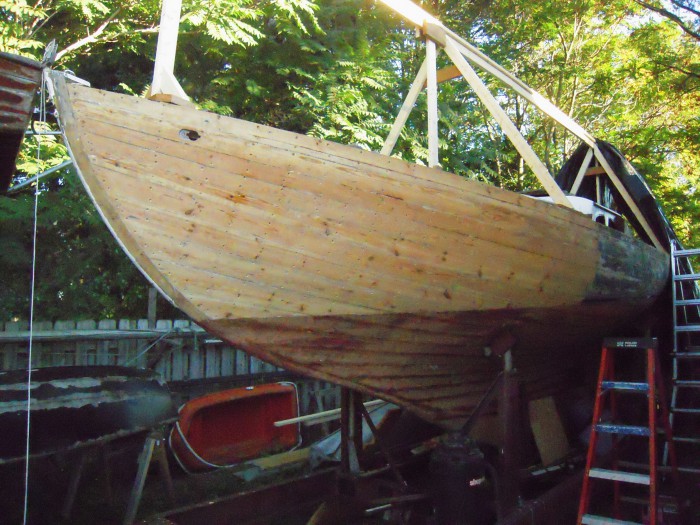
The waterline runs from the bow in a 3 inch strip and expands to 4 inches over the last few feet near the stern. Easy enough. I can mark where that begins and add that taper. I was going to tape along the bottom of the waterline and work from that but the blue painters tape that was already there wasn’t holding up to the heat gun. I chose to sharpen the scraper to a knife edge and work along the boot top (waterline)/bottom seam in an upward fashion so as to preserve the waterline. You can see in the photo, where I have the waterline removed, that it worked well and there will be an accurate line to follow when it’s time to paint the new waterline.
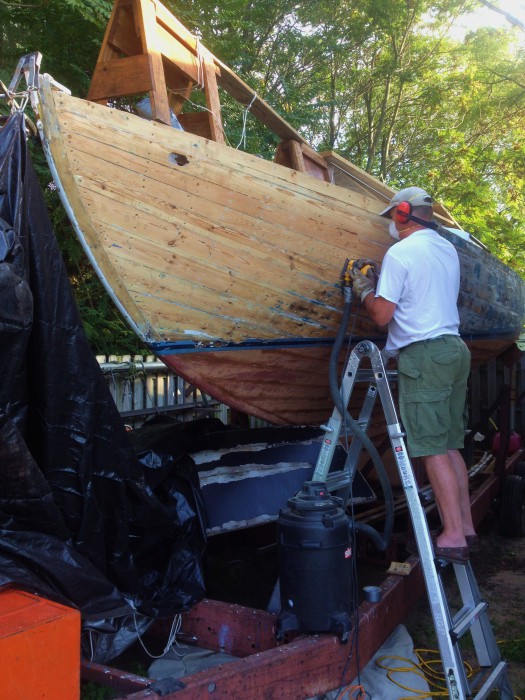
As the sanding progresses, the hull is revealing itself in a very positive way. It is nice to see the yellow pine exposed for the first time in over 60 years looking as if it had just been fastened. It has withstood the test of time admirably and is a testament to it’s efficacy as a planking material. I have a shop vac rigged up to the discharge of the sander and it is working quite well at keeping the dust down. With this system, it is virtually dust free. I’m still wearing a dust mask and ear protection but it is much more comfortable than the dreaded respirator.
We took a break from the topside project to begin construction of a better tarp frame. With Winter coming on, the frame needed a steep pitch to deflect the incessant lake effect snows that dump on the shoreline of Lake Michigan. The frame will be reinforced with more rafters as the season progresses but, for now, it’s enough to withstand the wind and rain. We had a makeshift setup last Winter and had quite a time getting the snow and ice dams off the deck. This new structure will also serve as a beam to lift the cabin off the boat. Julia is working on getting all the fasteners out of the cabin and cockpit (a whole lot of work in one small sentence). Then, we will lift the cabin top off with a block & tackle and get it off the deck in order to have better access to the deck beam and carline repairs. It will also make it easier to strip the inside of the coach roof and cabin sides as it can then be flipped upside down rather than us being showered by scraped varnish.
There is a bit of momentum and the only unknown factor is the weather. If it all doesn’t get done before the snow flies, that’s the way it goes. In the mean time, onward we plunge; led by an optimism that suggests a certain naivety while providing impetus to move along with this tedious, dirty job of stripping, sanding and oiling the topsides.




 Restoring Reverie
October 2, 2016 at 1:52 am
don’t know if u r getting these messages. I hope so. We may have a lot to share.
LikeLike
October 4, 2016 at 3:44 am
Hi Judy, Do you have any pictures? There’s one in the As We Found Her section that is the only one I have of her in the water.
LikeLike