
“To come to the end of a time of anxiety and fear! To feel the cloud that hung over us lift and disperse- the cloud that dulled the heart and made happiness no more than a memory! This at least is one joy that must have been known by almost every living creature.”
-Richard Adams, Watership Down
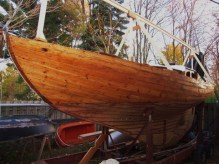
Last night, a task was put to rest that has plagued the restoration project for some time. Last night, as twilight fell, I wrestled the 20 x 30 ft tarp over it’s frame and drove away knowing I was done stripping, sanding and oiling the entire topsides of the good ship, Reverie. A November Gale was kicking into high gear on the entire Upper Great Lakes with our Lake Michigan seeing 50 mph gusts before midnight. It had begun to spit and gust earlier in the day but I had to finish leveling and blocking the trailer before another Winter set in. With Reverie buttoned up for the storm, level and covered, I felt like I finally had some good news to share.
The stripping, sanding and oiling of the topsides is now complete. I started the port-side last year and finished about this time last November, thinking I would be able to get the starboard-side done in the Spring and move along. I jumped into it last April with renewed enthusiasm and resolve to finish this most unpleasant task. What was it about this task, this minor detail (on paper), that made me want to do anything and everything but what needed to be done?
There was, first and foremost, the mess. Everything about the job involved a mess. Large piles of scraped paint and toxic sawdust required constant vigilance and tidiness. In April I got about six feet working on the starboard side from the bow back. Last Summer, we were in the grips of one of the most humid summers I can remember. Wearing coveralls, gloves, hat, goggles and respirator was like some form of Medieval torture . Eventually, I succumbed to heat exhaustion and decided to put the project on hold.
While the planning went on, the actual work on Reverie came to a quiet halt, for the summer. Instead, we got out on the water and had some sailing days aboard our little Com-Pac 16, Prudence; 85° F with 85-90% humidity is bearable when you are 10 miles offshore. We sailed and sailed until the weeds clogged our boat launch to the point of us almost getting stuck in invasive Eurasian Watermilfoil. Keels and milfoil don’t mix.
Click to access Eurasian_Watermilfoil_521353_7.pdf

Just one of the brilliant days on Lake Michigan
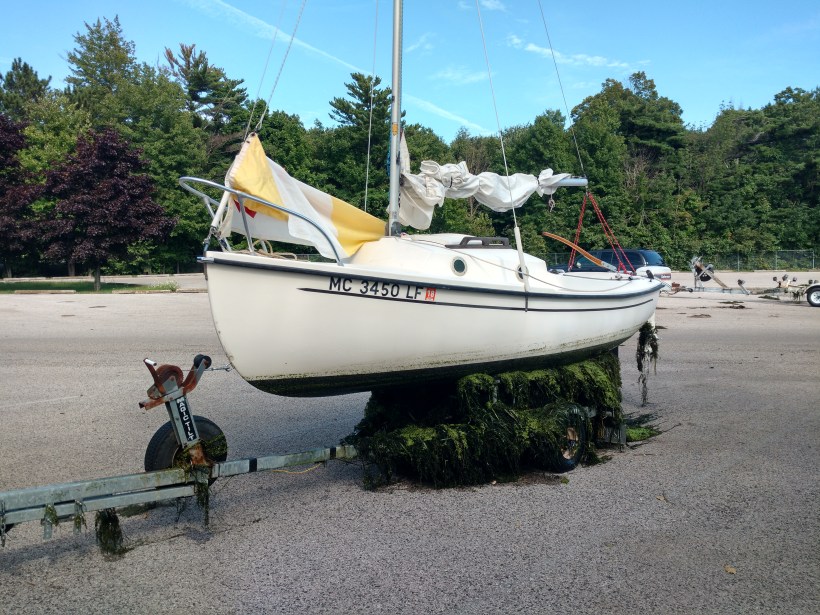
Invasive plants at Port Sheldon
By the time the weed situation shut down our sailing, we made time to get a thing or two done aboard Reverie. Julia started removing the rest of the interior cabinetry while I did various odd jobs that needed to be done sooner than later. She eventually removed enough of the galley to expose the engine which made it easier to get it ready for removal.
I ended up getting the last of the interior out with a hammer and pry bar, preserving only what would go back on board. A lot of the wood had experienced some effect of leaking rainwater and had to be taken out of the equation. We put everything into storage to be used as templates, if needed. The interior is so much easier to assess with all of the cabinetry removed.

Reverie. happy to have all the rotting wood removed
By the time all this work was done, the weather had cooled down enough for me to buck up and get back to the scraping. On a relatively large project, such as this, it is a good idea to stick to tasks as distractions lurk at every turn. Look, a bird! Checking something off the list allows the mind to be released from further thought on the subject and proceed toward the end. There’s a lot of that to come.
The starboard topsides proved to be a bit more of a challenge than the port-sides. It seems a good deal of Reverie’s life was spent taking the hard knocks on the starboard side. There, I found replaced planks (More on that later… Much more). There were areas that had been faired with what appeared to be an epoxy-based filler. Oh yes, someone used 5200 for caulking the plank seams. I have seen 5200 recommended, in various online forums where free advice is handed out like champagne on New Years Eve; copiously and carelessly. Dear reader, if you are ever thinking of restoring or maintaining a wooden boat and you choose to use 5200 to caulk seams, let me tell you, Old Nick has a special task in hell for you: eternity cleaning 5200 from plank seams. Don’t say I didn’t warn you. 5200 will be used in this project to great effect, later on down the road but not here.
I had to modify my heat gun/scraping technique and managed to get the brunt of it done by sharpening a flat scraper and using it much like a cabinet scraper. This produced a better surface than the method I used on the port, side reducing sanding time significantly. It took 60 hours to scrape, sand and oil the port topside compared to about 80 hours for the starboard.
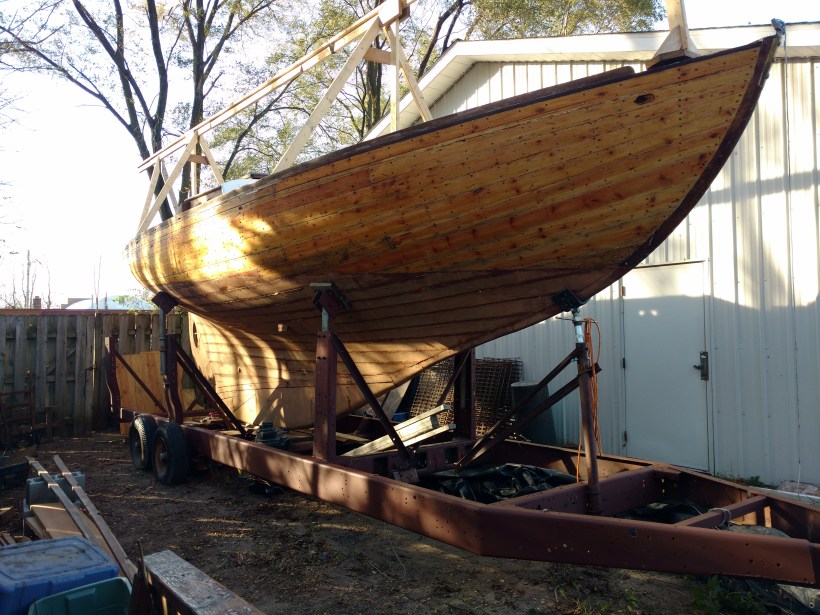
Starboard Topsides scraped, sanded and oiled
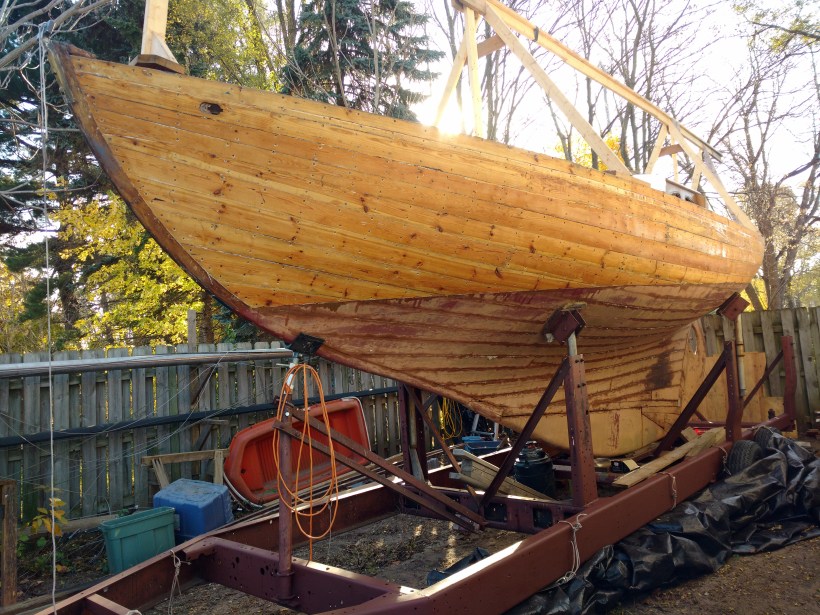
Port Topsides scraped, sanded and oiled. Trailer looks spiffy with some fresh primer.
The past few days were near record highs for November with temps around 70° F. Both sides got two coats of piping hot tung oil and turpentine. The boat smells wonderful! Reverie looks so different without the layers of cracked, peeling paint and exposed wood.
As the air pressure began to fall and the breeze became a gale, I put a quart of primer on the trailer. It to looks happier. I took a 12 ton bottle jack and it all rests on cement blocks instead of the trailer tires. After I got the trailer leveled, I got the boat leveled a bit more. It really helped to stabilize the whole thing and get the tires off the ground. I gave the lug nuts a good soak of penetrant and plan put the tires out of the elements for the duration of the project. With the wheels off, the brakes will be begging for an overhaul… .
Scraping, sanding and oiling below the waterline will go much better as there won’t be scaffolding involved and the paint seems to come off easier. We’ll see. For now, we can move forward and I no longer have that messy job to mess up my day. Today, my aches were a little less achy. My step, a little more peppy. There’s a little vim in my vigor. I even had to raise the rear view mirror in the car from so much slouching. Yes, the world was a kinder place, now that that is done. Onward!

 Restoring Reverie
December 2, 2016 at 7:12 pm
The smell of tung oil and turpentine is hard to beat, reminds me of my Grandpa’s studio. The boat is looking lovely, such sweet lines.
LikeLiked by 1 person
December 6, 2016 at 2:25 pm
Thanks, Jonnie. It’s getting easier to see her lovely lines with all that nasty paint gone. That project consumed a gallon of tung oil and a gallon of turpentine. We have 3 more gallons of tung oil, in reserve. That smell is indeed one of the rewards!
LikeLike